



Understand How the Golgi Complex Works, Why It Is Essential for Cell Life
The Golgi apparatus, also called the Golgi complex or Golgi body, is a membrane-bound cell organelle found in eukaryotic cells. This organelle is best understood as the cell’s processing, packaging, sorting, and dispatching centre because it receives proteins and lipids from the endoplasmic reticulum, modifies them, sorts them, and sends them to their required destination.
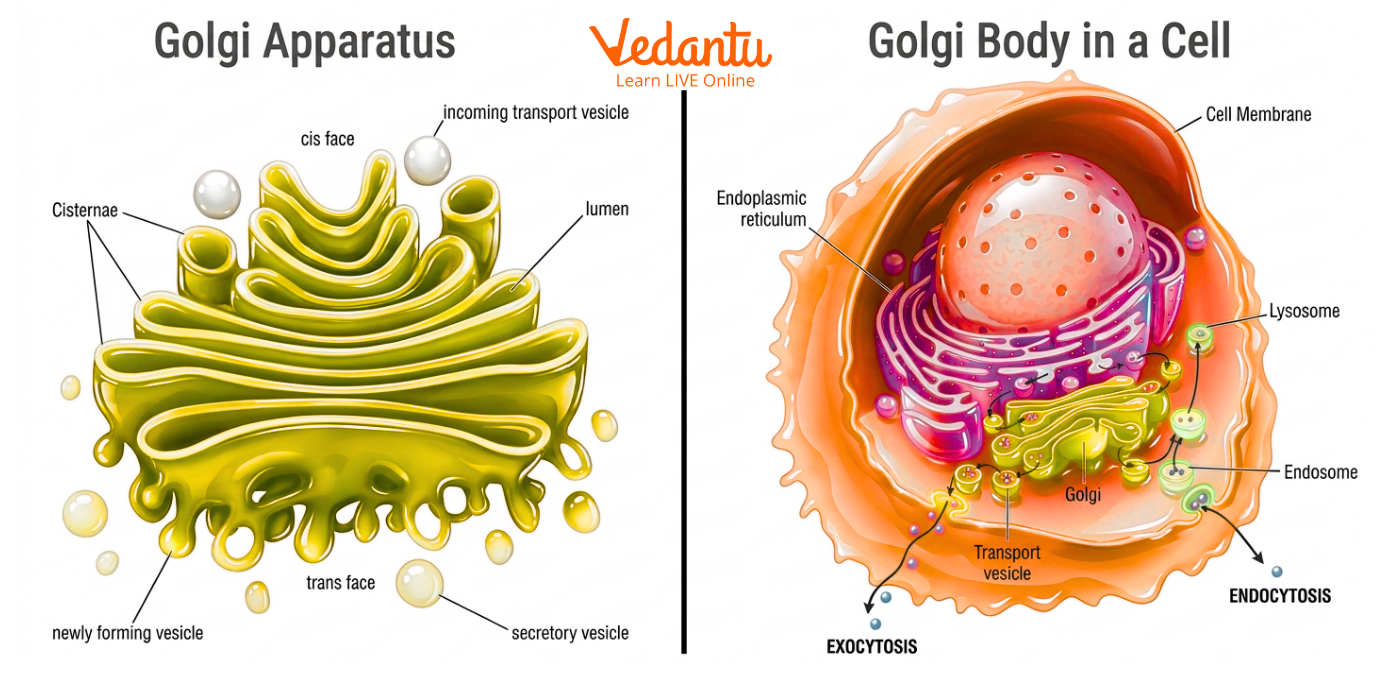
Different names call it:
Golgi Apparatus
Golgi Complex
Golgi Bodies
All these names refer to the same organelle. Structurally, it is composed of flattened membrane-bound sacs called cisternae, and functionally, it serves as a packaging and dispatching unit of the cell.
Golgi body = packaging and dispatching unit of the cell.
Discovery of the Golgi Apparatus
The Golgi apparatus was discovered by Camillo Golgi in 1898. This fact is often asked in one-mark biology questions, so it is worth remembering directly.
Structure of the Golgi Apparatus
The structure of the Golgi apparatus is one of the most important parts of this topic. The Golgi is made up of a series of flattened, stacked, membrane-bound sacs known as cisternae. A single stack of cisternae is often called a dictyosome.
Main Structural Components
1. Cisternae
These are the basic structural units of the Golgi apparatus. They are:
flattened
membrane-bound
arranged in stacks
functionally interconnected
The cisternae form the processing chambers through which proteins and lipids pass sequentially.
2. Vesicles
Small vesicles transport material:
from the endoplasmic reticulum to the Golgi
from one Golgi region to another
from the Golgi to other cellular destinations
3. Dictyosome
A stack of cisternae is called a dictyosome. In plant cells, several dictyosomes are commonly present and scattered in the cytoplasm.
Functional Polarity of Golgi Apparatus
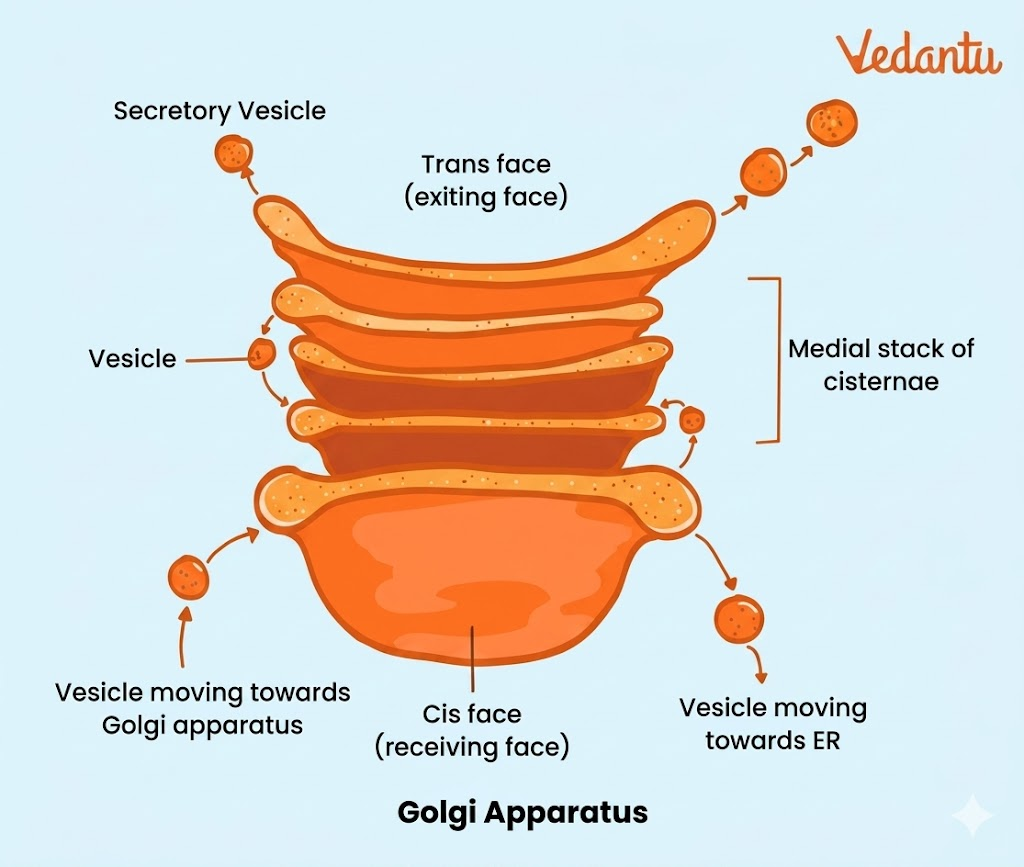
The Golgi apparatus has two distinct faces, which give it a clear functional polarity. This is one of the key structural ideas needed to understand how it works.
Cis Face
The cis face is the receiving face or forming face of the Golgi. It lies close to the endoplasmic reticulum and receives transport vesicles carrying proteins and lipids.
Role of the Cis Face
receives vesicles from the ER
marks the entry side of the Golgi
starts the processing pathway
Trans Face
The trans face is the shipping face, or maturation face, of the Golgi apparatus. This is the exit side from which modified molecules leave the Golgi, packed into new vesicles for transport.
Role of Trans Face
final sorting
packaging into vesicles
dispatch to lysosomes, plasma membrane, or outside the cell
This polarity makes the Golgi an organised, directional organelle rather than just a random stack of membranes.
Golgi Apparatus Function
It is broad and highly essential. It does not merely store substances. It actively modifies, sorts, packages, and transports a wide variety of molecules.
1. Modification of proteins and lipids
As proteins and lipids move through the Golgi cisternae, they undergo chemical modifications. One of the most important modifications is glycosylation, in which carbohydrate groups are added to molecules to form:
glycolipids
Other modifications also occur, such as:
phosphorylation
sulfation
Why is This Important?
Proteins synthesised in the ER are often not ready for final use. The Golgi refines them chemically so they become functional and can be directed properly.
2. Sorting and Packaging
The Golgi acts as a sorting centre. It identifies which molecule goes where and then packages it into the appropriate vesicles.
An example given in the content is that the Golgi adds a mannose-6-phosphate tag to proteins destined for lysosomes. This tagging is important because it ensures proteins reach the correct organelle.
Once sorted, molecules are enclosed in vesicles that bud from the trans face and move to:
lysosomes
plasma membrane
secretory pathways
extracellular space
3. Formation of lysosomes
The Golgi apparatus plays a major role in the formation of lysosomes. It packages hydrolytic enzymes into vesicles, which then become lysosomes. Lysosomes act as digestive and waste-recycling organelles of the cell.
Why Does This Matters?
Without Golgi packaging, lysosomal enzymes would not reach lysosomes properly, and cellular digestion and recycling would be severely affected.
4. Secretion
The Golgi is very important in secretion. It packages molecules such as:
enzymes
hormones
proteins
These are packed into secretory vesicles and released from the cell through exocytosis.
This function is especially important in secretory cells such as hormone-secreting or enzyme-secreting cells.
5. Cell Wall Synthesis in Plants
In plant cells, the Golgi has an additional vital role. It synthesises complex polysaccharides needed for cell wall formation.
This makes the Golgi especially important in plant cells, not only for packaging but also for structural support functions.
Golgi Bodies Location and Occurrence
The Golgi bodies are present in almost all eukaryotic cells, but they are absent in:
mature red blood cells
prokaryotes such as bacteria
In Animal Cells
Golgi bodies are usually located:
near the nucleus
close to the endoplasmic reticulum
This position is functionally useful because proteins and lipids arrive from the ER and are processed nearby.
In Plant Cells
Plant cells usually have:
Several smaller Golgi stacks
These are called dictyosomes
They are scattered throughout the cytoplasm
Golgi Bodies and Cellular Processes
The Golgi apparatus is deeply involved in maintaining cellular homeostasis and many important cellular processes.
1. Secretory Pathway
In secretory cells, the Golgi processes and packages secretory proteins before they are released from the cell. A specific example mentioned is insulin-producing cells.
2. Membrane Trafficking
The Golgi acts as a central hub for the movement of substances between membrane-bound compartments in the cell.
This means it is involved in:
vesicle movement
membrane turnover
intracellular distribution
3. Post-translational Modification
After proteins are translated from mRNA, they often need further processing. The Golgi performs these post-translational modifications, ensuring the proteins become functional and correctly targeted.
ER-Golgi Relationship
The coordinated action between the endoplasmic reticulum (ER) and the Golgi apparatus is essential for the cell’s synthetic and secretory pathways. The ER synthesises proteins and lipids, and the Golgi then modifies, packages, and distributes them. Together, they form a crucial part of the endomembrane system.
This relationship is important because NEET questions often test the sequence:
ER synthesis → Golgi modification and packaging → final transport
Differences Between Golgi Bodies in Plant and Animal Cells
This is a common comparison topic. The content clearly distinguishes the Golgi in plant and animal cells.
What Would Happen to the Life of a Cell if There Were No Golgi Apparatus?
This is an important conceptual question that can be answered directly by examining the functions of the Golgi.
If there were no Golgi apparatus:
Proteins and lipids from the ER would not be properly modified
The packaging and sorting of cellular products would fail
Lysosomes would not form properly
The secretion of enzymes and hormones would be impaired
membrane trafficking would be disrupted
In plant cells, the synthesis of important cell wall polysaccharides would be affected
As a result, the cell would lose its ability to process and distribute essential molecules correctly. The secretory pathway would collapse, waste recycling would be disturbed, and overall cellular organisation and survival would be seriously affected. This means the cell would not be able to function normally for long. The answer is strongly supported by the Golgi’s roles in modification, sorting, lysosome formation, secretion, and plant cell wall-related synthesis.
Golgi Complex in Secretory Cells
The Golgi is especially well developed in cells that actively secrete substances. Examples include:
liver cells
pancreatic cells
insulin-producing cells
These cells continuously process and export proteins, enzymes, or hormones. Such cells depend heavily on the Golgi apparatus for packaging and exocytosis.
Why the Golgi Apparatus is Called the Cell’s Post Office?
The Golgi is commonly compared to a post office because it:
receives material
processes it
labels it
sorts it
dispatches it to the correct destination
This analogy is useful for both school and NEET-level understanding and is directly consistent with its role in packaging and sorting proteins and lipids from the ER.
Golgi Apparatus in Plant Cells
In plant cells, the Golgi apparatus performs all usual functions of packaging and sorting, but it also contributes to cell wall synthesis by making complex polysaccharides. This makes the Golgi even more significant in plants.
Golgi Apparatus in Animal Cells
In animal cells, the Golgi is commonly involved in:
protein packaging
secretion
lysosome formation
membrane trafficking
It is usually larger, compact, and located near the nucleus and ER.
Quick Revision Points on Golgi Apparatus
Discovered by Camillo Golgi in 1898.
Present in eukaryotic cells.
Also called the Golgi complex or Golgi bodies.
Made of stacked cisternae.
Has cis face and trans face.
Modifies proteins and lipids by glycosylation, phosphorylation, and sulfation.
Sorts and packages molecules into vesicles.
Forms lysosomes.
In plants, it helps synthesise cell wall polysaccharides.
FAQs on Golgi Apparatus: Structure, Function, Diagram and Golgi Body Explained for NEET Biology
1. What is the function of the Golgi apparatus?
The Golgi apparatus function is to modify, sort, package, and transport proteins and lipids received from the endoplasmic reticulum. It transports these materials to their appropriate destinations, such as lysosomes, the plasma membrane, or the outside of the cell via secretion.
2. What best describes the Golgi apparatus?
The best description of the Golgi apparatus or Golgi complex is that it is the cell’s packaging and dispatching organelle. It appears as a stack of flattened membrane-bound sacs and helps process proteins and lipids before they are used or transported.
3. What is the Golgi known for?
Camillo Golgi is known for discovering the Golgi apparatus and developing the Golgi stain, or “black reaction,” which helped scientists study nerve cells more clearly under the microscope.
4. Where are Golgi cells found?
The Golgi apparatus is found in the cytoplasm of eukaryotic cells, usually near the nucleus and close to the endoplasmic reticulum. In animal cells, the Golgi apparatus is generally compact and centralised, whereas in plant cells, several smaller Golgi stacks, called dictyosomes, are scattered throughout the cytoplasm.
5. Which organ is single-membraned?
The Golgi apparatus is a single membrane-bound organelle. Other single membrane-bound organelles include lysosomes, vacuoles, and endoplasmic reticulum.
6. Who discovered the Golgi apparatus?
The Golgi apparatus was discovered by Camillo Golgi in 1898.
7. What happens if the Golgi fails?
If the Golgi apparatus fails, proteins and lipids are not properly modified, sorted, or packaged. This causes defective secretion, impaired lysosome formation, protein accumulation, and abnormal intracellular transport. In simple terms, the cell cannot function normally without a working Golgi body.
