



What Is the Candiru Fish? Habitat, Behavior, and Human Risk Explained
The Candiru is one of the most talked-about fish in the Amazon River. Known for its tiny size and unusual habits, this freshwater fish has created many stories and myths over the years. Though very small, it is a fascinating part of the Amazon ecosystem. Learning about Candiru facts, habitat, diet, and behaviour helps us understand how even the smallest creatures play important roles in nature.
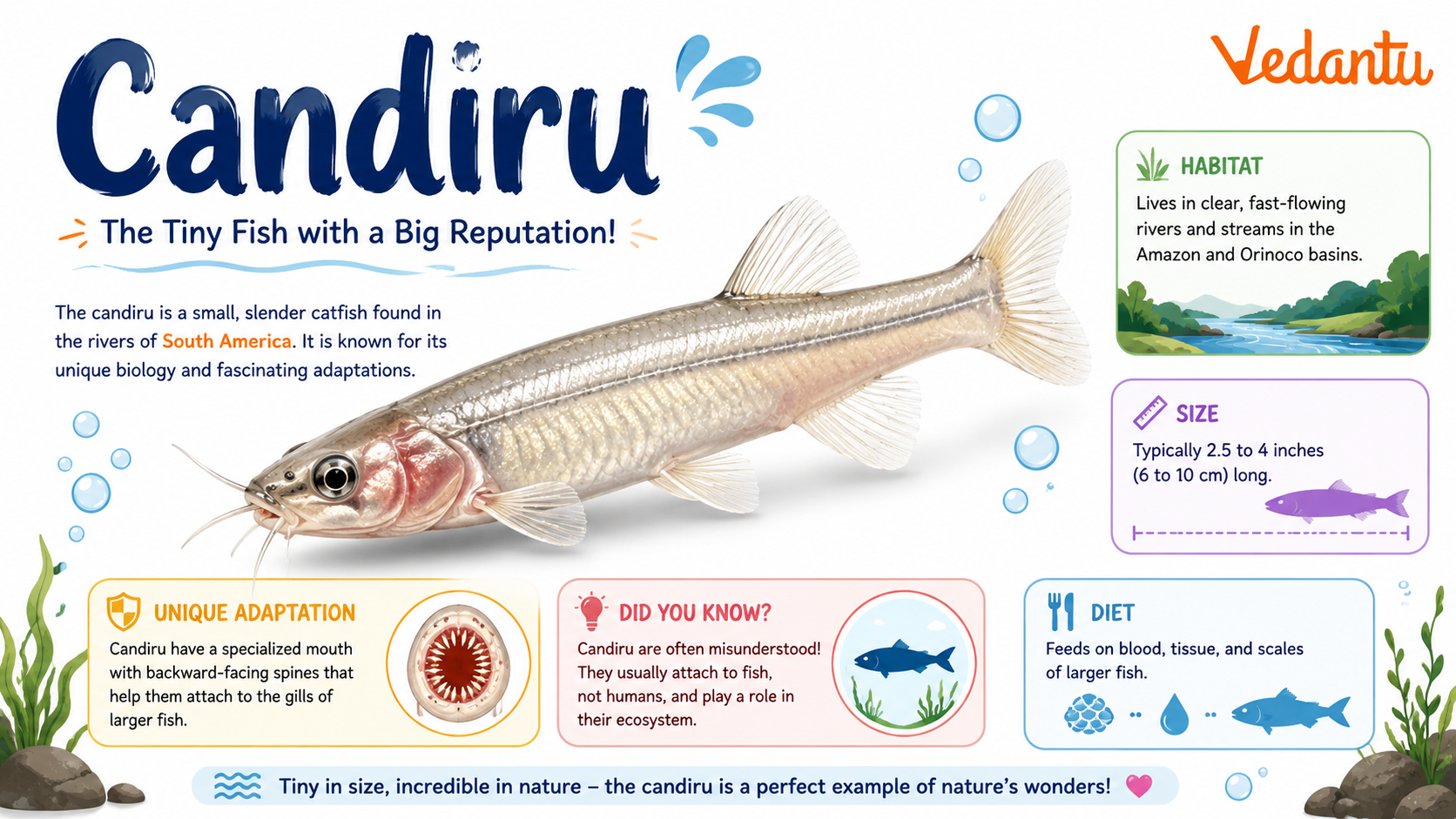
Quick Facts About Candiru
| Feature | Details |
|---|---|
| Common Name | Candiru |
| Scientific Name | Vandellia cirrhosa |
| Animal Group | Fish (Catfish family) |
| Size | About 2–8 cm long |
| Habitat | Freshwater rivers, mainly the Amazon Basin |
| Diet | Feeds on blood from larger fish |
| Special Feature | Transparent body and parasitic feeding style |
Appearance and Physical Characteristics
- Slender, eel-like body shape.
- Usually pale or nearly transparent in colour.
- Sharp, needle-like teeth.
- Small head with sensitive barbels (whisker-like organs).
- Grows only a few centimetres long.
Candiru Habitat and Distribution
The Candiru habitat is mainly in South America. It is found in freshwater rivers and streams.
- Lives in the Amazon River Basin.
- Found in Brazil, Peru, Colombia, and nearby regions.
- Prefers warm, tropical freshwater.
- Often stays near the river bottom.
Diet and Feeding Habits
The Candiru diet is what makes it famous. It is a parasitic fish, meaning it feeds from other fish.
Behaviour and Lifestyle
- Mostly active in freshwater environments.
- Solitary fish – does not form large groups.
- Uses smell and chemical signals to find host fish.
- Quick swimmer despite its tiny size.
Many stories exaggerate its behaviour. In reality, attacks on humans are extremely rare and mostly myths.
Candiru Life Cycle
- Egg Stage: Female lays eggs in freshwater.
- Larval Stage: Tiny larvae hatch and grow.
- Juvenile Stage: Begin searching for host fish.
- Adult Stage: Mature fish continue parasitic feeding.
Their lifespan is not very long, but exact details are still being studied by scientists.
What Makes the Candiru Special?
Importance and Role in Nature
Even though it is small, the Candiru importance in the ecosystem is significant.
- Part of the Amazon food web.
- Helps control populations of certain fish.
- Serves as prey for larger predators.
- Contributes to biodiversity of freshwater systems.
Amazing Candiru Facts
Fun Facts for Kids
- The Candiru is sometimes called the “vampire fish.”
- It is smaller than many classroom pencils.
- It lives in one of the largest rivers in the world.
- It hides easily because it is almost transparent.
- Despite scary stories, it usually feeds only on fish.
FAQs on Candiru Fish: Facts, Myths, and Real Dangers Explained
1. What is a Candiru?
Candiru is a tiny freshwater fish found in the Amazon River that is known for being a parasitic catfish.
- Scientific name: Vandellia cirrhosa
- Also called the toothpick fish or vampire fish
- Belongs to the catfish family (Trichomycteridae)
- Famous for feeding on the blood of larger fish
- Often mentioned in Amazon rainforest wildlife stories
2. Where does the Candiru live?
Candiru fish live in the Amazon River Basin in South America.
- Found mainly in Brazil, Peru, Colombia, and Ecuador
- Lives in warm freshwater rivers and streams
- Prefers muddy or slow-moving water
- Stays close to larger fish to find food
3. How big is a Candiru fish?
Candiru are very small fish, usually only a few inches long.
- Average size: 1 to 6 inches (2.5 to 15 cm)
- Thin, eel-like body
- Almost transparent appearance
- Sharp spines near the head
4. What does a Candiru eat?
Candiru feed on the blood of larger fish in the Amazon River.
- Swims into the gill openings of big fish
- Uses sharp spines to hold on
- Feeds on blood for a short time
- Then releases and swims away
5. Is the Candiru dangerous to humans?
The Candiru is rarely dangerous to humans, and attacks are extremely uncommon.
- Most stories are based on myths and legends
- Very few proven medical cases exist
- Candiru mainly target fish, not people
- Scientists say human incidents are very rare
6. Can a Candiru swim into a human body?
Stories say candiru can swim into the human body, but this is extremely rare and mostly a myth.
- Popular Amazon legend claims it is attracted to urine
- Scientific studies do not strongly support this belief
- Documented cases are very limited
- Experts consider the risk very low
7. Why is the Candiru called the vampire fish?
The Candiru is called the vampire fish because it feeds on blood.
- Attaches to larger fish using tiny spines
- Drinks blood from the gills
- Leaves after feeding
- Has a thin, needle-like body
8. What does a Candiru look like?
The Candiru is small, thin, and almost see-through.
- Long, slender body shape
- Nearly transparent skin
- Sharp backward-facing spines
- Looks like a tiny piece of string in water
9. How does the Candiru protect itself?
Candiru protect themselves using their size and sharp spines.
- Small body helps them hide
- Transparent skin acts as camouflage
- Sharp spines help them anchor safely
- Quick swimming ability
10. Are Candiru important to the ecosystem?
Candiru play a small but important role in the Amazon River ecosystem.
- Part of the freshwater food chain
- Help control fish populations
- Serve as prey for larger animals
- Contribute to biodiversity in the Amazon rainforest
