



Why Did the Moa Go Extinct? Size, Habitat, and Fascinating Facts
The Moa was a huge, flightless bird that once lived in New Zealand. These amazing birds disappeared hundreds of years ago, but their fossils still tell us exciting stories. Moa facts show that some species were taller than a human and lived peacefully by eating plants. Learning about the Moa helps us understand extinct animals, ancient ecosystems, and why protecting wildlife today is so important.
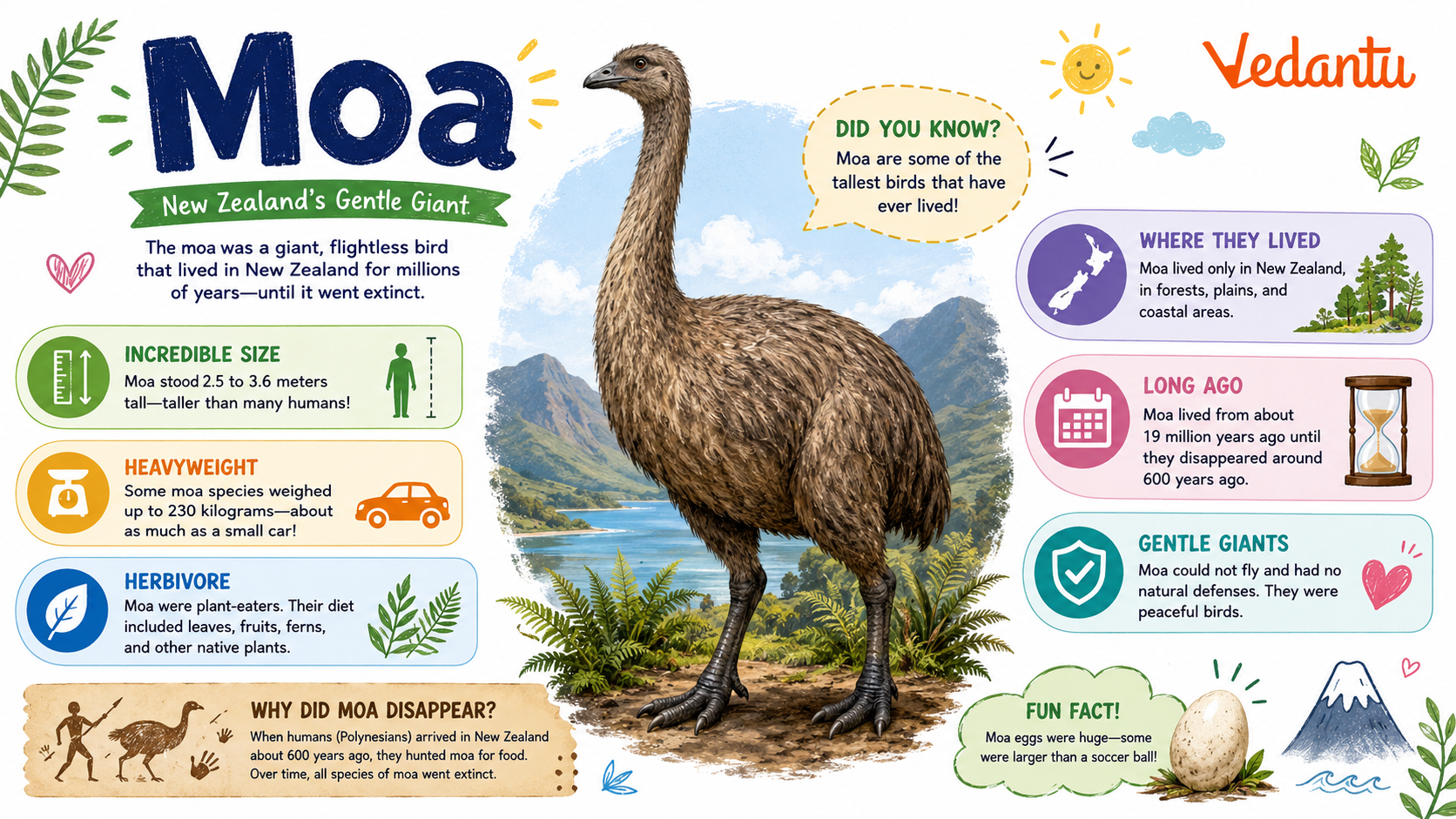
Quick Facts About Moa
| Feature | Details |
|---|---|
| Common Name | Moa |
| Scientific Order | Dinornithiformes |
| Animal Group | Bird |
| Height | Up to 3.6 meters (with neck stretched) |
| Weight | Up to 230 kg (largest species) |
| Diet | Herbivore (plants, leaves, fruits) |
| Habitat | Forests, grasslands, and shrublands of New Zealand |
| Conservation Status | Extinct (around 1400–1500 AD) |
Appearance and Physical Characteristics
- Very tall body with a long neck.
- Small head and strong, thick legs.
- No visible wings – even the bones were tiny.
- Covered with shaggy, hair-like feathers.
- Large, powerful claws for walking and balance.
Moa Habitat and Distribution
- Only found in New Zealand.
- Lived in forests, open grasslands, and coastal areas.
- Preferred areas with plenty of plants and shrubs.
- Adapted to both lowlands and mountainous regions.
Because New Zealand had no large land mammals at that time, Moa became the biggest plant-eating animals on the islands.
Diet and Feeding Habits
Moa were an important part of the food chain and helped shape New Zealand’s plant life.
Behaviour and Lifestyle
- Mostly peaceful and plant-eating birds.
- Likely lived alone or in small groups.
- Walked on strong legs instead of flying.
- Used height to reach higher branches.
- Main predator was the giant Haast’s eagle.
Moa Life Cycle
- Egg Stage: Moa laid large eggs in nests on the ground.
- Hatching: Chicks hatched fully feathered and could walk soon after birth.
- Growth: They grew slowly and took years to reach full size.
- Adult Stage: Fully grown Moa became massive plant-eaters.
Scientists believe Moa had a slow reproduction rate, which made them more vulnerable to extinction.
What Made the Moa Special?
Types of Moa
- Giant Moa (Dinornis) – tallest species.
- Eastern Moa – medium-sized.
- Bush Moa – lived mainly in forests.
- Coastal Moa – found near coastal areas.
Importance of Moa in Nature
Amazing Moa Facts
- Moa became extinct around 600 years ago.
- They had no wings at all – not even small ones.
- Their eggs were very large compared to modern bird eggs.
- Humans hunted Moa for food after arriving in New Zealand.
- Fossils and bones help scientists study Moa characteristics today.
- DNA studies have revealed details about their feathers and relatives.
Interesting Facts About Moa
- Moa were related to modern birds like kiwi and emu.
- They evolved for millions of years in isolation.
- The largest species weighed more than 200 kg.
- They are one of the most famous extinct birds in the world.
Fun Facts for Kids
FAQs on Moa Bird: The Giant Flightless Bird of Ancient New Zealand
1. What was the Moa?
The Moa was a giant, flightless bird that once lived in New Zealand and is now extinct.
- Moa birds belonged to a group of large birds called ratites, like ostriches and emus.
- They could not fly but had strong legs for running.
- Some species grew up to 3.6 meters (12 feet) tall.
- They lived only in New Zealand and nowhere else in the world.
2. When did the Moa become extinct?
The Moa became extinct around 1400 CE, shortly after humans arrived in New Zealand.
- Early Māori settlers hunted Moa for food.
- Moa eggs were also collected and eaten.
- Habitat destruction and overhunting caused their extinction.
- They disappeared within about 200 years of human settlement.
3. Why did the Moa go extinct?
The main reason for the Moa extinction was overhunting by humans.
- Māori hunters hunted Moa for meat and feathers.
- Humans destroyed forests where Moa lived.
- Moa laid few eggs, so their population grew slowly.
- They had no natural fear of humans, making them easy targets.
4. How big was the Moa?
Some species of giant Moa were among the tallest birds ever known.
- The tallest species, Dinornis robustus, reached up to 3.6 meters (12 feet).
- They could weigh about 230 kilograms (500 pounds).
- Smaller Moa species were about the size of a turkey.
- Females were usually larger than males.
5. What did the Moa eat?
The Moa diet mainly consisted of plants and vegetation.
- They ate leaves, grass, fruits, and seeds.
- Moa were herbivores, meaning they only ate plants.
- They used their strong beaks to clip branches.
- Fossilized droppings show they lived in forests and grasslands.
6. Did the Moa have any predators?
Before humans arrived, the Moa’s main natural predator was the Haast’s eagle.
- Haast’s eagle was one of the largest eagles ever known.
- It hunted smaller and young Moa.
- Adult giant Moa had few natural enemies.
- After Moa went extinct, Haast’s eagle also became extinct.
7. Where did the Moa live?
The Moa habitat was spread across New Zealand’s forests, grasslands, and mountains.
- They lived on both the North Island and South Island.
- Different species preferred different environments.
- Some Moa lived in coastal areas.
- Others adapted to alpine and forest regions.
8. How many species of Moa were there?
Scientists believe there were about nine species of Moa.
- These species varied in size and habitat.
- The largest belonged to the genus Dinornis.
- Smaller types included bush Moa and upland Moa.
- All species are now extinct.
9. How do scientists know about the Moa?
Scientists study Moa fossils and ancient remains to learn about them.
- Large bones have been found in caves and swamps.
- Fossilized eggshells reveal details about reproduction.
- DNA testing helps scientists understand Moa evolution.
- Rock art and Māori stories also mention Moa.
10. Can the Moa be brought back to life?
Although some scientists study de-extinction, bringing back the Moa is not currently possible.
- Researchers have recovered partial Moa DNA.
- Cloning would require a close living relative, like the emu.
- Technology is not advanced enough yet.
- For now, Moa remain an extinct prehistoric bird.
