



What Are Sand Flies? Habitat, Life Cycle, Bite Symptoms, and How to Prevent Infection
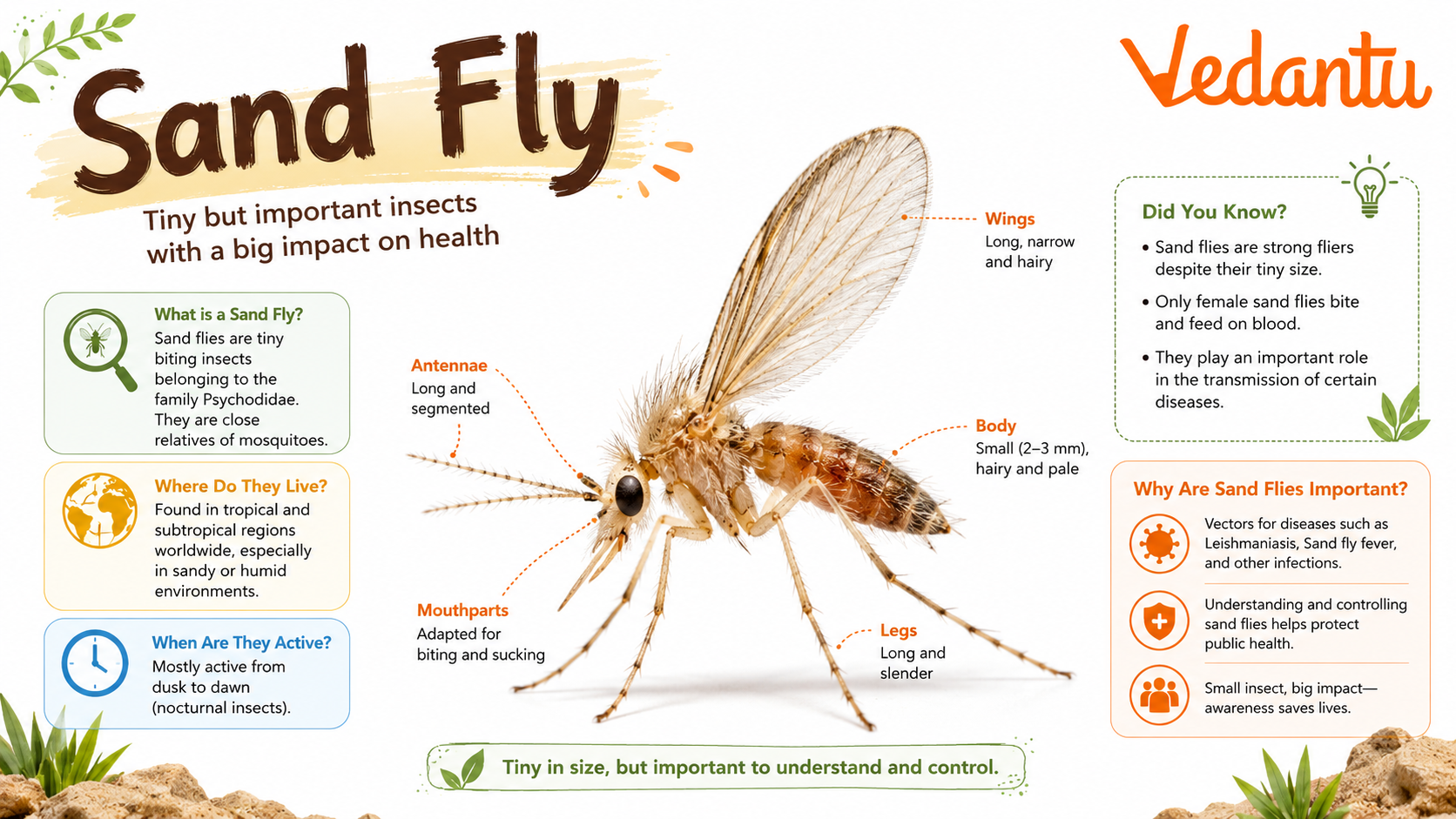
Quick Facts About Sand Fly
| Feature | Details |
|---|---|
| Common Name | Sand Fly |
| Scientific Name | Phlebotominae (subfamily) |
| Animal Group | Insect |
| Size | 2–3 mm long (very tiny) |
| Lifespan | Few weeks |
| Habitat | Warm, humid, sandy areas |
| Diet | Nectar (males), Blood & nectar (females) |
| Active Time | Mainly at night |
| Special Feature | Can transmit diseases like leishmaniasis |
Appearance and Physical Characteristics
- Very small – about the size of a grain of sand.
- Light brown or golden in colour.
- Body and wings covered with tiny hairs.
- Long legs and large black eyes.
- Wings held in a V-shape while resting.
Habitat and Distribution
- Found in Asia, Africa, South America, and Mediterranean regions.
- Prefer warm, humid climates.
- Live in sandy soil, cracks in walls, animal shelters, and forests.
- Rest in dark, cool places during the day.
Sand flies are common in rural areas but can also be found in towns where there is poor sanitation or nearby animals.
Diet and Feeding Habits
Males feed mainly on plant nectar and juices. They do not bite humans.
Females feed on blood because they need it to develop eggs.
- Females bite humans and animals.
- Use sharp mouthparts to pierce the skin.
- Inject saliva that may cause itching and swelling.
Behaviour and Lifestyle
- Mostly active at night (nocturnal).
- Weak fliers but good at short hops.
- Attracted to light and body heat.
- Prefer quiet and dark resting spots.
Unlike mosquitoes, sand flies do not make loud buzzing sounds, which makes them harder to notice.
Life Cycle of Sand Fly
- Egg: Female lays eggs in moist soil or organic matter.
- Larva: Larvae feed on decaying plants and organic waste.
- Pupa: The larva changes into a pupa inside the soil.
- Adult: A fully formed sand fly emerges and begins feeding.
The complete life cycle may take a few weeks depending on temperature and humidity.
What Makes Sand Fly Special?
Importance and Role in Nature
Amazing Sand Fly Facts
- Sand flies are much smaller than mosquitoes.
- They can squeeze through tiny holes in window screens.
- They are most active during dusk and night.
- Their bite can cause red, itchy bumps.
- They prefer warm tropical and subtropical climates.
- They have hairy wings that help in identification.
- There are more than 800 known species of sand flies.
Interesting Facts About Sand Fly
- Their flight is short and hopping rather than smooth.
- They rest with wings raised above their body.
- They are sensitive to temperature and moisture.
- They often breed in animal burrows and cracks in walls.
Fun Facts for Kids
FAQs on Sand Fly: Identification, Bites, Diseases, and Prevention Guide
1. What is a sand fly?
A sand fly is a tiny flying insect that looks like a small mosquito and is known for its itchy bite.
- Sand flies are very small, about 2–3 mm long.
- They belong to the Psychodidae family.
- They are active mostly at dusk and night.
- They are found in warm places like tropical and subtropical regions.
- People also ask: Are sand flies dangerous? Yes, some species can spread diseases.
2. Where do sand flies live?
Sand flies live in warm, humid environments where they can rest and breed safely.
- They are common in deserts, beaches, forests, and tropical areas.
- They hide in cracks, animal burrows, tree bark, and soil.
- They prefer places with shade and moisture.
- People also search: Do sand flies live in houses? Yes, they can enter homes in warm regions.
3. What do sand flies eat?
Sand flies feed on plant juices, but female sand flies also drink blood to lay eggs.
- Male sand flies eat nectar and plant sap.
- Female sand flies bite humans and animals for blood.
- Blood helps females produce eggs.
- People also ask: Why do sand flies bite? They need protein from blood to reproduce.
4. Are sand fly bites harmful?
Most sand fly bites cause itching, but some can spread serious diseases.
- Bites may cause red bumps, swelling, and itching.
- Some species spread Leishmaniasis, a parasitic disease.
- Scratching can lead to skin infections.
- People also ask: Can sand flies make you sick? Yes, certain species can transmit parasites.
5. What is Leishmaniasis?
Leishmaniasis is a disease caused by parasites spread through infected sand fly bites.
- It is caused by the Leishmania parasite.
- It can cause skin sores or affect internal organs.
- It is common in parts of Africa, Asia, and South America.
- People also search: How do sand flies spread disease? They pass parasites while biting.
6. How can you protect yourself from sand flies?
You can prevent sand fly bites by using protective clothing and insect control methods.
- Wear long sleeves and pants.
- Use insect repellent with DEET.
- Sleep under fine-mesh bed nets.
- Avoid going outside during dusk and nighttime.
- People also ask: Do mosquito nets stop sand flies? Yes, if the mesh is very fine.
7. How are sand flies different from mosquitoes?
Sand flies are smaller and quieter than mosquitoes but can also bite and spread disease.
- Sand flies are tinier and hairy.
- They fly in short, hopping movements.
- Mosquitoes are larger and make buzzing sounds.
- Both can transmit diseases, but they spread different parasites and viruses.
- People also search: Are sand flies the same as no-see-ums? They are similar but not exactly the same.
8. When are sand flies most active?
Sand flies are most active during the evening, night, and early morning.
- They prefer cooler nighttime temperatures.
- They hide during the hot daytime.
- Outdoor lights may attract them.
- People also ask: Do sand flies bite during the day? Mostly no, but some may bite in shaded areas.
9. How big are sand flies?
Sand flies are extremely small insects that are hard to see clearly.
- They are about 2–3 millimeters long.
- They have hairy wings and long legs.
- Their small size allows them to pass through loose screens.
- People also search: Can you see a sand fly? Yes, but they look like tiny specks.
10. Why are sand flies important in nature?
Sand flies play a role in the ecosystem even though they can be pests to humans.
- They help in pollination by feeding on nectar.
- They serve as food for birds, bats, and insects.
- They are part of the natural food chain.
- People also ask: Are sand flies useful? Yes, they support biodiversity despite being disease carriers.
