



What Is a Rat Snake? Diet, Behavior, Types, and Where They Live
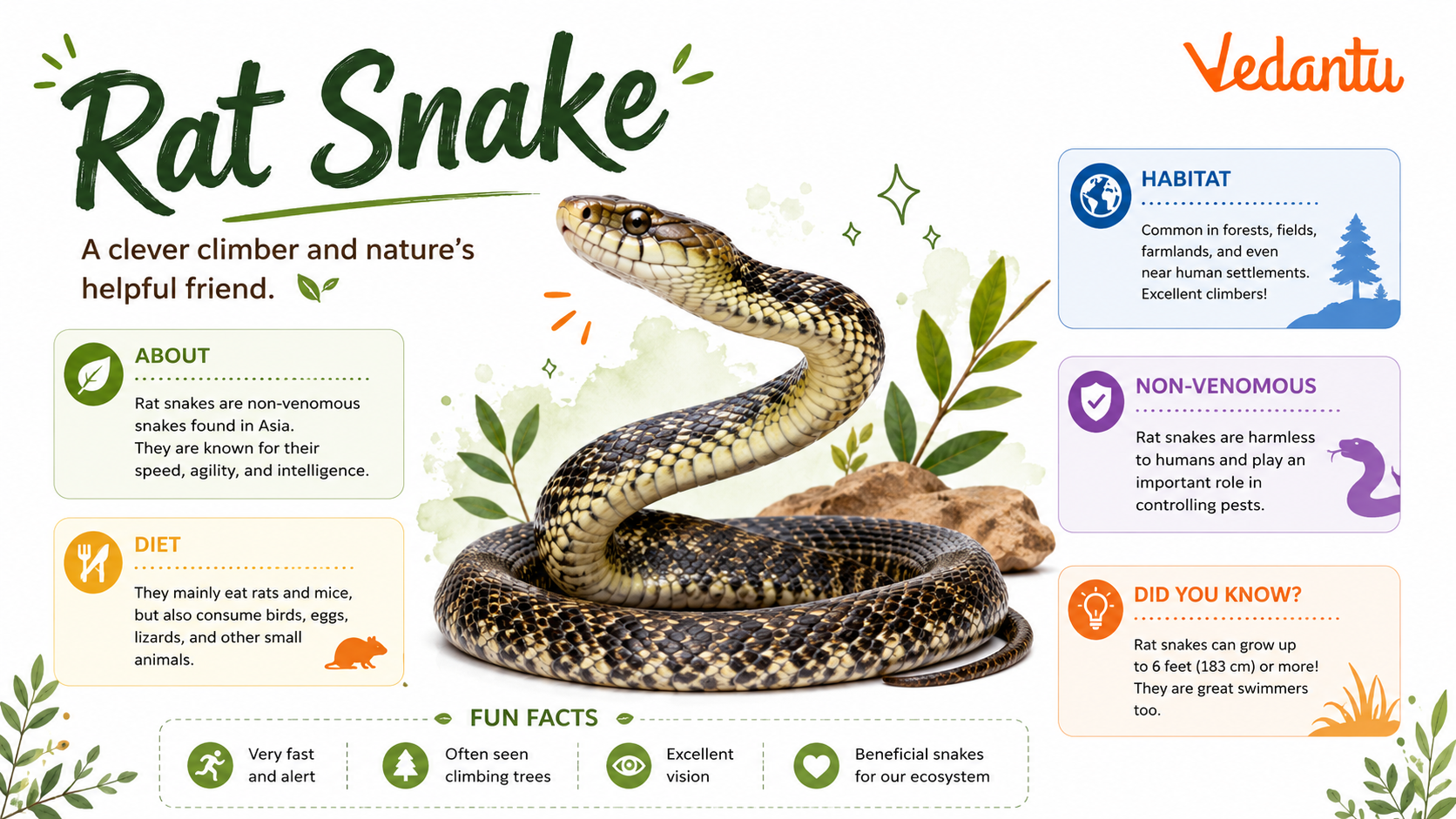
Quick Facts About Rat Snake
| Feature | Details |
|---|---|
| Common Name | Rat Snake |
| Scientific Name | Ptyas mucosa (Indian Rat Snake) and other species |
| Animal Group | Reptile |
| Length | 1.5 to 2.5 meters (can grow longer) |
| Diet | Rats, mice, birds, frogs, lizards |
| Habitat | Forests, farms, grasslands, near villages |
| Lifespan | 10–20 years (in the wild) |
| Conservation Status | Least Concern (most species) |
Appearance and Physical Characteristics
- Long, slender body with smooth scales.
- Colour varies: yellowish, brown, olive, or black.
- Light belly with darker back patterns.
- Large round eyes with good vision.
- Forked tongue to sense smell and vibrations.
Habitat and Distribution
- Found in Asia, North America, and parts of Europe.
- Common in India, especially in farms and villages.
- Prefers warm climates.
- Lives in forests, agricultural fields, gardens, and near water bodies.
- Often hides in burrows, tree holes, or thick bushes.
Diet and Feeding Habits
What Does a Rat Snake Eat?
- Rats and mice (main food)
- Bird eggs and chicks
- Frogs and lizards
- Small mammals
- It is a carnivore.
- Kills prey by constriction (squeezing tightly).
- Swallows prey whole.
Behaviour and Lifestyle
- Mostly active during the day (diurnal).
- Fast and agile mover.
- Excellent climber; can climb trees and walls.
- Good swimmer.
- Usually solitary.
Life Cycle of a Rat Snake
- Mating: Usually during warm months.
- Egg Laying: Female lays 6–20 eggs in hidden places.
- Incubation: Eggs hatch after about 2 months.
- Young Snakes: Baby snakes are independent from birth.
- Adult Stage: Grows to full size in 2–3 years.
The Rat Snake life cycle does not include metamorphosis. Young snakes look like smaller versions of adults.
What Makes Rat Snake Special?
Eats large numbers of rats and mice, helping farmers protect crops.
Uses body muscles to squeeze prey instead of venom.
Can climb trees to catch birds and eggs.
Moves quickly to escape predators.
Importance and Role in Nature
Amazing Rat Snake Facts
- Some rat snakes can grow longer than 3 meters.
- They are often mistaken for cobras.
- They can survive both on land and in water.
- They shed their skin several times a year.
- They use their tongue to “smell” the air.
- They play an important role in agriculture.
Interesting Facts About Rat Snake
- They may enter houses in search of rats.
- They are protected under wildlife laws in many countries.
- They rarely bite unless provoked.
- Their colour may change slightly as they grow.
Fun Facts for Kids
FAQs on Rat Snake: Complete Guide to Facts, Habitat, and Identification
1. What is a Rat Snake?
A Rat Snake is a non-venomous snake known for eating rodents and helping control pests in nature.
- Belongs to the Colubridae family
- Common in North America, Asia, and Europe
- Also called corn snake or black rat snake (in some regions)
- Helps farmers by controlling rats and mice
2. Are Rat Snakes poisonous or dangerous?
No, Rat Snakes are non-venomous and are generally harmless to humans.
- They do not have venom
- May bite if threatened, but bites are usually harmless
- Often confused with venomous snakes like copperheads
- Prefer to escape rather than attack
3. What do Rat Snakes eat?
Rat Snakes are carnivores that mainly eat small animals, especially rodents.
- Rats and mice (main food source)
- Birds and bird eggs
- Small reptiles and amphibians
- Sometimes squirrels or frogs
4. Where do Rat Snakes live?
Rat Snakes live in many different habitats across the world.
- Forests and woodlands
- Grasslands and farmlands
- Barns and abandoned buildings
- Rocky hillsides and trees
5. How big can a Rat Snake grow?
Rat Snakes can grow quite long compared to many other snake species.
- Average length: 3 to 6 feet
- Some can grow over 7 feet long
- Size depends on species and habitat
6. Are Rat Snakes good for the environment?
Yes, Rat Snakes play an important role in keeping ecosystems balanced.
- Control rodent populations
- Protect crops from pests
- Serve as prey for larger animals like hawks
- Help maintain food chain balance
7. Can Rat Snakes climb trees?
Yes, Rat Snakes are excellent climbers and often climb trees to find food.
- Strong muscles help them grip bark
- Climb to reach bird nests and eggs
- Can also climb walls and fences
- Good swimmers as well
8. How can you identify a Rat Snake?
Rat Snakes can be identified by their color patterns and body shape.
- Colors include black, gray, brown, or yellow
- Some have blotches or stripes
- Slender body with a narrow head
- Round pupils (unlike many venomous snakes)
9. Do Rat Snakes make good pets?
Some species like the corn snake (a type of Rat Snake) are popular pet snakes.
- Generally calm and easy to handle
- Require proper tank setup and heat
- Eat frozen-thawed rodents
- Can live 15–20 years in captivity
10. What should you do if you see a Rat Snake?
If you see a Rat Snake, it is best to stay calm and leave it alone.
- Do not try to touch or harm it
- Give it space to move away
- Remember it is non-venomous
- Contact wildlife control only if necessary
