



How to Find the Sample Space of Two Dice with 36 Outcomes
Probability is also known as a possibility of an event occurring. The probability is never negative and is never more than 1. Some of the real-life situations where probability is used are throwing dice, tossing coins, picking out students from a class, and many more. Probability has long been used in mathematics to approximate how likely events are to occur. Essentially, the probability is the degree to which something is predicted to occur.
What is Dice?
Dice is a tiny block with one to six marks or tints on its boundary that is used in games to generate a random number. Dice are tiny, tossable blocks having a visible border that can stop in the figures shown.
When thrown or rolled, the die comes to a halt and displays a random number from one to six on its upper side, with the occurrence of each event being equally likely. The dice drawn are used for playing board games as a fun way to relax with family and friends.
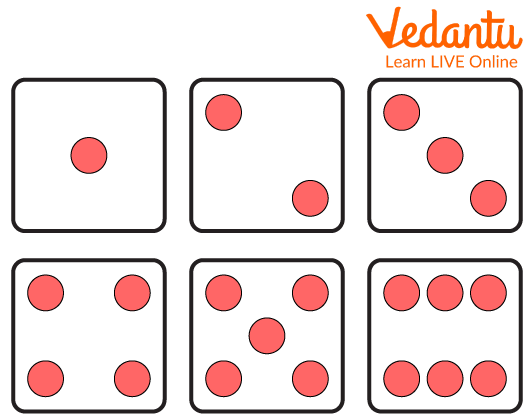
Possible Outcomes in a Dice
What is Sample Space?
A sample space is a collection of possible outcomes from a random experiment. The sign "S" represents the sample space. The events of an experiment are a subset of the possible outcomes. A sample region may have a range of results depending on the investigation. It is termed a discrete or finite sample space if it has a finite number of outcomes. Curly brackets "{ }" contain the sample spaces for a random experiment.
Different Scenarios to Calculate Dice Probabilities
One dice is thrown- The likelihood of a certain integer happening with one dice is the simplest and most straightforward situation of dice probabilities. Dice shows six possible outcomes. So, the result obtained will be given as: \[P\left( A \right) = \dfrac{\text{no of the outcome of A}}{\text{no of total outcomes}}\]
Two dice are thrown - The likelihood of receiving two 6s by tossing two dice is a rare occurrence as the outcome of one die is independent of the outcome of the other dice. The rule of probability applied in such situations states that separate probabilities must be multiplied together to achieve the outcome. As a result, the formula for this is,
Probability of both \[ = \] probability of first \[ \times \] probability of the second
Questions like two or more than two dice are thrown simultaneously to find the probability of getting a number can be done using the above-mentioned formula.
The total number from two or more dice - If one wants to know the possibility of receiving a specific sum obtained by rolling two or more dice, one must use the basic rule of probability which is
Probability = the number of desired results divided by the total number of results.
Sample Questions
1. A dice has how many faces or sides?
a. 4
b. 5
c. 6
d. 8
Ans: 6
Explanation: A dice is a cuboid that has 6 faces or sides in it.
2. How many possible outcomes would be there if two dice are thrown?
a. 6
b. 12
c. 36
d. 2
Ans: 36
Explanation: One dice has 6 possible outcomes. So, if two dice are rolled then we need to multiply 6 two times which will result in 36. The total number of outcomes in a simultaneous throw of two dice will be 36.
3. Possible outcomes that will come in an experiment are called
a. Sample space
b. Probability
c. Possibility
d. Luck
Ans: Sample space
Conclusion
Dice is a six-faced three-dimensional object which is used to play board games. When a dice is thrown there are different probabilities of getting a particular result which can be calculated by a probability formula. Sample space is all the possible outcomes that we can get in a particular situation and is useful in finding out the probability of large and complex sample space.
FAQs on Sample Space of Two Dice Explained Clearly
1. What is the sample space of two dice?
The sample space of two dice is the set of all possible ordered pairs when both dice are rolled, which contains 36 outcomes.
Each die has 6 faces numbered 1 to 6. When two dice are rolled, the outcomes are written as ordered pairs (a, b), where:
- a = result on the first die
- b = result on the second die
2. How do you find the total number of outcomes when rolling two dice?
The total number of outcomes when rolling two dice is found by multiplying the number of faces on each die, giving 6 × 6 = 36.
Step-by-step method:
- Each die has 6 possible outcomes.
- Apply the multiplication principle: 6 × 6.
- Total outcomes = 36.
3. What are the elements of the sample space of two dice?
The elements of the sample space of two dice are the 36 ordered pairs from (1,1) to (6,6).
The sample space S is:
- (1,1), (1,2), …, (1,6)
- (2,1), (2,2), …, (2,6)
- ...
- (6,1), (6,2), …, (6,6)
4. What is the probability of getting a sum of 7 when rolling two dice?
The probability of getting a sum of 7 when rolling two dice is 6/36 = 1/6.
Favourable outcomes that give sum 7:
- (1,6)
- (2,5)
- (3,4)
- (4,3)
- (5,2)
- (6,1)
Total possible outcomes = 36
Probability = 6/36 = 1/6.
5. What is the difference between sample space and event in two dice?
The sample space includes all 36 possible outcomes, while an event is a subset of those outcomes.
For example:
- Sample space S = all 36 ordered pairs.
- Event A (sum = 8) = {(2,6), (3,5), (4,4), (5,3), (6,2)}.
6. How many outcomes give an even sum when two dice are rolled?
There are 18 outcomes that give an even sum when two dice are rolled.
An even sum occurs when:
- Both dice show even numbers, or
- Both dice show odd numbers.
Even-even outcomes = 3 × 3 = 9
Odd-odd outcomes = 3 × 3 = 9
Total = 18.
7. What is the probability of getting doubles when rolling two dice?
The probability of getting doubles when rolling two dice is 6/36 = 1/6.
Doubles occur when both dice show the same number:
- (1,1), (2,2), (3,3), (4,4), (5,5), (6,6)
Total outcomes = 36
Probability = 6/36 = 1/6.
8. Why are there 36 outcomes in the sample space of two dice?
There are 36 outcomes because each die has 6 possible results and every result of one die can pair with every result of the other.
Using the multiplication rule:
- First die → 6 outcomes
- Second die → 6 outcomes
- Total = 6 × 6 = 36
9. What is the sample space for the sum of two dice?
The sample space for the sum of two dice ranges from 2 to 12.
Possible sums are:
- 2, 3, 4, 5, 6, 7, 8, 9, 10, 11, 12
10. How do you represent the sample space of two dice in a table?
The sample space of two dice can be represented using a 6 × 6 table where rows represent the first die and columns represent the second die.
Steps to construct:
- Write numbers 1–6 along the top (second die).
- Write numbers 1–6 along the left side (first die).
- Fill each cell with ordered pairs (row, column).
