




Stepwise Solutions & Important Q&A for The Tunnel Class 7 English
The Tunnel Question Answer – Let Us Do These Activities Before We Read. (Pages 139-140)
I. What kind of an adventure activity would you like to be a part of ? Now, choose the option(s) that best applies to you.
Question 1. How would you like to spend your weekends?
(i) Trying new activities
(ii) Reading a book
(iii) Spending time with friends
(iv) Learning something new
Answer: (iv) Learning something new
Question 2. Which of these places would you prefer to explore?
(i) Dense forests and clear streams
(ii) Magical lands with fairies
(iii) Busy cities with interesting people
(iv) Quiet places to think and create
Answer: (iv) Quiet places to think and create
Question 3. Which one of these activities would you prefer to do?
(i) Climbing a mountain or exploring a jungle
(ii) Finding a hidden treasure or discovering a secret world
(iii) Solving puzzles or guessing riddles with friends
(iv) Making something creative or building a model
Answer: (iv) Making something creative or building a model
Question 4. What do you think about teamwork?
(i) I love leading the team.
(ii) I enjoy working with others.
(iii) I prefer sharing ideas with friends.
(iv) I like working alone.
Answer: (i) I love leading the team.
(Note: These are suggestive answers. Students to write as they like these activities)
Based on your choices, which of the following do you think applies the best to you? Discuss with your classmates.
Bold Explorer
Imaginative Dreamer
Energetic Planner
Thoughtful Creator
You may add to the list as per your choices.
Answer: I feel I am a combination of a bold explorer, an energetic planner, and a thoughtful creator. I approach challenges with curiosity, organise my ideas with enthusiasm, and express my creativity with care. This mix helps me take on new experiences, bring my ideas to life, and create meaningful work.
The Tunnel Class 7 Question Answer – Let us discuss (Pages 144-145)
Question 1. Suraj compares the train to a magical creature. Pick the phrases that convey the meaning.
Answer: The phrases that show Suraj comparing the train to a magical train are:
(a) The railway tracks looked like two long black snakes vanishing into the hillside tunnel.
(b) The steam engine burst out of the tunnel, snorting and puffing like a dragon coloured green, black, and gold.
(c) It rushed straight into the tunnel, roaring past Suraj like the magnificent dragon he had imagined in his dreams.
Question 2. Suraj knew that the train was close by because ___________.
Answer: He had heard the sharp whistle of the engine from far away.
Question 3. What did Spraj see inside the tunnel?
Answer: Inside the tunnel, it was completely dark; the walls felt damp and sticky, a bat swooped by, and a lizard darted between the tracks.
Question 4. Select the correct option.
What does Sunder Singh convey about the tunnel?
He says that ___________ (it is damp and sticky inside/he has lent it to the Government).
Answer: He has lent it to the Government.
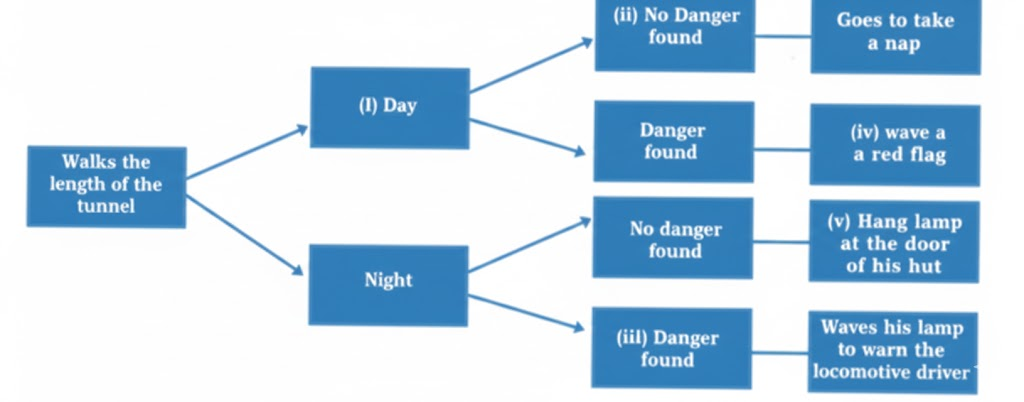
Question 5. The watchman has created a system through which he informs the locomotive driver about any danger in the tunnel. The following flow chart shows this system. Refer to the text and complete the flow chart.
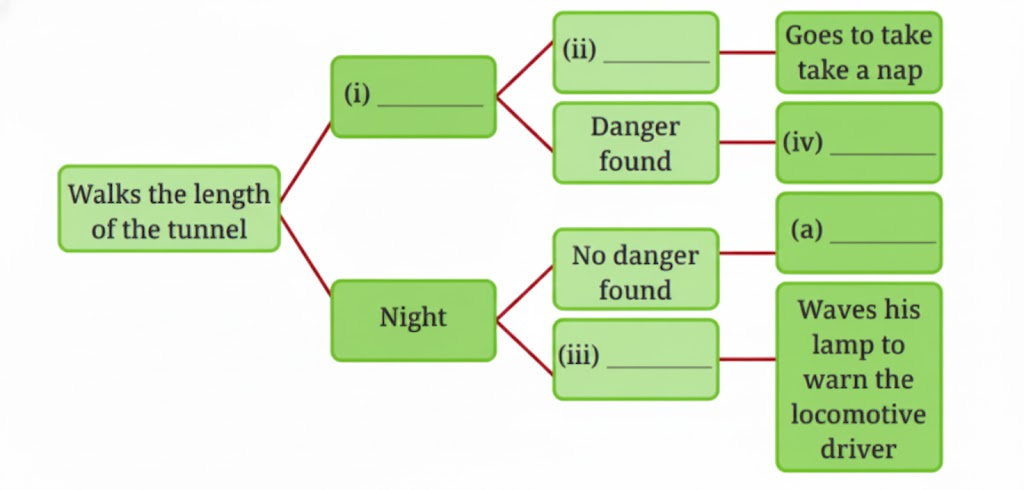
Answer:
Class 7 English The Tunnel Question Answer – Let us discuss (Page 149)
Question 1. Sunder Singh knew that the leopard was in the tunnel because ___________.
Answer: He could hear the soft footsteps of the leopard and the rustling of dry leaves.
Question 2. Why do you think Suraj was unable to do any shouting in the tunnel in the beginning?
(i) He was afraid of the leopard.
(ii) He didn’t want to disturb the leopard,
(iii) He was trying to listen for the leopard.
(iv) He didn’t really believe Sunder Singh.
Answer: (iii) He was trying to listen for the leopard.
Question 3. What made the leopard disappear into the darkness?
Answer: The leopard ran into the darkness because Suraj and Sunder Singh’s loud shouts echoed through the tunnel. The echoes frightened the animal, making it think that many people were chasing it.
Question 4. How did Suraj know Sunder Singh was at the tunnel?
Answer: Suraj realised that Sunder Singh was at the tunnel because he saw a lamp shining inside it while travelling with his father to Delhi. Although he couldn’t see Sunder Singh’s face, he was certain it was his friend.
Question 5. Why did Suraj’s father take him along to Delhi?
Answer: Suraj’s father took him to Delhi because he believed it was time for Suraj to understand the work he was involved in.
The Tunnel Class 7 Questions and Answers – Let us think and reflect (Pages 149-151)
I. Read the following lines and answer the questions that follow:
1. Suraj had to turn and look back at the opening to reassure himself that there was still daylight outside. Ahead of him, the tunnel’s other opening was just a small round circle of light.
The tunnel was still full of smoke from the train, but it would be several hours before another train came through. Till then, the cutting belonged to the jungle again.
Suraj didn’t stop, because there was nothing to do in the tunnel and nothing to see. He had simply wanted to walk through, so that he would know what the inside of a tunnel was really like.
(i) Write whether the following statement is true or false.
Suraj looked back at the opening of the tunnel to check if the train was coming.
Answer: False
(ii) Choose the correct option to complete the sentence given below.
Suraj did not stop anywhere in the tunnel because .
A. there was nothing to see in the tunnel
B. the tunnel was damp and sticky
C. he was in a hurry to get out of the tunnel
D. It was time for another train to come
Answer: A. there was nothing to see in the tunnel
(iii) What does the sentence Till then, the cutting belonged to the jungle again’ mean?
Answer: It means that once the train passed, the cleared track would go back to its natural state, blending into the jungle again.
(iv) Suraj wanted to know the inside of the tunnel. What character trait of Suraj is highlighted here?
Answer: This highlights Suraj’s boldness and curiosity.
2. “The train will soon be here,” said Suraj.
“Yes, my friend. And if we don’t drive the leopard out of the tunnel it will be run over and killed. I can’t let that happen.” “But won’t it attack us if we try to drive it out?” asked Suraj, beginning to share the watchman’s concern.
“Not this leopard. It knows me well. We have seen each other many times. It has a weakness for goats and stray dogs, but it ufill not harm us. Even so, I’ll take my axe with me. You stay here; Suraj.”
(i) What was the watchman’s concern?
Answer: The watchman heard the leopard making noise inside the tunnel. He was worried that if he didn’t chase it out, the train might run over it.
(ii) Complete the sentence with a suitable reason.
Sunder Singh was sure that the leopard in the tunnel would not attack him and Suraj because ___________.
Answer: Sunder Singh knew that the leopard had a liking for goats and stray dogs.
(iii) Select the sentences that are true from those given below.
A. Suraj wants to see leopards in the jungle.
B. Suraj is concerned about Sunder Singh’s safety.
C. The leopard in the tunnel attacks goats and stray dogs.
D. Sunder Singh wants to protect Suraj.
E. Sunder Singh knows all about the animals in the jungle.
Answer: Sentences B, C, D and E are true.
(iv) Choose the correct option to complete the sentence.
Sunder Singh decides to take his axe with him. This tells us that he was ___________.
A. violent
B. cautious
C. bold
D. afraid
Answer: B. cautious
II. Answer the following questions
Question 1. What does Sunder Singh convey by saying that he has lent his tunnel to the Government?
Answer: What he wants to express is that since the tunnel lies in the middle of the forest and no one bothers to visit or inspect it, he is the only person who looks after it. He feels it is his in a personal sense, though he understands it is government property.
Question 2. According to Sunder Singh, “It is safer in the forest than in the town”. What example does Sunder Singh give to support his opinion? What does this tell us about him?
Answer: Sunder Singh backed his statement, “It is safer in the forest than in the town,” by explaining that he was nearly hit by a bus during a visit to the town last month. This reveals that he is satisfied with his simple life in the forest and values its peace, far from the noise and rush of the city.
Question 3. Sunder Singh has become part of the jungle life. Support the view with a suitable reason.
Answer: Sunder Singh has become closely connected to the jungle, shown by his deep knowledge of its creatures. He knows how each animal behaves; for example, he understands that the leopard rarely harms humans and hunts goats and stray dogs instead. He went into the tunnel to chase the leopard away and took an axe only after Suraj suggested it might hurt them.
Question 4. Sunder Singh and Suraj form an unlikely friendship. What draws them together?
Answer: Suraj and Sunder Singh develop an unexpected friendship, united by their shared love for nature and the quiet life of the forest. Suraj, who is curious and adventurous, arrives from the city to visit the tunnel and explore the jungle. Sunder Singh, however, values the peace and simplicity of the forest more than the noise and busyness of the town. Their mutual respect for the jungle and its animals brings them closer, despite their very different backgrounds.
Question 5. Why is Sunder Singh referred to as a ‘firefly’?
Answer: He is called a firefly because, like a firefly that glows in the dark, Sunder Singh serves as a beacon for the train driver in the lonely jungle. With his lamp, he stands as a dependable watchman, giving travellers a sense of reassurance as they journey through the night. His presence brings light, safety, and familiarity to the otherwise dark and unknown surroundings.
Question 6. Do you think Suraj is an adventure-loving boy? Give reasons.
Answer: Yes, Suraj clearly loves adventure. He cycled from the city to a village, left his bicycle behind, and then walked through the jungle to explore the tunnel. He witnessed the train rushing past, leaving behind smoke and flying cinders, heard the rustling of leaves, saw bats fluttering, and noticed a lizard crawling between the tracks. He observed the tunnel’s dark, damp walls, came across a leopard in the forest, drank tea with the watchman, and even helped drive the leopard out of the tunnel to save it from the approaching train. All these experiences show just how adventurous he is.
The Tunnel Question Answer Class 7 – Let us learn (Pages 151-153)
I. Complete the following sentences using the suitable phrases from the text given in the box below:
1. We could hear the ______________________ of the train long before it came into view at the station.
2. The street was completely dark but the little boy walked to his house guided by the ______________________ from the houses.
3. The ______________________ from the carpenter’s workshop grew louder every hour.
4. From the balcony, she watched the ______________________ from her neighbour’s chimney flat across the backyard.
Answer:
1. We could hear the approaching engine of the train long before it came into view at the station.
2. The street was completely dark but the little boy walked to his house guided by the flickering lights from the houses.
3. The sawing sound from the carpenter’s workshop grew louder every hour.
4. From the balcony, she watched the drifting smoke from her neighbour’s chimney float across the backyard.
II. The text has many ‘sound words’. Some of these words are given in Column 1 and their meanings are given down. At night, the watchman lit an oil lamp and made a similar inspection of the tunnel
Now, complete the sentences given below by filing in the blanks with the correct form of the sound words given in Column 1.
1. The steam engine reached the station __________________ black smoke into the sky.
2. Suddenly the snake raised its hood and made a __________________ noise.
3. When the wind blew, I heard the __________________ of the wooden roof.
4. He heard a __________________ of leaves behind him when he was walking in the woods.
5. I get disturbed by the continuous __________________ of the monkeys in the neighbourhood.
Answer:
1. The steam engine reached the station puffing black smoke into the sky.
2. Suddenly the snake raised its hood and made a hissing noise.
3. When the wind blew, I heard the creaking of the wooden roof.
4. He heard a rustling of leaves behind him when he was walking in the woods.
5. I get disturbed by the continuous chattering of the monkeys in the neighbourhood.
III. Read what the watchman Sunder Singh did regularly at the tunnel as part of his duty. Notice the use of ‘would’.
Every day, before the train came through, he would walk the length of the tunnel. If all was .well,, he would return to his hut and take a nap. If something was wrong, he would walk back up the line and wave a red flag and the engine driver would slow down. At night, the watchman lit an oil lamp and made a similar inspection of the tunnel
Question 1. Why is the word ‘would’ used here?
(i) to make a polite request
(ii) to express a desire
(iii) to talk about a habit in the past
Answer: In these sentences, the word “would’ is used to speak about a past habit.
GOLDEN GRAMMAR TIPS
‘Would’ is used in these sentences to describe actions again and again over a period of time in the past. These are known as “habitual or routine actions’.
Would and used to both describe actions that happened regularly in the past. However, “used to’ is often used for past habits or situations that no longer occur.
She used to sing when she was in standard 6.
Arun used to eat a lot of chocolates, but he stopped last month.
Question 2. Complete the sentences using the verb in brackets with the correct form of ‘used to’ or ‘would’. An example has been done for you.
When I was a child we used to live in a village near a forest. Back then, we (i) _____________ (grow) vegetables in our back garden. Every day we (ii) _____________ (get up) early and go for a walk. The weather in summer (iii) _____________ (be) really nice. There was a lake near the house and we (iv) _____________ (go) there every Sunday for a picnic. Winters (v) _____________ (be) rather cold. In the evenings, my father (vi) _____________ (tell) us incredible stories and we (vii) _____________ (listen) with admiration.
Answer: When I ‘was a child we used to live in a village near a forest. Back then, we (i) used to grow (grow) vegetables in our back garden. Every day we (ii) would get up (get up) early and go for a walk. The weather in summer (iii) used to be (be) really nice. There was a lake near the house and we (iv) would go (go) there every Sunday for a picnic. Winters (v) used to be (be) rather cold. In the evenings, my father (vi) would tell (tell) us incredible stories and we (vii) would listen (listen) with admiration.
IV. We use punctuation marks to make our writing clear. You already know how to use full stops and commas. Let us look at three more punctuation marks-brack- ets, semicolon; and colon.
Colon (:) is used to introduce a list or an explanation.
You need the following ingredients to make Ela Ada: ghee, coconut, jaggery, and rice flour.
He has one goal: to win the championship.
Semicolon (;) is used to connect two clauses which are closely related without a conjunction.
She loves reading; he prefers watching movies.
Suraj followed close behind; but he found he was unable to do any shouting
Now, use semicolons and colons to punctuate the following paragraph.
Answer: We explored the lively by-lanes of Charminar, the vibrant centre of Hyderabad, and it turned out to be an exciting day. We had a small list of things we wanted to do—buy bangles, taste biryani, and pick up pearl earrings, which the area is famous for. As we walked through the streets, we passed stalls filled with spices, clothes, and jewellery, creating a colourful atmosphere. We also visited well-known landmarks such as Charminar, Golconda Fort, the Salar Jung Museum, and Chowmahalla Palace, each of which was stunning.
Class 7 English Chapter 10 Question Answer – Let us listen (Pages 153-154)
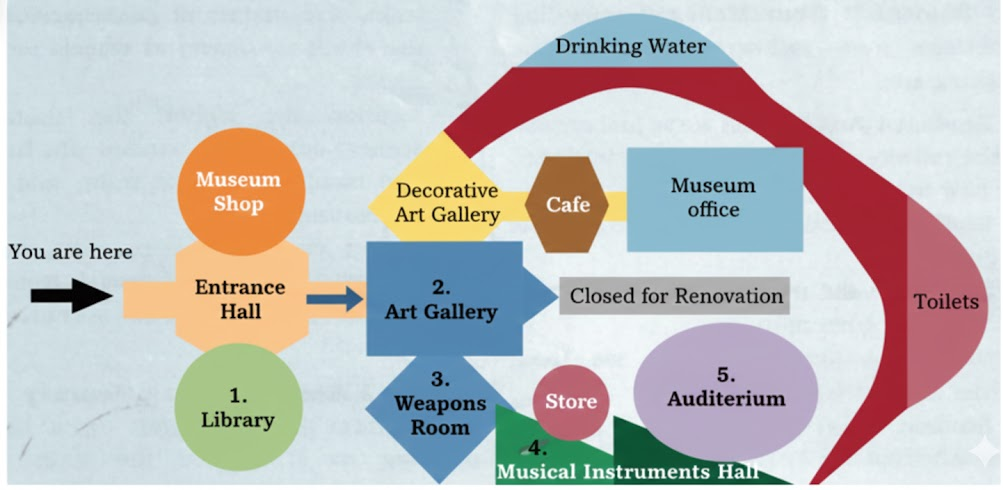
A famous museum in your town is organising a treasure hunt in the museum premises. You and your friends decide to participate in it. Upon arrival, you find that there are many other teams. Each team is given an audio guide (recorded information) and a map to the museum.
(Transcript for the teacher on NCERT Page 176)
Listen to the audio recording and as you listen, mark your map with the route to take to find the treasure. To help you, the names of a few rooms in the museum are given below. Now listen to the audio and mark the various rooms.
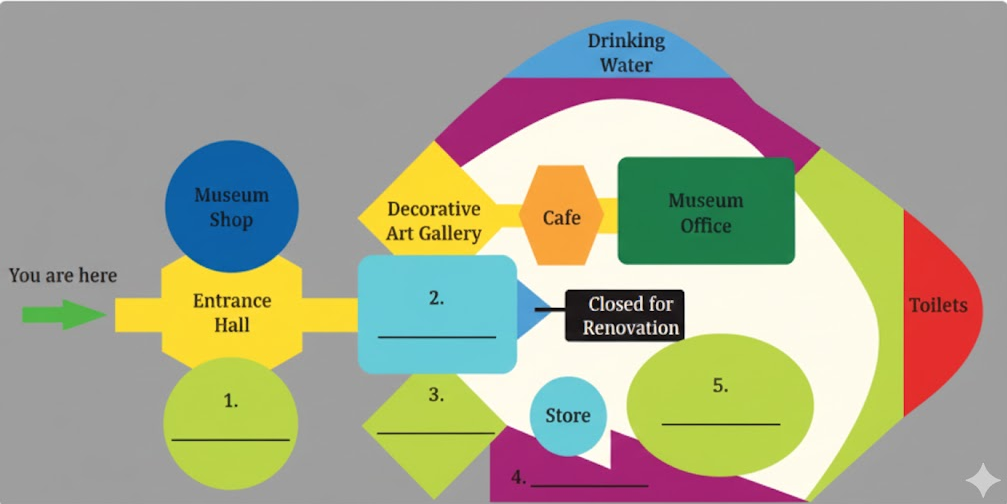
Answer:
NCERT Class 7 English Poorvi Chapter 10 Question Answer – Let us speak (Pages 154-155)
Anju is going on a trekking trip with her family during the summer vacation. They have reached the railway station. Anju calls the tour manager for directions to the trekking site.
Work in pairs and have this conversation. Student A will play the role of Anju and mark the route on the map given below. Student B will play the role of the tour manager. Looking at the map, give directions to reach the trekking site from the railway station. You may use phrases like the ones in the box to help you.
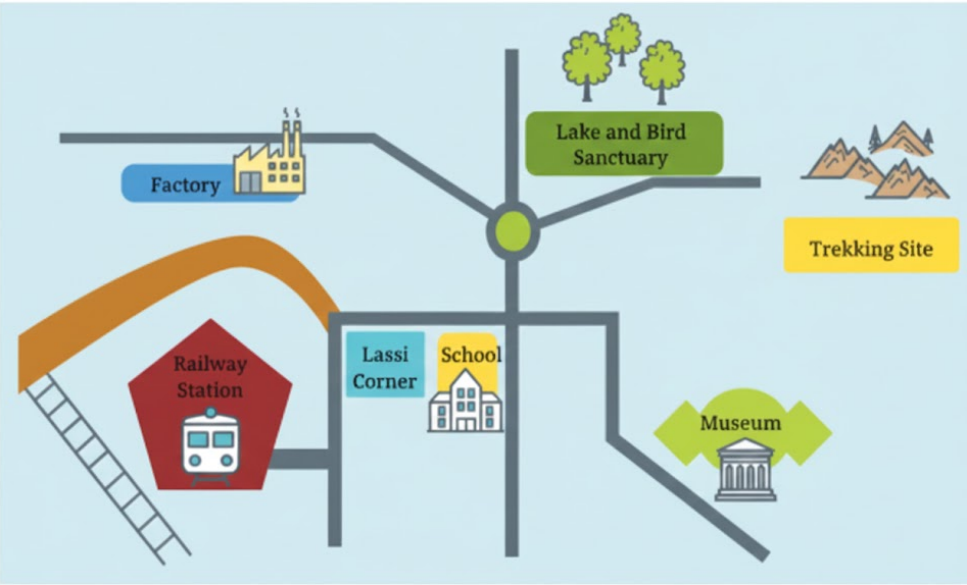
Answer:
Conversation between Student A (Anju) and Student B (Tour Manager) about directions from the railway station to the trekking site
Student A (Anju): Hello! We’ve just reached the railway station. Could you please tell me how to get to the trekking site?
Student B (Tour Manager): Of course, Anju! I’ll guide you.
Start from the railway station, take the first left, and then turn right.
Student A (Anju): Alright, I can see Lassi Corner and a school along the way.
Student B (Tour Manager): Yes, that’s correct! Now turn left at the crossing and continue straight until you reach the roundabout.
Student A (Anju): I’m at the roundabout now. Which exit should I take?
Student B (Tour Manager): Good! Take the third exit from the roundabout.
Student A (Anju): Okay, I’m taking the third exit.
Student B (Tour Manager): Great! Keep going straight, and you’ll find the trekking site on your right, just opposite the Lake and Bird Sanctuary.
Student A (Anju): Wonderful, thank you very much!
Class 7th English Chapter 10 The Tunnel Question Answer – Let us write (Page 155)
Write a descriptive paragraph about your experience of a train journey. Describe the sights, sounds, and feelings you experienced during the journey. Include details about the people around you, the scenery outside, and the atmosphere inside the train to make your paragraph vivid and engaging.
You may use the following guidelines to help you create the paragraph.
Start with how the journey began: boarding the train, finding your seat, and the initial impressions.
Describe the sounds: the whistle of the train, the chatter of passengers, and the rhythmic clatter of wheels on the tracks.
Mention the sights: the changing scenery outside the window, the hustle and bustle inside the train, and any interesting moments.
Reflect on your feelings: Were you excited, relaxed, or curious? How did the journey make you feel overall?
Answer: A Memorable Train Journey
My train journey began on a bright morning, and I boarded the train with excitement bubbling inside me. After settling into my window seat, I looked around at the busy station filled with rushing passengers, loud announcements, and hawkers calling out their goods. As the train pulled out, the rhythmic clatter of the wheels and the whistle of the engine felt like the beginning of an adventure.
Outside the window, the view slowly shifted from crowded city streets to quiet villages and wide green fields. Children waved as we passed by, and cattle grazed peacefully in the distance. Inside the coach, the atmosphere was cheerful—families shared snacks, children played games, and friendly travellers chatted with one another.
The entire journey left me feeling relaxed and happy. There was something truly magical about watching the world glide past from a moving train. It wasn’t just a trip—it was an experience filled with beautiful sights, lively sounds, and unforgettable moments.
The Tunnel Class 7 NCERT Solutions – Let us explore (Page 156)
I. The Nation’s pride Atal Tunnel is 9.02 kilometres long. It runs under the Rohtang Pass. It was constructed on the Manali–Leh Highway under the challenging conditions of freezing temperatures in extremely diffilt terrain. The Atal Tunnel has offially been certifid by World Book of Records as the ‘World’s Longest Highway Tunnel above 10,000 Feet’!
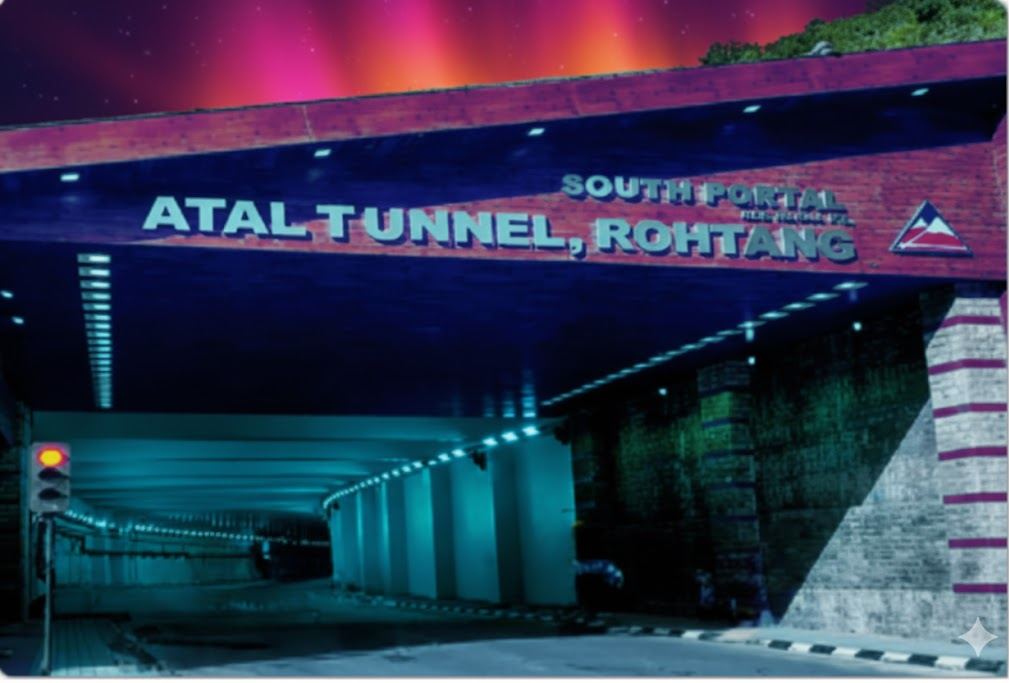
Answer: Students should do it by themselves.
II. The history of Indian Railways spans over 165 years. On 16 April 1853, the fist passenger train ran between Bori Bunder (Mumbai) and Thane, covering 34 kilometres. It was operated by three locomotives named Sahib, Sultan, and Sindh and had thirteen carriages. In 1864, the North received its fist station, Delhi Junction, near Chandni Chowk. You may refer to the given link to know more about Indian Railways.
Answer: Students should do it by themselves.
NCERT Solutions Class 7 English Chapter 10 The Tunnel – Summary and Insights
With NCERT Solutions for Class 7 English Chapter 10 The Tunnel, students dive into an exciting story about adventure and bravery. Understanding Suraj and Sunder Singh’s journey can make learning enjoyable and help strengthen your main concepts for exams.
This chapter shines a light on the value of courage, observation, and teamwork. By practicing the NCERT book exercises and referring to precise solutions, students gain the confidence needed to answer any question related to the chapter.
Regular revision with chapter-wise solutions ensures you remember key events and vocabulary. For best results, focus on important scenes and practice expressing answers in your own words, boosting your preparation for the 2026-27 English exam.
FAQs on NCERT Solutions For Class 7 English Chapter 10 The Tunnel - 2026-27 Free PDF Download (Login Required)
1. What is included in NCERT Solutions for Class 7 English Chapter 10 The Tunnel?
NCERT Solutions for Class 7 English Chapter 10 The Tunnel include stepwise answers to all textbook and back exercise questions, fully aligned to the latest CBSE syllabus.
Key features:
- Exam-focused, easy-to-understand solutions for every question
- Concise summaries, definitions, and key points
- Structured long and short answer frameworks
- Free PDF download for offline practice
- Extra questions and revision notes for thorough preparation
2. How should I write stepwise answers for NCERT to score full marks in Chapter 10 The Tunnel?
To score full marks in Class 7 English Chapter 10 The Tunnel, always write answers step by step following CBSE evaluation criteria.
Tips:
- Start with a brief introduction using chapter keywords
- Address every part of the question in clear, separate steps
- Include relevant definitions or important lines where needed
- Present answers in neat points or short paragraphs
- Conclude with a concise statement or summary
3. Which questions from The Tunnel are likely to appear in school exams?
School exams for Class 7 English often cover both direct and inferential questions from Chapter 10 The Tunnel.
Common exam questions:
- Back exercise and intext questions from the NCERT book
- Summary or character-based questions
- Definitions and explanation of key terms
- Long answers based on main events or moral lessons
- Extra questions covering central themes and plot details
4. Are diagrams or definitions compulsory for scoring in this chapter?
While diagrams are not usually part of English Chapter 10 The Tunnel, writing accurate definitions is essential for scoring marks.
What helps you score:
- Neat, exam-aligned definitions of key words and expressions
- Answering map/diagram-based exercises if your school assigns them
- Including clear references to the text in your answers
5. What is the best way to structure long answers for maximum marks in Class 7 English Chapter 10?
The best way to structure long answers is to use a clear introduction, a detailed middle section covering all points, and a brief conclusion.
Long answer structure:
- Begin with a one-line summary of the topic or question
- Describe events or characters in logical order using key facts
- Add supporting points or examples from the chapter
- End with a conclusion or your interpretation
6. Where can I download the PDF of NCERT Solutions for Class 7 English Chapter 10 The Tunnel?
You can download the free PDF of NCERT Solutions for Class 7 English Chapter 10 The Tunnel directly from trusted educational websites.
How to access:
- Look for the “Download PDF” button on the solutions page
- Ensure the PDF is updated for academic year 2026–27
- Use offline to revise and practice anytime
7. Are NCERT Solutions enough for Class 7 English exams?
NCERT Solutions for Class 7 English provide the foundational material needed to score well in exams.
For best results:
- Revise all NCERT questions and answers thoroughly
- Practice extra questions and long answers
- Read chapter summaries and key points for last-minute revision
8. What are the most important topics from Chapter 10 The Tunnel for CBSE exams?
The most important topics from The Tunnel include the main plot, character actions, and the chapter’s central message.
Key focus areas:
- Main events and their sequence
- Character traits and motivations
- Theme of courage, fear, and overcoming obstacles
- Key words and definitions from the text
9. How to present long answers to match CBSE marking?
To match CBSE marking, long answers should be logically structured, relevant, and contain all necessary keywords from the chapter.
Tips:
- Address each part of the question in separate paragraphs
- Use bullet points for clarity where appropriate
- Highlight important lines and concepts from the chapter
- Write a short conclusion to summarise your answer
10. Do examiners award partial marks for correct steps even if the final answer is wrong?
Yes, in CBSE exams, examiners often give partial marks for correct steps or relevant information even if the answer is incomplete.
Scoring advice:
- Write all steps and supporting points clearly
- Include definitions, examples, and key terms even if unsure about the final answer
- Attempt every question for a chance at step-wise marks
11. Where to get chapterwise solutions PDF for offline study?
You can get chapterwise NCERT Solutions PDFs for Class 7 English from reputable educational platforms offering free downloads.
How to find them:
- Search for “Class 7 English NCERT Solutions chapterwise PDF”
- Check that the source covers all current syllabus chapters
- Download for flexible revision from your device anytime
12. Are references to textbook page numbers useful during revision?
Yes, referencing textbook page numbers while revising NCERT Solutions for Class 7 English helps you quickly locate key information.
Benefits:
- Speeds up cross-checking with the actual text
- Improves accuracy for intext and back exercise questions
- Enhances confidence in the exam hall
