


Let’s Tackle Class 9 Maths Chapter 5 Exercise 5.6


Exercise Set 5.6
Question 1.
In a circle with centre O, the central angle AOB is 60°. If the radius of the circle is 12 cm, what is the length of the chord AB?
Solution:
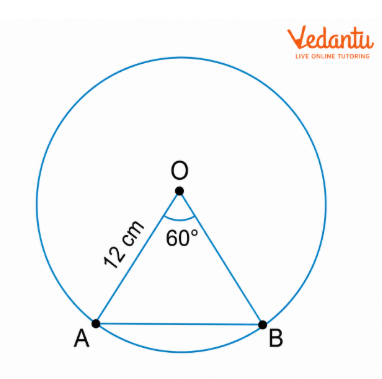
OA and OB are radii of the same circle.
Therefore:
OA = OB = 12 cm
So, ∆AOB is an isosceles triangle.
Given:
∠AOB = 60°
Let:
∠OAB = ∠OBA = x
Using the angle-sum property of a triangle:
x + x + 60° = 180°
2x = 120°
x = 60°
Thus, all three angles of ∆AOB are 60°. Therefore, ∆AOB is equilateral.
Hence:
AB = OA = OB = 12 cm
Therefore, the length of chord AB is 12 cm.
Question 2.
Let A and B be two points on a circle with centre O.
(i) Are there points X, Y on the circle, on the same side of AB, such that ∠AXB is different from ∠AYB?
Solution:
No. Points X and Y lie on the same segment of the circle formed by chord AB.
Angles subtended by the same chord at points lying in the same segment are equal.
Therefore:
∠AXB = ∠AYB
Hence, these two angles cannot be different.
(ii) Is it true that if ∠AXB = ∠AYB, then X and Y lie on the same side of the circle?
Solution:
No, this is not always true.
For example, if AB is a diameter, then the angle subtended by AB at any point on the circle is 90°. Therefore, points X and Y may lie on opposite sides of AB and still satisfy:
∠AXB = ∠AYB = 90°
Hence, equal angles do not always mean that X and Y lie on the same side of AB.
(iii) If ∠AXB = ∠AYB, and X and Y do not lie on the circle, does the circle through A, B, and X also pass through Y?
Solution:
If X and Y lie on the same side of AB and
∠AXB = ∠AYB, then A, B, X, and Y are concyclic.
Therefore, the circle passing through A, B, and X will also pass through Y.
However, the condition that X and Y lie on the same side of AB is important.
Question 3.
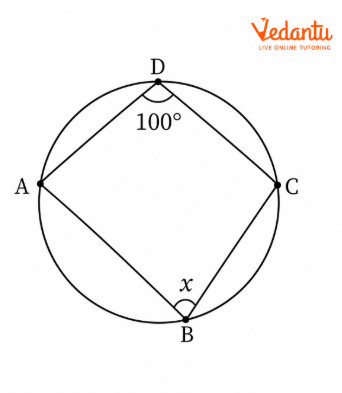
Find x in Fig. 5.26.
Solution:
Given:
∠ADC = 100°
The angle subtended by arc ABC at the centre is twice the angle subtended by it at the circumference.
Therefore:
Reflex central angle corresponding to arc ABC
= 2 × 100°
= 200°
The complete angle around the centre is 360°.
Therefore, the central angle corresponding to the remaining arc ADC is:
360° - 200° = 160°
The angle x subtended by this arc at the circumference is half the corresponding central angle.
x = 160°/2
x = 80°
Therefore, x = 80°.
Make the Most of Vedantu’s Class 9 Maths Chapter 5 Exercise 5.6 Solutions
Exercise 5.6 is especially useful when you want to connect circle properties with actual angle problems. The Class 9 Maths Chapter 5 Exercise 5.6 solutions can help you:
Understand how a 60° central angle leads to an equilateral triangle.
Work out questions involving the same chord and different points on a circle.
Recognise how concyclic points are identified through angle relationships.
Use the given figure to decide which circle property applies.
Refer to the Class 9 Maths Chapter 5 Exercise 5.6 solutions CBSE material when practising theorem-based questions.
Keep the Class 9 Maths Chapter 5 PDF or Class 9 Maths Chapter 5 solutions PDF handy to practise the full chapter.
Use the Class 9 Maths Chapter 5 Solutions PDF Ganita Manjari material when you want to go back to the chapter and check related exercises.
For more explanations, solutions, and study material, students can visit Vedantu and explore NCERT Solutions Class 9 Maths.
Access Exercise Wise NCERT Solutions for Chapter 5 Maths Class 9
CBSE Class 9 Maths Chapter 5 Other Study Materials
Chapter-Specific NCERT Solutions for Class 9 Maths
Additional Study Materials for Class 9 Maths
FAQs on NCERT Solutions for Class 9 Maths Chapter 5 Exercise 5.6 (2026-27)
1. What is the main topic of Class 9 Maths Chapter 5 Exercise 5.6?
Exercise 5.6 mainly covers angles in circles, including central angles, chords, arcs, segments, and conditions involving points on the same circle.
2. Why does a 60° central angle make the chord equal to the radius?
The two radii and the chord form an isosceles triangle. With the central angle equal to 60°, the other two angles are also 60°, making the triangle equilateral. Hence, the chord equals the radius.
3. What is the answer to Question 1 of Exercise 5.6?
The chord AB is 12 cm because the radius is 12 cm and the 60° central angle makes the triangle AOB equilateral.
4. Can angles subtended by the same chord be unequal?
If the points are on the same segment, the angles subtended by the same chord are equal. Check the points' positions before applying this property.
5. What does Question 2 of Exercise 5.6 test?
It checks whether you can correctly apply the property of angles subtended by the same chord and recognise situations where equal angles do or do not prove that points lie in the same position.
6. What does it mean when four points are concyclic?
Four points are concyclic if they all lie on one circle. In Exercise 5.6, we use angle equality to examine this relationship.
7. How is the 100° angle used in Question 3?
The 100° angle at the circumference corresponds to a reflex central angle of 200°. The remaining central angle is 160°, so the angle x at the circumference is 80°.
8. What is the answer to Question 3 in Class 9 Maths Exercise 5.6?
The given angle is 100°. The corresponding reflex angle at the centre is 200°. Therefore, the remaining central angle is 360° − 200° = 160°. Since the angle at the circumference is half the central angle: x = 160° ÷ 2 = 80°. Hence, the required value of x is 80°.
9. Which circle properties should I know before attempting Exercise 5.6?
Revise the relationships between chords, arcs, central angles, angles at the circumference, and angles formed in the same segment.
10. How can I use the Class 9 Maths Chapter 5 Exercise 5.6 solutions CBSE material?
Try the questions independently first. Then compare your angle calculations and reasoning with the Class 9 Maths Chapter 5 Exercise 5.6 solutions CBSE to identify mistakes.
11. Is the Class 9 Maths Chapter 5 PDF useful for all the exercises?
Yes. A Class 9 Maths Chapter 5 PDF is useful when you want to refer to the chapter content, figures, definitions, and exercises in one place.
12. Where can I get a Class 9 Maths Chapter 5 solutions PDF?
You can use the Class 9 Maths Chapter 5 solutions PDF available through the relevant PDF download option to keep the solved material together for practice.
13. Can I use the Ganita Manjari solutions PDF for Chapter 5?
Yes. The Class 9 Maths Chapter 5 solutions PDF from Ganita Manjari material can help you check questions from the corresponding chapter and understand the methods used.
14. How should I solve angle questions in Exercise 5.6?
Start by locating the given angle in the figure. Identify the related chord or arc, then apply the appropriate circle property instead of calculating every angle separately.
15. Where can I find more help for Class 9 Maths Chapter 5?
For additional explanations, chapter-wise solutions, and other study resources, visit Vedantu and explore NCERT Solutions for Class 9 Maths.