



Introduction to Epithelium Tissue in the Human Body: Structural Features. Characteristics, Classification
Epithelium is a fundamental type of body tissue that forms the protective covering of all internal and external surfaces of the body. It lines body cavities and hollow organs and is the primary component of glands. This tissue acts as the first point of contact for any substance entering or leaving the body.
In human biology, the body is composed of four major tissue types: epithelial, connective, muscular, and nervous tissues. Among these, epithelium plays a critical role in protection, absorption, secretion, and filtration, making it essential for survival.
Epithelium Tissue Diagram
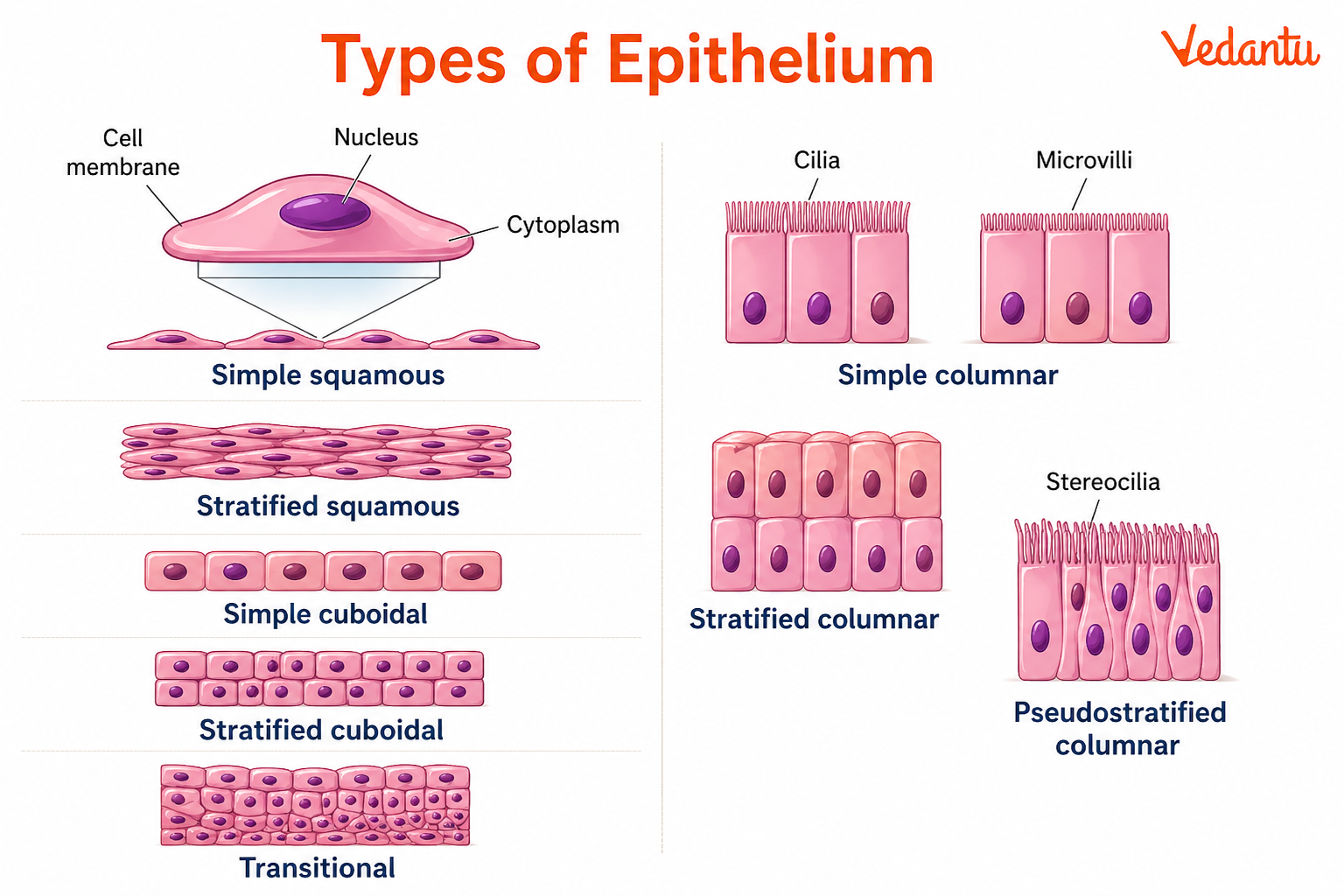
From the outer skin (epidermis) to the lining of the intestine and respiratory tract, epithelial tissue is present throughout the body and performs location-specific functions.
Structure of Epithelial Cells
Epithelial tissue is made up of tightly packed cells with minimal intercellular space. These cells form continuous sheets that may consist of a single layer or multiple layers, depending on their function.
Each epithelial cell contains:
Cell membrane – regulates the movement of substances in and out
Nucleus – controls cell activities and contains DNA
Cytoplasm – contains organelles and supports cellular processes
Special Surface Modifications
Some epithelial cells have specialised structures that enhance their function:
Microvilli – increase surface area for absorption (intestine)
Cilia – move substances like mucus (respiratory tract)
Stereocilia – involved in hearing and balance (inner ear)
These adaptations make epithelium highly efficient in carrying out diverse physiological roles.
Classification of Epithelium
The classification of epithelium is based on two main criteria:
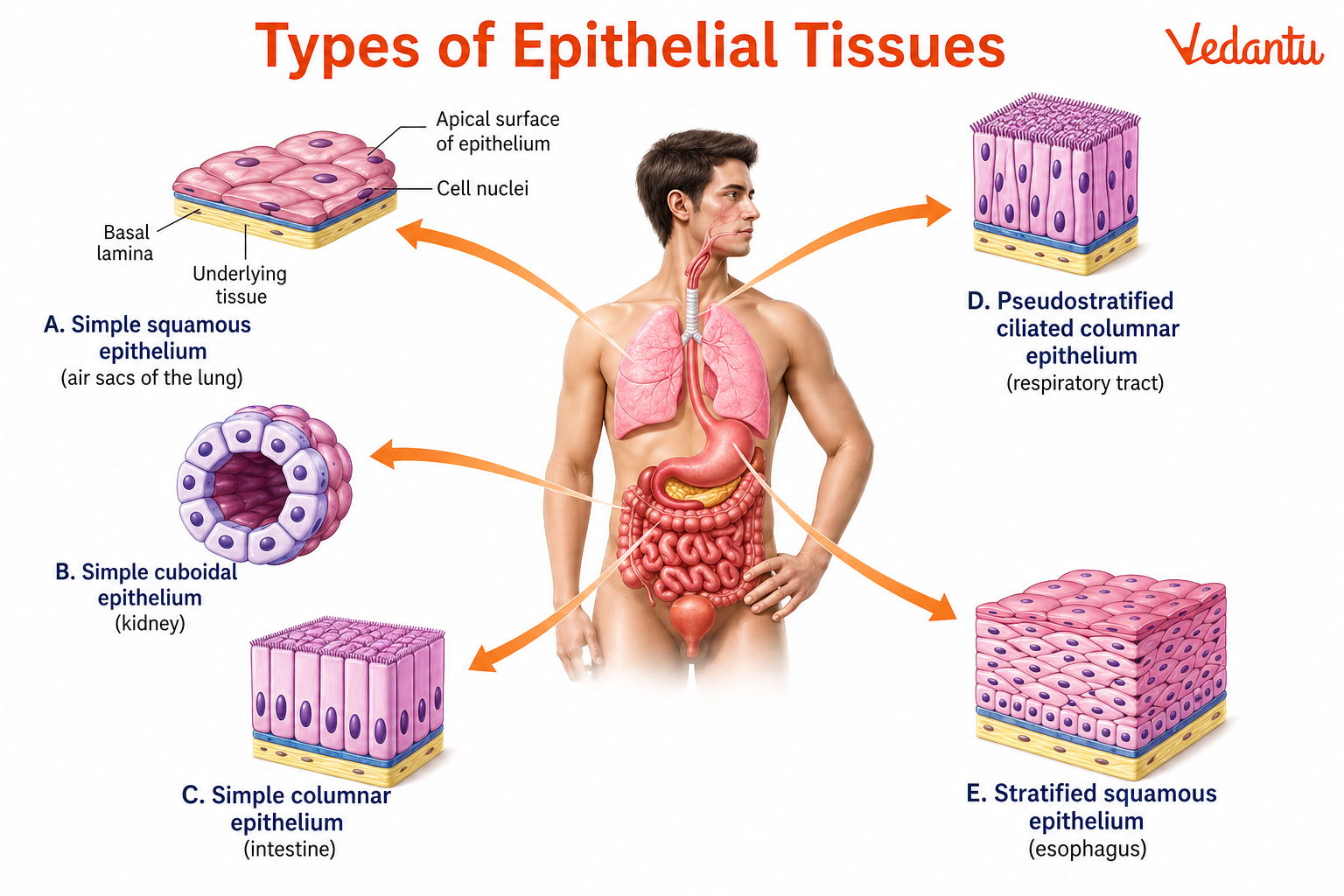
1. Based on Cell Shape
Columnar epithelium
2. Based on Number of Layers
Simple epithelium (single layer)
Stratified epithelium (multiple layers)
Pseudostratified epithelium (appears multilayered but is a single layer)
This dual classification helps in understanding the correlation between structure and function in epithelial tissues.
Types of Epithelium (Detailed Explanation)
Squamous Epithelium
Squamous epithelium consists of thin, flat, sheet-like cells. It allows easy diffusion and filtration due to its minimal thickness.
Types:
Simple squamous epithelium – found in blood vessels and alveoli; helps in diffusion
Stratified squamous epithelium – found in skin; provides protection
Function: Protection, diffusion, and filtration
Cuboidal Epithelium
Cuboidal epithelium is made up of cube-shaped cells with equal dimensions.
Location:
Kidney tubules
Glandular tissues
Function: Secretion and absorption
Columnar Epithelium
Columnar epithelium consists of tall, pillar-like cells.
Location:
Stomach lining
Intestine
Features:
May contain microvilli for absorption
May have cilia for movement
Function: Absorption and secretion
Stratified Squamous Epithelium
This is a multilayered epithelium mainly found in areas exposed to friction.
Location:
Skin (epidermis)
Mouth lining
Function:
Protection from pathogens
Prevention of water loss
Pseudostratified Columnar Epithelium
Although it appears multilayered, all cells are attached to the basement membrane.
Location:
Respiratory tract
Function:
Movement of mucus using cilia
Protection against dust particles
Glandular Epithelium
Glandular epithelium is specialised for secretion.
Location:
Endocrine glands (hormones)
Exocrine glands (enzymes, sweat)
Function:
Secretion of hormones, enzymes, and fluids
Transitional Epithelium
This epithelium can stretch and change shape.
Location:
Urinary bladder
Function:
Allows expansion and contraction
Functions of Epithelium
Epithelial tissue performs multiple vital functions:
1. Protection
Skin protects internal organs from injury and pathogens
2. Secretion
Glandular epithelium releases hormones, enzymes, and mucus
3. Absorption
Intestinal epithelium absorbs nutrients
4. Excretion
Kidney epithelium removes waste
5. Filtration
Filters air and blood
6. Diffusion
Allows movement of gases and nutrients
7. Sensory Reception
Detects stimuli (taste buds, smell receptors)
These functions vary depending on the location and specialisation of epithelial cells.
Location of Different Types of Epithelium in the Body
Diseases and Disorders Related to Epithelium
Epithelial tissue can be affected by several conditions:
1. Cancer (Carcinoma)
Adenocarcinoma affects the glandular epithelium
Common in prostate, breast, colon, pancreas
2. Asthma
Damage to the respiratory epithelium
3. Celiac Disease
Damage to intestinal microvilli reduces absorption
4. HPV Infection
Causes warts in squamous epithelium
5. Vertigo
Linked to abnormal epithelial growth in the ear
Difference Between Epithelium, Endothelium and Mesothelium
FAQs on Epithelium Tissue in Biology: Complete Guide to Types, Classification, Structure and Functions
1. What is the epithelium in the body?
Epithelium refers to a specialised tissue made up of closely packed cells that form a continuous layer over body surfaces.
It covers the outer surface of the body (such as the skin), lines internal cavities and hollow organs (such as the stomach and lungs), and forms the functional parts of glands.
This tissue acts as a protective barrier and regulates the exchange of substances between the body and the external environment.
2. What are the 4 types of epithelium?
Epithelial tissues are mainly classified based on cell shape and arrangement into four major types:
Simple Squamous Epithelium: Composed of a single layer of flat cells, it allows rapid diffusion and filtration. It is found in structures like lung alveoli and blood vessels.
Simple Cuboidal Epithelium: Made up of cube-shaped cells, this type is involved in secretion and absorption and is present in kidney tubules and glandular tissues.
Simple Columnar Epithelium: Consists of tall, elongated cells, often with microvilli or cilia, specialised for absorption and secretion in organs like the intestine and stomach.
Stratified Squamous Epithelium: Formed by multiple layers of cells, it protects against mechanical stress and is found in the skin, mouth, and oesophagus.
In addition to these, pseudostratified epithelium is a specialised form that appears multilayered but is actually a single layer and plays a key role in the respiratory system.
3. Can epithelial cells be cancerous?
Yes, epithelial cells can become cancerous. Since these cells divide and renew frequently, they are more prone to genetic mutations over time. Most cancers in the human body, known as carcinomas, originate from epithelial tissues. Common examples include cancers of the breast, colon, prostate, and lungs.
4. What is epithelium in urine?
Epithelial cells in urine are cells that are naturally shed from the lining of the urinary tract, including the kidneys, bladder, and urethra.
A small number of these cells is normal. However, a high count may indicate conditions such as urinary tract infection (UTI), kidney disease, or inflammation.
The main types observed are squamous, transitional, and renal epithelial cells.
5. What is the function of the epithelium?
Epithelium performs several essential functions in the body depending on its location:
Protection: Shields underlying tissues from injury, dehydration, and infections
Absorption: Helps in the uptake of nutrients and water, especially in the intestine
Secretion: Produces substances like hormones, enzymes, mucus, and sweat
Filtration and Diffusion: Enables exchange of gases and removal of waste (e.g., in lungs and kidneys)
Sensory Reception: Specialised epithelial cells detect stimuli such as taste, smell, and sound
Excretion: Eliminates waste products through sweat glands and kidneys
6. What diseases affect epithelial cells?
Several medical conditions can affect epithelial tissue, including:
Celiac Disease: Damages intestinal epithelial cells and affects nutrient absorption
Asthma: Alters the respiratory epithelium, making airways sensitive
Human Papillomavirus (HPV): Causes warts in squamous epithelium
Vertigo: Linked to abnormal epithelial growth in the inner ear
7. How many cancers are epithelial?
A significant majority of cancers-around 90% of all human cancers, originate from epithelial tissues. These cancers are collectively known as carcinomas and commonly affect organs such as the breast, colon, lungs, and prostate.
8. How to remove epithelial cells in urine?
The presence of excess epithelial cells in urine is not treated directly. Instead, the underlying cause must be addressed. This may include:
Taking prescribed medications such as antibiotics for infections
Staying well-hydrated to flush out toxins
Maintaining proper hygiene to prevent contamination
Managing kidney or urinary tract conditions
Once the root cause is treated, epithelial cell levels usually return to normal.
9. What does epithelial cell +++ mean?
A report showing “+++ epithelial cells” indicates a high concentration of epithelial cells in urine. This often suggests an infection, such as a UTI, inflammation, or possible kidney-related issues. In some cases, it may also point toward contamination during sample collection or more serious underlying conditions.
10. What organs contain epithelial tissue?
Epithelial tissue is widely distributed throughout the body. Some major locations include:
Outer layer of the skin (epidermis)
Lining of the digestive tract (stomach and intestines)
Respiratory tract (nose, trachea, lungs)
Abdominal cavity lining
Glands such as sweat and endocrine glands
11. What happens if my epithelial cells are high?
An increased number of epithelial cells in urine can indicate different conditions depending on the type of cells present. It may suggest:
Urinary tract infection (UTI)
Kidney disease or damage
Inflammation in the urinary system
Improper sample collection (especially with squamous cells)
A doctor should evaluate persistent high levels to identify and treat the underlying cause.
