



What is Transduction in Bacteria? Steps, Types and Diagram Explained
Transduction in bacteria is a mode of genetic transfer in which DNA is transferred from one bacterium to another using a virus called a bacteriophage. In this process, there is no direct contact between the donor and recipient bacterial cells. Instead, the bacteriophage acts as the carrier of bacterial genetic material.
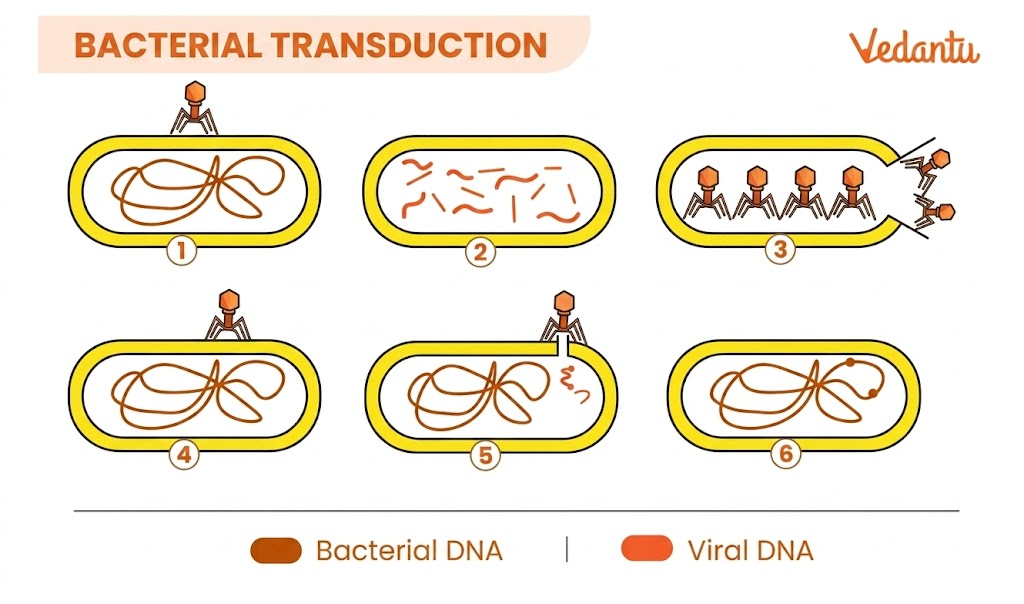
This makes transduction one of the major methods of bacterial recombination, along with transformation and conjugation.
Bacteriophages mediate transduction in Bacteria. Bacteriophages are viruses that infect bacteria. They attach to bacterial cells, inject their genetic material, and use the host cell to make new viral particles. During this process, they may carry bacterial DNA from one host to another. Because of this role, bacteriophages are the mediators of bacterial transduction.
Zinder and Lederberg discovered transduction in Bacteria. They discovered transduction while working on Salmonella. Their work showed that bacterial genes could be transferred through a viral intermediary without direct contact between bacterial cells. Later, Hershey and Chase also used transduction-related work to support the idea that DNA is the genetic material.
Bacterial Recombination and Role of Transduction
Bacterial recombination refers to the transfer and rearrangement of genetic material between bacterial cells. There are three main natural methods of bacterial recombination:
transformation
conjugation
Among these, transduction is unique because it uses a virus as the carrier. This makes transduction a very important mechanism not only in natural bacterial evolution but also in genetics research and biotechnology.
The significance of transduction is that it allows bacterial genes to move across cells without direct contact. This helps bacteria acquire new characteristics such as metabolic capabilities or resistance traits.
Transduction in Bacteria Steps
The steps of transduction in bacteria are closely linked to viral infection. To understand this process clearly, it is helpful to study it stage by stage.
Step 1: Infection of the Donor Bacterial Cell
The process begins when a bacteriophage infects a bacterial cell. The phage attaches to the bacterial surface and injects its genetic material into the host.
Step 2: Multiplication of the Phage
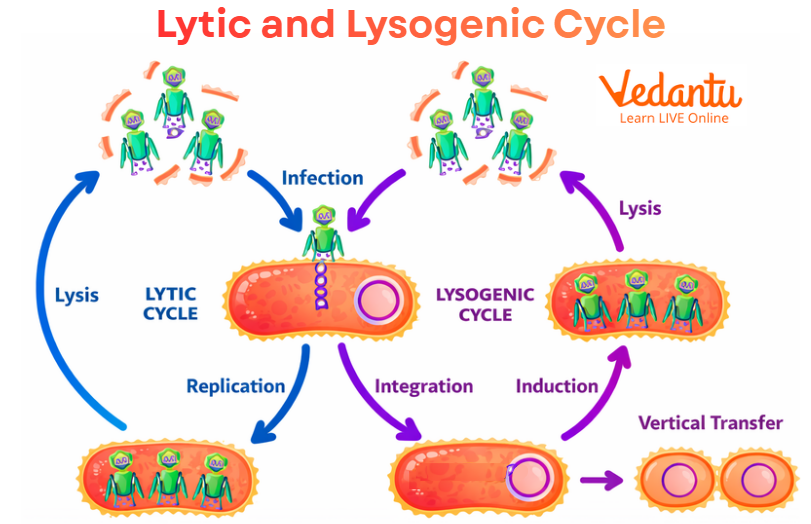
The viral DNA now uses the host bacterial machinery to replicate itself. This can happen through:
the lytic cycle, where phage particles are formed rapidly, and the host cell eventually bu
rsts
The lysogenic cycle, where the phage DNA first becomes incorporated into the bacterial genome as a prophage and later may enter a lytic phase
Step 3: Accidental Packaging of Bacterial DNA
During assembly of new bacteriophages, some phage heads may accidentally package pieces of bacterial DNA instead of viral DNA. In the lysogenic cycle, during prophage excision, some flanking bacterial DNA may also be excised and packaged together with viral DNA.
This is the central event in transduction because it creates a phage particle that carries bacterial genes.
Step 4: Infection of the Recipient Bacterial Cell
The phage carrying donor bacterial DNA infects another bacterial cell. Along with viral genetic material, it injects the donor cell's bacterial DNA into the recipient.
Step 5: Fate of the Transferred DNA
Once inside the recipient cell, the bacterial DNA may do one of the following:
remain as extrachromosomal DNA
recombine with homologous regions of the recipient chromosome
Reform a plasmid if the transferred DNA originated from a plasmid
integrate with the prophage in the case of temperate phages
Step 6: Expression of New Traits
If the donor DNA is maintained and expressed, the recipient bacterium acquires new characteristics. This may change its genotype and phenotype.
Generalised Transduction in Bacteria
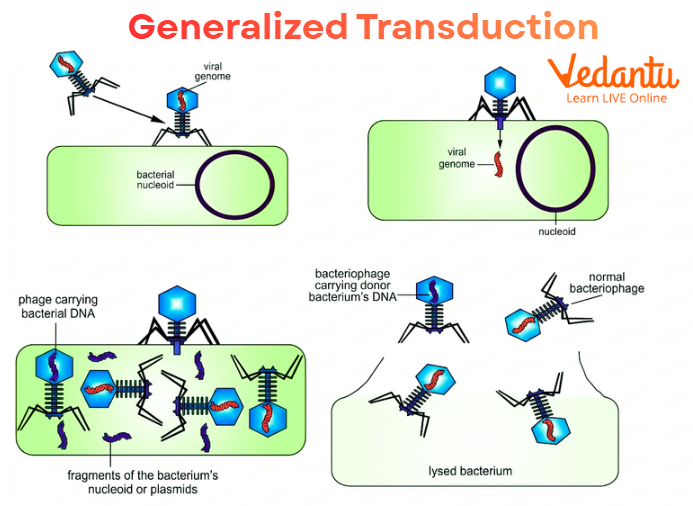
Generalised transduction in bacteria is the type of transduction in which a bacteriophage can carry any random part of bacterial DNA from the donor cell. It usually occurs during the lytic phase of the phage life cycle, although it may also be linked with lysogenic phages entering lytic growth.
How It Happens?
During phage assembly inside the donor bacterium:
The host bacterial chromosome is broken down
Viral heads are assembled
Occasionally, bacterial DNA fragments are packed into the viral capsid instead of phage DNA
When such a phage infects another bacterial cell, it injects the donor bacterial DNA, which may later recombine with the recipient chromosome.
Features of Generalised Transduction
can transfer any part of the donor bacterial DNA
mostly associated with the lytic stage
The transferred DNA is random
useful in gene mapping and linkage studies
Example of Generalised Transduction
A standard example is E. coli transduction by P1 phage.
Uses of Gene
Generalised transduction
Generalised transduction is used in:
gene mapping
studying linkage information
Comparing bacterial genomes
mutagenesis studies
Specialised Transduction in Bacteria
Specialised transduction in bacteria is more specific than generalised transduction. In this case, only certain specific bacterial genes are transferred, usually those located near the prophage insertion site.
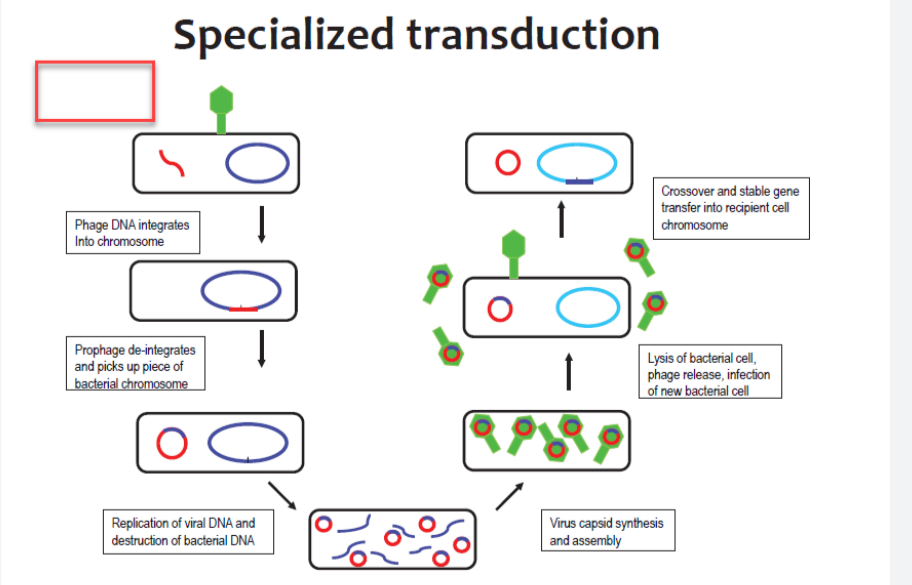
In specialised transduction in bacteria, only a specific part of bacterial DNA is carried by the phage. This occurs when a temperate phage, after integrating into the bacterial chromosome as a prophage, excises incorrectly, taking adjacent bacterial genes with it.
How It Happens?
The steps are:
A temperate phage infects the bacterium
phage DNA integrates into the bacterial chromosome as a prophage
During excision, the prophage is removed incorrectly
neighbouring bacterial genes are also excised
This recombinant DNA is packaged into new phage particles
When these phages infect another bacterium, they transfer those specific bacterial genes
Features of Specialised Transduction
occurs only through the lysogenic cycle
mediated by temperate phages
transfers only specific genes
Those genes are usually adjacent to the prophage site
The transferred DNA may integrate with the phage genome in the new host
Example of Specialised Transduction
A classic example is E. coli transduction by the lambda (λ) phage.
Importance of Specialised Transduction
Specialised transduction is commonly used for:
isolation of specific genes
insertion of selected genes
studies involving prophage integration and excision
Difference Between Generalised and Specialised Transduction
Generalised Transduction in Bacteria
Random bacterial DNA is transferred
can occur during the lytic phase
Any part of a chromosome may be transferred
Example: P1 phage in E. coli
Specialised Transduction in Bacteria
Only specific bacterial genes are transferred
occurs only in the lysogenic cycle
genes adjacent to the prophage site are transferred
Example: lambda phage in E. coli
A simple memory trick:
generalised = general or random transfer
specialised = specific gene transfer
Examples of Bacterial Transduction
The most important examples are:
1. E. coli Transduction by P1 Phage
This is the classic example of generalised transduction in bacteria.
2. E. coli Transduction by Lambda Phage
This is the standard example of specialised transduction in bacteria.
These examples should be memorised as direct recall points.
Applications of Transduction
Transduction is not only a natural biological process but also a very important tool in genetics and biotechnology.
1. Tool in Genetic Engineering
Transduction is used for introducing foreign DNA into host cells. Because viruses naturally transfer genetic material, they can be modified and used in biotechnology.
2. Gene Therapy
Transduction has huge potential in gene therapy because viral vectors can deliver corrective genes into cells. This makes it relevant in the treatment of genetic disorders.
3. Molecular Biology Research
It is an important experimental tool in genetics and molecular biology for analysing gene transfer, recombination, and genome organisation.
4. Gene Mapping and Linkage Studies
Generalised transduction is especially useful for studying the relative positions of genes in bacterial chromosomes.
5. Isolation and Insertion of Selected Genes
Specialised transduction is useful when specific genes near prophage insertion sites are to be studied or transferred.
Importance of Transduction in Genetics
The importance of transduction goes beyond bacterial recombination. It has a major place in the development of modern genetics.
proves that DNA can move between bacteria
explains horizontal gene transfer
helps in understanding bacteriophage biology
supports gene mapping
provides tools for molecular cloning
has practical use in gene therapy and biotechnology
Also, transduction helped provide evidence in molecular biology, and related phage studies played a key role in proving that DNA is the genetic material.
FAQs on Transduction in Bacteria: Steps, Types, Diagram, Discovery and Applications for NEET
1. What is the process of transduction in bacteria?
Transduction in bacteria is the transfer of DNA from one bacterium to another with the help of a bacteriophage. The phage infects a bacterial cell, carries bacterial DNA, and then transfers that DNA into another bacterium.
2. What is a transduction process?
Transduction is a process in which a virus transfers genetic material from one bacterial cell to another. In bacteria, this is done by bacteriophages, which infect bacterial cells and act as carriers of DNA.
3. What are the three types of transduction?
The three types of transduction are:
Generalized transduction
Specialized transduction
Lateral transduction
4. What are the 4 stages of bacterial growth?
The four stages of bacterial growth are:
Lag phase
Log or exponential phase
Stationary phase
Death phase
5. Why is it called transduction?
It is called transduction because the term was coined by Lederberg from the Latin word transducere, meaning to lead across. It describes the transfer of genetic material from one bacterium to another through a virus.
6. What are the classifications of transduction?
The main classification of transduction includes:
Generalised transduction – the phage carries any random part of bacterial DNA
Specialised transduction – the phage carries only a specific part of bacterial DNA
7. What are the three types of bacterial conjugation?
The three main functional parts involved in bacterial conjugation are:
Relaxosome
Coupling protein
Type IV secretion system
These work together to transfer DNA from one bacterium to another during conjugation.
