Class 9 Science Chapter 1 Important Questions with Answers PDF
The following practice set includes MCQs, very short answer questions, short answer questions and long answer questions covering important concepts and applications. The questions focus on understanding how science works, evaluating evidence, selecting useful models and applying scientific reasoning to real-life situations.
Class 9 Science Chapter 1 Important Questions MCQ
Q1. A student wants to predict whether a cricket ball will cross the boundary without touching the ground. Which combination of information is most useful for a simple model?
(a) Colour of the ball, brand of bat and colour of grass
(b) Speed and direction of the ball after being hit
(c) Name of the batter and size of the spectators' gallery
(d) Colour of the player's uniform and type of scoreboard
Answer: (b) Speed and direction of the ball after being hit.
Explanation: A scientific model includes factors that significantly affect the question being studied. Speed and direction are important for predicting the ball's motion, while details such as uniform colour do not help. A more detailed model may also consider the ball's mass, air resistance and spin.
Q2. Why do scientists sometimes ignore certain details while building a scientific model?
(a) Because science does not require accurate results
(b) Because every detail has the same effect
(c) To simplify a complicated situation while retaining the information needed to answer a question
(d) To avoid performing experiments
Answer: (c) To simplify a complicated situation while retaining the information needed to answer a question.
Explanation: A model is a simplified representation of a real system. Scientists deliberately choose relevant features and make assumptions. These choices make a problem easier to understand, but the model must still be suitable for its intended purpose.
Q3. Which statement correctly describes a scientific theory?
(a) A personal opinion that does not require evidence
(b) An explanation supported by evidence and careful testing
(c) A statement that can never be questioned
(d) An inaccurate scientific law
Answer: (b) An explanation supported by evidence and careful testing.
Explanation: A scientific theory explains observed patterns using evidence. It is not simply a guess. Scientific explanations can be improved or revised when reliable new evidence becomes available.
Q4. Two laboratories record the mass of the same object. One reports 2 kg and the other reports 2000 g. What do these measurements demonstrate?
(a) The laboratories have measured different masses.
(b) Grams and kilograms cannot be compared.
(c) Different standard units can express the same quantity accurately.
(d) Scientists should avoid using standard units.
Answer: (c) Different standard units can express the same quantity accurately.
Explanation: Since 1 kg = 1000 g, the two values represent the same mass. Shared measurement standards allow scientists to communicate and compare results reliably.
Q5. A student predicts rainfall only because the sky looks dark. Which additional information would make the prediction more scientific?
(a) The student's favourite season
(b) Humidity, temperature, wind conditions and observations from previous rainy days
(c) The colour of the student's umbrella
(d) The number of people discussing the weather
Answer: (b) Humidity, temperature, wind conditions and observations from previous rainy days.
Explanation: Scientific predictions should be supported by measurable observations and relevant patterns. Dark clouds may suggest rain, but additional weather data makes the prediction more testable.
Class 9 Science Chapter 1 Very Short Answer Questions
Q6. What is a scientific model?
Answer: A scientific model is a simplified representation of a real object, process or system. It includes the features needed to understand or predict something while leaving out details that are not important for the question being studied.
Q7. What do the magnifying glass and compass symbols in the Exploration textbook represent?
Answer: The magnifying glass represents careful observation and attention to patterns. The compass represents direction in scientific investigation, including asking suitable questions, choosing models and understanding their limitations.
Q8. Why does science use internationally agreed measurement units?
Answer: Standard units help scientists communicate measurements clearly, compare experimental results and avoid confusion. They are also important in technology, trade and everyday life.
Q9. What does the symbol 'c' represent in science, and what is its exact value in SI units?
Answer: The symbol 'c' commonly represents the speed of light in a vacuum. Its exact value is 299,792,458 metres per second (m/s).
Q10. What should scientists do when a prediction does not match an observation?
Answer: Scientists should examine the evidence, check their measurements, review the assumptions and limitations of their models, and revise the explanation if needed. A failed prediction can help improve scientific understanding.
Class 9 Science Chapter 1 Short Answer Questions
Q11. A student wants to estimate the time taken to cycle from school to home. Which details should be included in a simple scientific model, and which can be ignored?
Answer:
To estimate cycling time, the student should focus on quantities that affect how long the journey takes.
For a simple estimate, time can be calculated as:
Time = Distance ÷ Average Speed
For example, travelling 6 km at an average speed of 12 km/h takes approximately 30 minutes if no additional stops are included.
Explanation: The model is useful because it selects the details that affect travel time. It can be improved by including traffic signals or other delays when greater accuracy is needed.
Q12. How are scientific laws, theories and principles different? Explain with examples.
Answer:
A law describes a relationship, while a theory provides an explanatory framework. A principle expresses a broad idea that can guide reasoning.
These terms are not arranged in a hierarchy where a theory automatically becomes a law. Each has a different role in scientific understanding.
Q13. How did physicist Meghnad Saha use simplification to study stars?
Answer:
Meghnad Saha studied the light emitted by stars to understand their properties. Instead of accounting for every atom and process inside a star, he treated stellar matter as a hot gas and focused on important factors such as temperature, pressure and ionisation.
This simplified approach helped explain the connection between stellar temperature and the light received from stars.
His work shows that scientists can understand a complicated system by selecting the most relevant physical processes instead of trying to describe everything at once.
Q14. Why can incorrect measurement units create serious problems? Explain using the aircraft fuel example from the chapter.
Answer:
The chapter discusses an aircraft incident in which a fuel calculation was affected by confusion between pounds and kilograms.
The required fuel amount was 22,300 kg, but an incorrect unit conversion contributed to the aircraft having insufficient fuel. The aircraft eventually made an emergency landing.
The example teaches three important lessons:
Units must be identified before calculations begin.
Conversions between different units must be checked.
Standard measurement systems help reduce errors.
Measurement errors can be especially serious in aviation, engineering and medical applications, where safety depends on accurate quantities.
Q15. A friend shares a message claiming that food becomes harmful during a solar eclipse. How should a student investigate this claim scientifically?
Answer:
The student should not accept or reject the claim only because it is widely shared.
A scientific investigation would ask:
What physical changes occur during an eclipse?
Does an eclipse directly change the chemical composition of food?
What evidence supports the claim?
Can food kept under comparable conditions be observed and tested?
Are ordinary factors such as storage time, temperature and contamination being considered?
A solar eclipse occurs when the Moon blocks sunlight from reaching part of Earth. The chapter explains that the claim of food becoming harmful merely because of an eclipse is not supported by an established physical, chemical or biological mechanism.
Explanation: Scientific claims should be evaluated through evidence and testable explanations rather than popularity, tradition or repeated messages.
Q16. Why can weather forecasts become less reliable when predicting conditions further into the future?
Answer:
Weather depends on several interacting factors, including temperature, atmospheric pressure, humidity and wind.
Forecasting models use measurements to estimate how these factors may change. However, small differences in starting conditions can lead to increasingly different outcomes over time.
As a result, shorter-range forecasts are generally more reliable than forecasts made far in advance.
This example helps students understand that a scientific prediction may be evidence-based even when it is not perfectly accurate.
Q17. Explain why estimation is useful even when an exact answer is not available.
Answer:
Estimation helps scientists determine whether a result is reasonable before attempting a more detailed calculation.
For example, estimating the quantity of rice a family needs for a month involves considering the number of people, daily food requirements and number of days.
A result of only 100 g for the entire month would clearly be too small, while several tonnes would be unrealistically large for an ordinary family.
Estimating therefore helps students:
Recognise unrealistic answers.
Identify the important quantities in a problem.
Detect mistakes in calculations or units.
Develop scientific intuition.
An estimate is not meant to replace an accurate measurement when precision is essential.
Q18. Why does studying a surgical mask require knowledge from more than one branch of science?
Answer:
Understanding how a surgical mask works involves several scientific ideas.
These branches contribute different kinds of knowledge to the same problem.
The example shows that real-world scientific problems do not fit neatly within a single subject. Understanding them often requires several disciplines to work together.
Class 9 Science Chapter 1 Long Answer Questions
Q19. Explain the process of building a scientific model using the example of a cricket ball hit for a six.
Answer:
A scientific model helps us study a complicated situation by representing only the features needed to answer a particular question.
Consider a cricket ball hit high into the air. We want to predict whether it will cross the boundary without touching the ground.
Step 1: Identify the Question
The question is whether the ball will travel far enough before reaching the ground.
This determines which details matter.
Step 2: Select the Important Quantities
The speed and direction of the ball immediately after it is hit are important.
The ball's mass may also matter when considering its motion through the air, especially in more detailed models.
Step 3: Identify Less Important Details
The colour of the ball, brand of the bat and colour of the grass generally do not help answer this question.
A simple model can exclude these details.
Step 4: Make Assumptions
The model may initially ignore air resistance and spin to make the problem easier to understand.
These assumptions simplify the calculation but may reduce its accuracy.
Step 5: Make a Prediction
Using the selected quantities and mathematical relationships, we can estimate the ball's path.
Step 6: Compare with Observation
The predicted trajectory can be compared with what happens when the ball is actually hit.
If the prediction differs significantly, the model may need to include more information, such as air resistance or spin.
Conclusion
A useful scientific model does not describe every detail of reality. It includes enough information to answer the chosen question and can be improved when additional accuracy is necessary.
Q20. Describe how observation, measurement, mathematical reasoning and evidence help scientists understand the natural world.
Answer:
Scientific understanding develops through a connected process of observation, measurement, reasoning and testing.
1. Observation
Scientists begin by noticing events, changes and patterns.
For example, a student may observe that a ball travels different distances when thrown with different levels of effort.
2. Forming Questions
Observations lead to questions such as:
Does the initial speed affect the distance travelled by the ball?
A clear question helps decide what to investigate.
3. Measurement
Measurements allow observations to be expressed quantitatively.
Scientists may record speed, distance, time and other relevant quantities using standard units.
4. Mathematical Relationships
Mathematics provides a precise way to describe relationships between quantities.
For example:
Average Speed = Total Distance ÷ Total Time
A mathematical expression can help estimate how one quantity changes when another changes.
5. Building Models
Scientists construct simplified representations that help explain observations or make predictions.
6. Testing Predictions
Predictions must be compared with measurements and experimental results.
A model becomes more useful when it consistently makes reliable predictions within the conditions where it applies.
7. Revising Ideas
If observations disagree with predictions, scientists examine their methods and assumptions rather than ignoring the evidence.
Conclusion
Science is not limited to remembering facts. It involves asking useful questions, gathering reliable information, finding relationships and improving explanations through evidence.
Q21. Compare scientific predictions with ordinary guesses. Why are predictions important to scientific progress?
Answer:
Scientific predictions differ from ordinary guesses because they are based on evidence, established ideas and reasoning.
Example: Predicting Rainfall
A person who says that it will rain simply because the sky looks dark has made a prediction based on a limited observation.
A more scientific prediction considers measurable conditions, such as:
Humidity
Temperature
Atmospheric pressure
Wind speed and direction
Patterns from previous rainfall
Why Predictions Matter
1. They help test explanations. If a model predicts something correctly under suitable conditions, confidence in its usefulness may increase.
2. They help identify problems. An incorrect prediction may reveal missing information, inaccurate measurements or unsuitable assumptions.
3. They guide further investigation. Scientists can design tests to understand why an expected result did not occur.
4. They support practical decisions. Predictions are useful in weather forecasting, engineering and many other fields.
Conclusion
Scientific predictions are reasoned expectations, not claims of absolute certainty. Their value lies in being supported by evidence and open to testing.
Q22. Explain why standard scientific symbols, units and equations are important. Include the role of the speed-of-light symbol and an example of a unit-conversion error.
Answer:
Scientific communication requires terms and measurements that can be understood consistently across different places and languages.
1. Standard Symbols
Scientific quantities are often represented using agreed symbols.
Using consistent symbols makes scientific expressions easier to communicate.
2. Standard Units
A kilogram must represent the same mass regardless of where it is measured.
Internationally agreed units help scientists and engineers compare results accurately.
3. Mathematical Equations
Equations show relationships between quantities.
For example:
Speed = Distance ÷ Time
The equation helps connect measurements rather than treating them as unrelated values.
4. Why the Speed of Light Uses 'c'
The symbol 'c' is associated with the Latin word celeritas, meaning speed.
The speed of light in a vacuum is defined as exactly 299,792,458 m/s.
5. The Danger of Incorrect Conversions
The aircraft fuel incident described in the chapter demonstrates the risk of confusing measurement units.
When a calculation requires kilograms but a conversion uses pounds incorrectly, the result can be seriously inaccurate.
6. The Importance of Checking Units
Before solving a scientific problem, students should identify the quantities involved, ensure that units are compatible and check whether the answer is reasonable.
Conclusion
Standard symbols, units and mathematical relationships support accurate communication, reproducible calculations and safer applications of science.
Q23. A student wants to estimate the volume of air breathed in during one day. Explain how to make a reasonable estimate using simple assumptions.
Answer:
The aim is to estimate the volume of air breathed in during a day without measuring every breath individually.
Step 1: Estimate the Breathing Rate
Assume a person takes about 14 breaths per minute while resting.
Step 2: Calculate the Number of Minutes in One Day
Minutes in a day = 60 × 24 = 1440 minutes.
Step 3: Estimate the Number of Breaths
Breaths per day = 14 × 1440 = 20,160 breaths.
This is approximately 20,000 breaths.
Step 4: Estimate the Volume of One Breath
Assume that one ordinary breath involves approximately 0.5 litres of air.
Step 5: Calculate the Total Air Volume
Total volume = Number of breaths × Volume per breath
= 20,160 × 0.5
= 10,080 litres.
Estimated Answer: Approximately 10,000 litres of air per day.
Step 6: Identify the Limitations
The result is approximate because:
Breathing rate changes during sleep, exercise and other activities.
Breaths do not all have the same volume.
Different people have different breathing patterns.
Conclusion
The example demonstrates how scientific estimation combines assumptions, measurements and simple calculations to obtain a reasonable answer without requiring an exact count.
Q24. Study the illustration showing students investigating a claim about a solar eclipse. Explain how they can decide whether the claim is scientifically reliable.
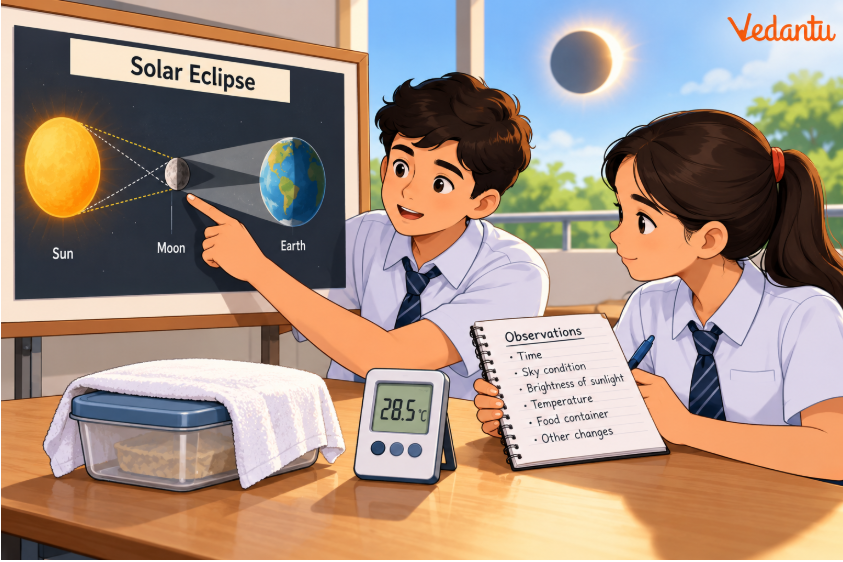
Answer:
The illustration represents the importance of investigating claims with evidence rather than accepting them because they are widely repeated.
1. Identify the Claim
Suppose someone claims that a solar eclipse automatically makes food harmful.
The students should clearly state what is being claimed.
2. Understand the Natural Event
A solar eclipse occurs when the Moon passes between Earth and the Sun, blocking sunlight from part of Earth's surface.
3. Ask Testable Questions
The students should investigate:
Does the eclipse change the food's chemical composition?
Is there evidence of a biological or chemical process that makes the food harmful?
Could storage conditions, temperature or contamination explain any observed changes?
4. Collect Relevant Evidence
They should consult reliable scientific explanations and, where appropriate, compare observations under controlled conditions.
5. Avoid Unrelated Explanations
A claim should not be accepted solely because it appears in a viral message or is repeated by many people.
6. Reach a Reasoned Conclusion
The chapter explains that there is no established physical, chemical or biological mechanism by which an eclipse itself makes food harmful.
Conclusion
The image illustrates a key principle of scientific thinking: ideas should be evaluated using observations, testable explanations and reliable evidence.
Q25. Why does the chapter describe science as a human activity involving curiosity, creativity, collaboration and correction? Explain with examples.
Answer:
The chapter explains that science is not simply a collection of facts and formulas. It is an ongoing process in which people investigate the natural world together.
1. Curiosity Encourages Questions
Scientific learning begins when people ask why something happens.
A student wondering why a football travels farther after a stronger kick has begun thinking scientifically.
2. Creativity Helps Build Models
Scientists often create simplified models to study complex systems.
For example, representing a moving car as a point may help when studying its position and motion.
3. Evidence Supports Explanations
Scientific ideas must be connected with observations, measurements and careful testing.
4. Collaboration Connects Different Skills
Understanding how a mask works may require physics, chemistry, biology and mathematics.
Scientists from different fields can contribute different explanations and methods.
5. Mistakes Can Improve Understanding
When a prediction fails, scientists review the evidence and check whether their assumptions were appropriate.
An unexpected result may lead to a more useful model.
6. Scientific Ideas Can Change
Scientific explanations remain open to improvement when new evidence is obtained.
This openness is a strength because it allows scientific knowledge to become more reliable.
7. Scientific Thinking Matters Beyond School
Students can use scientific reasoning to evaluate social-media claims, interpret measurements, understand technology and make informed decisions.
Conclusion
Science develops through questioning, creativity, evidence, teamwork and a willingness to learn from mistakes. The chapter encourages students to practise these habits throughout their lives.
Important Topics and Preparation Tips for Class 9 Science Chapter 1
Students preparing important questions for Class 9 Science Chapter 1 should focus on scientific models, measurements and evidence-based reasoning. Examples involving cricket, cycling, Meghnad Saha, weather predictions and solar eclipses help connect these concepts with real situations.
How to Prepare for Class 9 Science Chapter 1
Understand models: Identify relevant and irrelevant factors in cricket and cycling examples.
Practise measurements: Revise SI units and conversion errors.
Apply scientific reasoning: Evaluate eclipse claims and weather predictions.
Solve estimations: Practise rice consumption and breathing-volume calculations.
Download Class 9 Science Chapter 1 Important Questions PDF
The Class 9 Science Chapter 1 Important Questions PDF, once available, will support 2026–27 exam preparation with solved MCQs, short answers, long answers and application-based questions.
Additional Study Materials for Class 9 Science Chapter 1 – Exploration: Entering the World of Secondary Science
Chapter-wise Important Questions for Class 9 Science – Exploration
Other Important Related Links for CBSE Class 9 Science


FAQs on Important Questions and Answers for Class 9 Science Exploration Chapter 1 – Exploration: Entering the World of Secondary Science |2026–27
1. Why does Class 9 Science Chapter 1 begin with a cricket ball example?
The cricket example introduces scientific modelling. Students learn that predicting a ball's path requires relevant information such as its speed and direction, while details such as its colour are usually unnecessary. It demonstrates how scientists simplify real-world situations to study them.
2. Can two different scientific models of the same situation both be useful?
Yes. A simple model of a bicycle journey may use only distance and average speed, while a detailed model may also consider traffic, slopes and stopping time. Both can be useful depending on the accuracy required and the question being investigated.
3. Why did Meghnad Saha treat stars as hot gases instead of studying every particle separately?
Meghnad Saha simplified stellar matter to focus on temperature, pressure and ionisation. This helped explain how conditions inside stars relate to the light they emit. His work is an example of using a scientific model to understand a complicated natural system.
4. What does the aircraft fuel incident teach students about SI units?
The incident shows how confusion between kilograms and pounds can lead to serious calculation errors. Students should identify units, perform conversions carefully and check whether their final answers are reasonable.
5. Why is the speed of light represented by the letter 'c' in science?
The symbol 'c' is associated with the Latin word celeritas, meaning speed. In scientific equations, it commonly represents the speed of light in a vacuum, which is exactly 299,792,458 metres per second.
6. Why can a weather forecast be scientific even when it turns out to be incorrect?
Weather forecasts use observations, measurements and mathematical models. However, atmospheric conditions are complex, and small changes can affect future outcomes. A prediction can be scientifically justified without being guaranteed to be correct.
7. Does food really become harmful during a solar eclipse?
There is no established scientific evidence that a solar eclipse itself makes food harmful. Food safety depends on factors such as storage conditions, temperature and contamination. This example helps students distinguish unsupported claims from evidence-based explanations.
8. Which numerical and application-based questions are important for Class 9 Science Chapter 1?
The Class 9 Chapter 1 Science important questions include calculations involving speed, time, unit conversions and estimation. Students should practise examples such as bicycle travel time, daily breathing volume and rice consumption. They should also explain their assumptions and check whether their answers are reasonable.
9. How can students tell whether an estimate is reasonable without knowing the exact answer?
Students can compare their estimate with familiar quantities and everyday experience. For example, estimating a family's monthly rice requirement as only 100 grams would be unrealistic. Checking the approximate size of an answer helps identify calculation mistakes.
10. Why does the chapter use a surgical mask to explain connections between scientific subjects?
A surgical mask involves Physics through airflow and particle movement, Chemistry through material properties, Biology through microorganisms and Mathematics through measurements. This example shows why solving real-world problems often requires knowledge from several subjects.
11. Is Class 9 Science Chapter 1 in the Exploration textbook different from older Class 9 Science textbooks?
Yes. In the 2026–27 Exploration textbook shown here, Chapter 1 is titled Exploration: Entering the World of Secondary Science. It introduces scientific reasoning, models, evidence and measurements. Students using older editions should check their chapter titles before selecting study materials.
12. How should students practise important questions for Class 9 Science Chapter 1 before exams?
Students can begin with MCQs, followed by short and long answer questions. While practising important questions for Class 9 Science Chapter 1, they should focus on explaining scientific models, evaluating predictions, checking measurements and applying concepts to real situations. The solved answers can help identify mistakes and improve reasoning.