Watch Video





Class 9 Science Chapter 12 Important Questions and Answers – Patterns in Life: Diversity and Classification
Why does a mushroom belong to Fungi rather than Plantae? What makes the Western Ghats a biodiversity hotspot, and how can scientists identify millions of organisms using a shared classification system? Chapter 12, Patterns in Life: Diversity and Classification, explores the variety of living organisms and explains how their structures, nutrition, reproduction and evolutionary relationships help scientists classify them.
 Table of Content

These Class 9 Science Chapter 12 Important Questions include solved MCQs, comparisons, organism-identification problems, classification diagrams and application-based questions from the Exploration textbook for 2026–27. Students will revise the five kingdoms, plant groups, animal classification, taxonomic hierarchy, scientific naming, fossils and biodiversity conservation. Explore more resources through Class 9 Science Important Questions.
Important Questions and Answers for Class 9 Science Exploration Chapter 12 – Patterns in Life: Diversity and Classification |2026–27


 Share
The questions below move from identifying organisms to explaining how scientists classify them and why biodiversity matters. They include reasoning-based MCQs, short answers, comparative tables, classification activities and detailed answers.
Multiple Choice Questions on Biodiversity and Classification
Q1. A region contains many plant and animal species found nowhere else, but its forests have been severely reduced. Which term best describes such a region?
(a) Agricultural field
(b) Biodiversity hotspot
(c) Artificial ecosystem
(d) Single-species habitat
Answer: (b) Biodiversity hotspot.
Explanation: A biodiversity hotspot is a region with many endemic species that has experienced substantial habitat loss. Such regions are important conservation priorities because losing their habitats may threaten species that cannot naturally survive elsewhere.
Q2. A student classifies a bat as a bird because it flies. Why is this classification incorrect?
(a) Bats cannot move through air.
(b) All flying organisms belong to the same group.
(c) Flight alone is not a sufficient classification criterion; bats are mammals.
(d) Birds and mammals have identical reproductive characteristics.
Answer: (c) Flight alone is not a sufficient classification criterion; bats are mammals.
Explanation: Scientists consider several characteristics, including body covering, internal structures and reproduction. Bats have mammalian features such as hair and mammary glands. Their ability to fly does not make them birds.
Q3. A microscopic organism consists of one cell and has no membrane-bound nucleus. Under the five-kingdom system, where should it be placed?
(a) Protista
(b) Fungi
(c) Monera
(d) Animalia
Answer: (c) Monera.
Explanation: Monera includes prokaryotic organisms, such as bacteria and cyanobacteria, which lack a membrane-bound nucleus. Protists are eukaryotes and possess a true nucleus.
Q4. Two organisms are observed under a microscope. Organism A is unicellular with a true nucleus. Organism B is multicellular, has chitin-containing cell walls and absorbs nutrients from dead matter. Identify their most likely kingdoms.
(a) A – Monera; B – Plantae
(b) A – Protista; B – Fungi
(c) A – Animalia; B – Monera
(d) A – Fungi; B – Animalia
Answer: (b) A – Protista; B – Fungi.
Explanation: Organism A matches the general characteristics of Protista, which contains mostly unicellular eukaryotes. Organism B has features typical of fungi, including chitin-containing cell walls and absorptive nutrition.
Q5. Which feature distinguishes gymnosperms from angiosperms?
(a) Gymnosperms lack vascular tissues.
(b) Gymnosperms produce seeds not enclosed within fruits.
(c) Gymnosperms reproduce only through spores.
(d) Gymnosperms have no roots or leaves.
Answer: (b) Gymnosperms produce seeds not enclosed within fruits.
Explanation: Gymnosperms such as pines bear seeds that are not enclosed in fruits. Angiosperms are flowering plants whose seeds develop within fruits.
Q6. A newly studied animal has a segmented body, jointed legs and a hard outer covering. To which group is it most likely to belong?
(a) Annelida
(b) Arthropoda
(c) Mollusca
(d) Echinodermata
Answer: (b) Arthropoda.
Explanation: Jointed appendages and an exoskeleton are defining features of arthropods. This group includes insects, spiders and crabs. Some annelids are also segmented, but they do not possess jointed legs and a hard arthropod exoskeleton.
Very Short Answer Questions on Classification
Q7. What is an endemic species? Give one Indian example.
Answer: An endemic species occurs naturally in a particular geographical region and nowhere else in the wild. The Nilgiri tahr and lion-tailed macaque are examples associated with India's Western Ghats.
Q8. What is the function of rhizoids in bryophytes?
Answer: Rhizoids help anchor bryophytes to their growing surface and may assist with water absorption. They are not equivalent to the true roots of vascular plants.
Q9. What is a notochord?
Answer: A notochord is a flexible, rod-like supporting structure found in chordates at least during some stage of their development. In many vertebrates, the vertebral column develops around or replaces much of this supporting structure.
Q10. Write the scientific name of the tiger correctly.
Answer: Panthera tigris.
The genus name, Panthera, begins with a capital letter, while the species epithet, tigris, begins with a lowercase letter. Both words are italicised when printed.
Short Answer Questions on Five Kingdoms, Plant Groups and Animals
Q11. Scientists studying four hornbill species in Pakke Tiger Reserve notice that they use different parts of the forest. How can classification help scientists understand their habitats and conservation needs?
Answer:
Classification helps scientists identify and distinguish the hornbill species using their shared and differing characteristics.
In Pakke Tiger Reserve, hornbills depend on suitable trees for nesting and particular fruits for food.
By identifying each species correctly, scientists can:
Record where different hornbills occur.
Study their food and nesting requirements.
Identify which tree species are important to them.
Monitor changes in population and habitat.
Plan conservation measures for different species.
Conclusion: Classification is not only about naming birds. It helps researchers understand ecological relationships and identify habitats that require protection.
Q12. Why did scientists move from a two-kingdom system to a five-kingdom system of classification?
Answer:
The early two-kingdom system grouped organisms mainly into Plantae and Animalia.
However, it could not satisfactorily classify many microorganisms.
For example:
Bacteria do not have a membrane-bound nucleus.
An amoeba has a true nucleus but is unicellular.
Fungi do not prepare food through photosynthesis like green plants.
Many microorganisms have characteristics that differ from ordinary plants and animals.
As microscopy and biological knowledge improved, scientists recognised these differences.
The five-kingdom system proposed by R. H. Whittaker grouped organisms into:
Monera
Protista
Fungi
Plantae
Animalia
Conclusion: The five-kingdom system provided a more useful framework based on cell structure, body organisation and mode of nutrition.
Q13. A student says that all organisms with cell walls must be plants. Explain why this statement is incorrect.
Answer:
The presence of a cell wall does not automatically place an organism in Plantae.
Different kingdoms contain organisms with cell walls.
The mode of nutrition also matters.
Green plants usually prepare their own food through photosynthesis, while fungi absorb nutrients from their surroundings.
Conclusion: Classification requires several characteristics, not a single visible feature.
Q14. A moist rock has a green mat of moss, while a nearby plant has well-developed roots, stems, leaves and spores. How can these organisms be classified?
Answer:
The green mat of moss belongs to Bryophyta.
The plant with true roots, stems, leaves, and spores is likely to belong to Pteridophyta, such as a fern.
Explanation: Pteridophytes have specialised tissues called xylem and phloem for transporting water and food. Bryophytes lack these tissues and generally remain small.
Q15. How can lichens help scientists study environmental conditions?
Answer:
Lichens are associations involving a fungus and a photosynthetic partner, usually a green alga or cyanobacterium.
The photosynthetic partner prepares food, while the fungal partner provides structural support and helps retain moisture.
Some lichens are sensitive to air pollutants.
By observing the abundance and condition of suitable lichen species, scientists can gather information about environmental quality.
Important Point: Not every lichen responds to pollution in the same way. Accurate assessment requires identifying the species and considering local conditions.
Q16. A student places an earthworm and a beetle in the same group because both have segmented bodies. What additional features should be examined to classify them correctly?
Answer:
Body segmentation is a shared feature, but the two animals belong to different groups.
An earthworm has a soft segmented body, whereas a beetle has a hard external skeleton and jointed legs.
Conclusion: A combination of characteristics is more reliable than classifying organisms using only segmentation.
Q17. Why are spores, vascular tissues, seeds and fruits important when comparing major plant groups?
Answer:
These features show different ways in which plants reproduce and survive in different habitats.
Spores: Allow reproduction and dispersal without seeds, as seen in ferns and mosses.
Vascular tissues: Transport water and food, allowing larger and more differentiated plant bodies.
Seeds: Protect developing embryos and store nutrients.
Fruits: Protect seeds and may assist their dispersal through animals, wind or water.
The major plant groups illustrate different combinations of these features.
For example, ferns have vascular tissues but do not form seeds. Gymnosperms produce seeds without fruits, while angiosperms produce seeds enclosed within fruits.
Q18. An unknown pond organism is single-celled, has a visible nucleus and moves using cilia. How would you classify it, and what further observations would help?
Answer:
The organism is most likely a protist, such as Paramecium.
The observations supporting this identification are:
It is unicellular.
It has a membrane-bound nucleus.
It uses cilia for movement.
It lives in an aquatic environment.
To improve the identification, the student could examine its body shape, feeding structures, method of movement and other visible cell structures under a microscope.
Conclusion: The combination of cell organisation, nucleus and movement helps distinguish the organism from bacteria and other microscopic life forms.
Long Answer and Application-Based Questions on Diversity and Classification
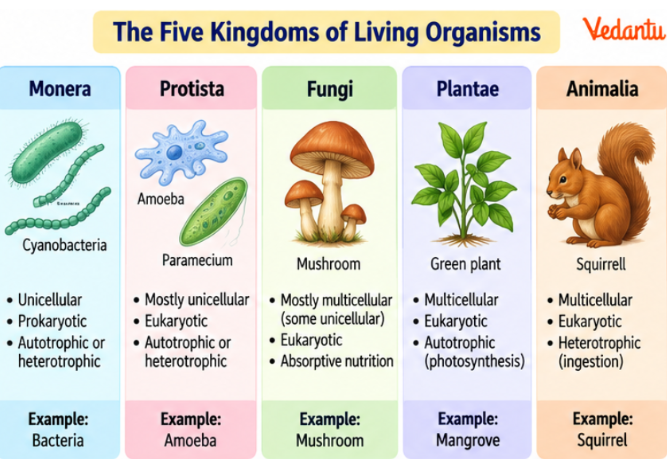
Q19. Explain Whittaker's five-kingdom classification using the main features and examples of each kingdom.
Answer:
The five-kingdom system groups organisms according to characteristics such as cell type, cellular organisation and mode of nutrition.
1. Monera
Monerans lack a membrane-bound nucleus.
They include bacteria and cyanobacteria.
Some bacteria help with nutrient cycling, nitrogen fixation and other useful processes.
2. Protista
Protists include mostly unicellular organisms with a true nucleus.
Some are autotrophic, while others depend on external sources of food.
3. Fungi
Fungi generally absorb nutrients from organic matter.
Many act as decomposers and help recycle nutrients.
4. Plantae
Plants are multicellular organisms that generally produce food through photosynthesis.
They support food chains and release oxygen.
5. Animalia
Animals obtain nutrients by consuming other organisms or organic matter.
They display a wide range of body structures and movement patterns.
Conclusion
The five-kingdom system helps organise biological diversity, but modern classification also uses genetic information and evolutionary relationships.
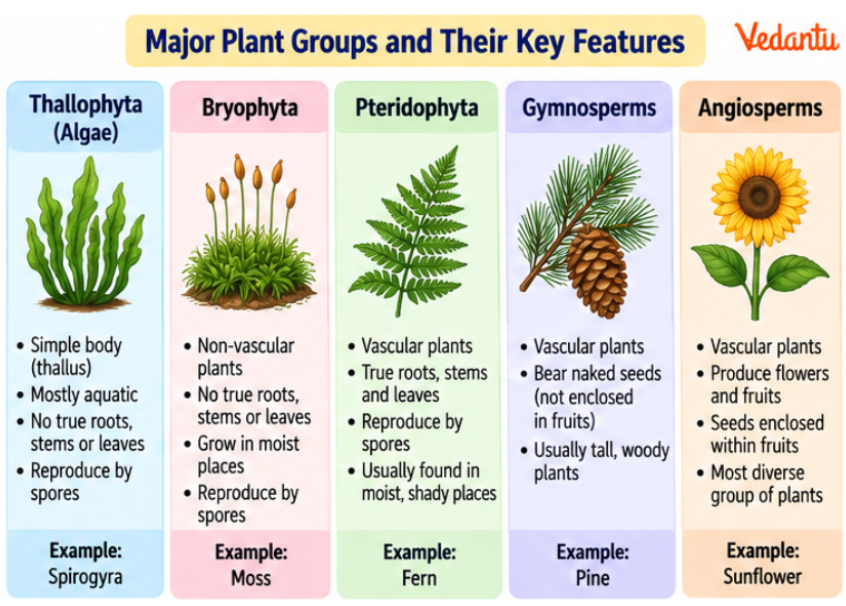
Q20. Compare the five major groups of plants and explain how their structural features help them survive.
Answer:
The five plant groups in the chapter demonstrate different structural and reproductive adaptations.
1. Thallophyta
These organisms have a simple body structure.
Their body is not differentiated into true roots, stems and leaves.
2. Bryophyta
Bryophytes can live on moist land but depend on water for sexual reproduction.
Their lack of vascular tissues limits the size and complexity of many members.
3. Pteridophyta
Ferns have vascular tissues that help transport water and food.
They also possess true roots, stems and leaves but reproduce through spores rather than seeds.
4. Gymnosperms
Gymnosperms produce seeds that are not enclosed in fruits.
Their reproductive structures allow fertilisation without requiring free-standing water for swimming male gametes.
5. Angiosperms
Angiosperms produce flowers and fruits.
Flowers support pollination, while fruits can protect and disperse seeds.
Conclusion
These groups show how different plant structures help solve the challenges of transport, reproduction and survival.
Q21. Compare important invertebrate groups using their body organisation, distinctive structures and examples.
Answer:
Invertebrates show wide differences in body structure, movement, feeding and protection.
Porifera
Sponges have pores that allow water to flow through their bodies, helping them obtain food and oxygen.
Cnidaria
Hydra and jellyfish possess specialised tissues and tentacles for capturing prey.
Platyhelminthes
Flatworms possess bilateral symmetry and a flattened body that facilitates diffusion.
Nematoda
Roundworms have cylindrical bodies and a complete digestive tract with a mouth and anus.
Annelida
Earthworms possess body segments that support controlled movement.
Arthropoda
Arthropods have jointed legs and a hard external skeleton.
Mollusca
Many molluscs have a muscular foot, a soft body and a protective shell.
Echinodermata
Starfish and sea urchins possess an internal skeleton made largely of calcium carbonate.
Conclusion
Comparing body organisation helps scientists identify animals and understand how different structural features support their survival.
Q22. Why is the notochord important in animal classification? Compare protochordates and vertebrates with examples.
Answer:
The notochord is a flexible supporting rod present in chordates during at least some stage of development.
Its presence is an important feature for identifying members of Chordata.
1. Protochordates
Protochordates possess a notochord at least during part of their life cycle but do not possess a vertebral column like vertebrates.
Example: Amphioxus.
2. Vertebrates
Vertebrates develop a vertebral column that supports the body and protects the spinal cord.
They also possess more specialised internal organs and sensory systems.
3. Major Vertebrate Groups
4. Why the Notochord Matters
The notochord provides internal support during development.
Its presence helps scientists distinguish chordates from non-chordates.
Conclusion
Animal classification considers evolutionary and structural features, not just where animals live or whether they can fly, swim or walk.
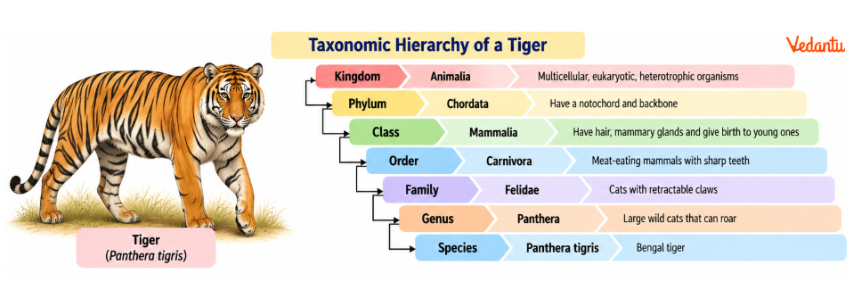
Q23. Explain the classification hierarchy using a tiger as an example. Why is scientific naming more reliable than common names?
Answer:
Biological classification follows a hierarchy from broad groups to increasingly specific groups.
Classification Hierarchy
Kingdom → Phylum → Class → Order → Family → Genus → Species
Classification of a Tiger
Understanding the Hierarchy
Kingdom is a broad category containing many different organisms.
Each lower category generally contains organisms sharing more specific characteristics.
Genus groups closely related species.
Species is one of the most specific common ranks in the system.
Scientific Naming
Carolus Linnaeus introduced the binomial system of scientific naming.
Each scientific name contains two parts:
Genus
Specific epithet
For example, the tiger is Panthera tigris.
Rules
The genus name begins with a capital letter.
The second word begins with a lowercase letter.
Both words are italicised when printed.
When handwritten, the two words are underlined separately.
Why Scientific Names Are Useful
A tiger has different common names in different languages.
Scientific names allow researchers to refer to the same species consistently around the world.
Conclusion
Classification provides an organised way to identify organisms, while binomial nomenclature reduces confusion caused by local names.
Q24. A forest region loses many old trees, and the number of hornbills begins to decline. Explain how biodiversity, classification and conservation are connected in this situation.
Answer:
This situation illustrates how the survival of organisms depends on their habitats and ecological relationships.
1. Importance of Old Trees
Many hornbills depend on large, old trees containing cavities for nesting.
These trees also form part of a forest ecosystem supporting the fruiting plants and animals they depend on.
2. Effect of Habitat Loss
When old trees disappear, suitable nesting places may become scarce.
The birds may be unable to reproduce successfully or may move to other areas.
3. Role of Classification
Scientists can identify different hornbill species and study their particular needs.
This allows them to recognise which species are most affected.
4. Role of Biodiversity Studies
Researchers examine the relationships among birds, trees, fruits and other organisms.
A decrease in one species can affect several other components of the ecosystem.
5. Conservation Measures
Useful conservation actions include:
Protecting mature trees and nesting habitats.
Preventing unnecessary forest destruction.
Restoring suitable native vegetation.
Monitoring populations of threatened species.
Involving local communities in habitat protection.
Conclusion
Biodiversity conservation depends on understanding which organisms are present, how they are classified and what they require to survive.
Important Concepts, Classification Diagrams and Preparation Tips for Class 9 Science Chapter 12
The Class 9 Chapter 12 Science important questions cover biodiversity, five kingdoms, plant and animal groups, scientific naming, evolutionary relationships and conservation. Focus on identifying organisms through their characteristics rather than memorising names alone.
Preparation Tips: Practise five-kingdom classification charts, plant-group comparisons, animal-identification questions and taxonomic hierarchy diagrams. Revise the characteristic features of organisms and explain how biodiversity conservation connects with farming and ecosystems.
The Class 9 Science Chapter 12 Important Questions PDF, once available, can support offline revision through solved questions, classification tables, diagrams and real-world examples from Patterns in Life: Diversity and Classification for 2026–27.
Additional Study Materials for Class 9 Science Chapter 12 – Patterns in Life: Diversity and Classification
CBSE Class 9 Science Chapter-wise Important Questions
Chapter-wise Important Questions for Class 9 Science help students revise concepts from the Exploration textbook for the 2026–27 academic session.
Other Important Related Links for CBSE Class 9 Science


FAQs on Important Questions and Answers for Class 9 Science Exploration Chapter 12 – Patterns in Life: Diversity and Classification |2026–27
1. Why does Class 9 Science Chapter 12 focus on classification instead of simply memorising animal and plant names?
Classification helps students understand similarities, differences and evolutionary relationships among organisms. By examining cell structure, nutrition, reproduction and body organisation, students learn why particular organisms belong to certain groups. This makes it easier to identify unfamiliar organisms rather than memorising separate lists of names.
2. How are biodiversity hotspots different from regions that simply contain many organisms?
Biodiversity hotspots are regions with a high number of endemic plant species that have experienced substantial habitat loss. A region may have many organisms without meeting the criteria for a global hotspot. The Western Ghats, Himalayas and Indo-Burma region are relevant examples discussed in the chapter.
3. Can a single animal belong to different groups depending on how it is classified?
Yes, an animal may belong to different informal groups based on its habitat, food habits or activity pattern. For example, a bat can be grouped with flying animals when studying movement but belongs to Mammalia in biological classification. Scientific classification uses inherited structural and evolutionary characteristics rather than only one behaviour.
4. Why are fungi placed in a separate kingdom even though they do not move like plants?
Fungi differ from plants in their mode of nutrition, cell-wall composition and other cellular characteristics. They absorb nutrients from organic material instead of preparing food through photosynthesis. Their cell walls generally contain chitin, while plant cell walls contain cellulose. These differences justify their separate placement.
5. What should students observe when identifying an unknown microorganism under a microscope?
Students should examine whether the organism is unicellular or multicellular, whether it has a visible nucleus, its shape, method of movement and other observable features. If possible, they may also investigate its mode of nutrition. These characteristics help distinguish bacteria, protists and microscopic fungi.
6. Why are bryophytes called the amphibians of the plant kingdom?
Bryophytes commonly grow on moist land but still depend on water for sexual reproduction. Their male reproductive cells generally need a film of water to reach female reproductive structures. This dependence on moisture explains their traditional description as amphibians of the plant kingdom.
7. What is the main difference between pteridophytes and gymnosperms?
Pteridophytes possess vascular tissues and true roots, stems and leaves but reproduce through spores rather than seeds. Gymnosperms produce seeds that are not enclosed within fruits. They also have reproductive adaptations that reduce dependence on external water during fertilisation.
8. Why do scientists use a notochord rather than simply body size to classify chordates?
The notochord is a specific developmental structure associated with chordates, making it more informative than body size. Animals of very different sizes may belong to the same broad evolutionary group. Classification therefore considers shared structural and developmental features rather than superficial similarities.
9. How can students remember the biological classification hierarchy in Chapter 12?
The correct sequence is Kingdom, Phylum, Class, Order, Family, Genus and Species. Students can practise drawing a classification pyramid and use examples such as a tiger or pea to connect each rank with a real organism. Understanding how groups become more specific at each level is more useful than memorising the order alone.
10. Why do scientific names such as Panthera tigris and Mangifera indica have two words?
The binomial naming system uses two words to identify an organism. The first identifies its genus, while the second is the specific epithet. Together, they form a scientific name that can be used consistently across different languages and countries.
11. Why do biological classification systems change when scientists discover new information?
Classification systems are scientific models based on available evidence. Better microscopes, cell studies and DNA analysis reveal differences or relationships that earlier scientists could not observe. These discoveries may require groups to be revised so the system more accurately reflects evolutionary relationships.
12. What can fossils tell us that studying living organisms alone cannot?
Fossils provide evidence of organisms that existed in the past, including species that are now extinct. They help scientists investigate changes in body structures, ancient environments and the history of life across geological time. Studying fossils alongside living organisms gives a more complete picture of biological diversity.
13. Where can students practise Chapter 12 Class 9 Science important questions with diagrams and answers?
Students can use this Vedantu page to practise conceptual questions, five-kingdom comparisons, plant and animal classification, scientific naming, fossils and biodiversity conservation. The solved important questions of Chapter 12 Class 9 Science also help students prepare for identification and diagram-based questions.