Watch Video





Class 9 Science Chapter 5 Important Questions and Answers PDF
Sugar dissolves completely in water, mud settles at the bottom of a container, and milk remains mixed even after standing for some time. These examples show that mixtures have different properties and need different methods of separation. In Chapter 5, Exploring Mixtures and their Separation, students learn how mixtures behave and how substances can be separated using differences in solubility, particle size, density and boiling point.
 Table of Content

Vedantu's Class 9 Science Chapter 5 important questions cover solutions, suspensions, colloids, concentration, crystallisation, distillation, chromatography, centrifugation and the Tyndall effect. Students looking for important questions Class 9 Science Chapter 5 can practise solved MCQs, numericals, experiment-based questions and real-life applications for the 2026–27 exams. Explore more chapter-wise practice through Class 9 Science Important Questions.
Important Questions and Answers for Class 9 Science Exploration Chapter 5 – Exploring Mixtures and their Separation | 2026–27


 ShareShare
These important questions for Class 9 Science Chapter 5 help students compare mixtures, calculate concentrations, interpret solubility data and choose suitable separation techniques. The questions also cover experiments involving crystals, chromatography, a separating funnel, blood separation and water purification.
Multiple Choice and Assertion–Reason Questions on Mixtures
Q1. Three beakers contain salt solution, chalk powder mixed with water, and diluted milk. Which mixture is expected to leave a visible solid residue during ordinary filtration?
(a) Salt solution only
(b) Chalk powder and water
(c) Diluted milk only
(d) All three mixtures
Answer: (b) Chalk powder and water.
Explanation: Chalk powder forms a suspension containing comparatively large, insoluble particles. These can be trapped by ordinary filter paper. Dissolved salt passes through the filter, while the fine dispersed particles in diluted milk are not removed by ordinary filtration.
Q2. Which statement correctly describes a saturated solution?
(a) It always contains equal masses of solute and solvent.
(b) It cannot dissolve any additional solute at the given temperature under the same conditions.
(c) It contains only undissolved particles.
(d) It always becomes colourless after filtration.
Answer: (b) It cannot dissolve any additional solute at the given temperature under the same conditions.
Explanation: A saturated solution contains the maximum amount of a particular solute that can dissolve in the given amount of solvent at a specified temperature.
Q3. A bottle contains 15 g of sugar dissolved in 135 g of water. What is the mass-by-mass percentage concentration?
(a) 10%
(b) 11.1%
(c) 15%
(d) 90%
Answer: (a) 10%.
Solution:
Mass of solution = 15 + 135 = 150 g
Mass-by-mass percentage = (Mass of solute ÷ Mass of solution) × 100
= (15 ÷ 150) × 100
= 10%
Q4. A laboratory needs to separate acetone and water and collect the liquid with the lower boiling point. Which method is most suitable?
(a) Sedimentation
(b) Sublimation
(c) Simple distillation
(d) Magnetic separation
Answer: (c) Simple distillation.
Explanation: Acetone and water are miscible, but acetone has a much lower boiling point. Controlled heating and condensation allow the more volatile component to be collected as a distillate.
Q5. Assertion–Reason
Assertion (A): Milk can scatter a beam of light without its dispersed particles settling quickly.
Reason (R): Milk is a colloid containing fine particles that scatter light and remain dispersed under normal conditions.
(a) Both A and R are true, and R correctly explains A.
(b) Both A and R are true, but R does not explain A.
(c) A is true, but R is false.
(d) A is false, but R is true.
Answer: (a) Both A and R are true, and R correctly explains A.
Explanation: Milk is an emulsion, which is a type of colloid. Its dispersed droplets scatter light but do not settle as readily as the larger particles in a suspension.
Q6. Which pair can be separated using sublimation?
(a) Camphor and sand
(b) Mustard oil and water
(c) Salt and dissolved sugar
(d) Acetone and water
Answer: (a) Camphor and sand.
Explanation: Camphor can change directly from solid to vapour when heated under suitable conditions, while sand remains behind. Cooling the camphor vapour gives solid camphor through deposition.
Very Short Answer Questions on Mixtures and Their Properties
Q7. What is the difference between a homogeneous and a heterogeneous mixture?
Answer: A homogeneous mixture has a uniform composition throughout, such as a well-mixed sugar solution. A heterogeneous mixture does not have a uniform composition, such as sand mixed with water.
Q8. What are solute and solvent? Give one example.
Answer: A solute is a substance that dissolves in a solvent. In a salt solution, salt is the solute and water is the solvent. The resulting homogeneous mixture is called a solution.
Q9. Why can an alloy such as brass be considered a homogeneous mixture?
Answer: Brass contains copper and zinc distributed throughout the solid material. It appears uniform and does not have the fixed composition of a pure chemical compound. Its components cannot be separated using ordinary physical separation methods.
Q10. What is the difference between sublimation and deposition?
Answer: Sublimation is the direct change of a solid into vapour without passing through the liquid state. Deposition is the reverse change, in which vapour turns directly into a solid. Camphor is a familiar example.
Q11. What is meant by dispersed phase and dispersion medium in a colloid?
Answer: The dispersed phase consists of the small particles or droplets distributed through a colloid. The dispersion medium is the substance in which those particles are dispersed. In milk, fat droplets form part of the dispersed phase, while the surrounding water-based liquid acts as the dispersion medium.
Numerical and Data-Based Questions on Concentration and Solubility
Q12. A laboratory prepares 250 mL of a glucose solution containing 10 g of glucose. Calculate its mass-by-volume percentage concentration.
Solution:
Given:
Mass of glucose = 10 g
Volume of solution = 250 mL
Mass-by-volume percentage = (Mass of solute ÷ Volume of solution) × 100
= (10 ÷ 250) × 100
= 4% m/v
Answer: The solution contains 4 g of glucose per 100 mL of solution.
Q13. A student mixes 30 mL of a fruit-juice concentrate with sufficient water to prepare 200 mL of juice. Calculate the volume-by-volume percentage of the concentrate.
Solution:
Volume of concentrate = 30 mL
Final volume of juice = 200 mL
Volume-by-volume percentage = (Volume of solute ÷ Volume of solution) × 100
= (30 ÷ 200) × 100
= 15% v/v
Answer: The concentrate forms 15% v/v of the prepared juice.
Important Point: Use the final volume of the mixture, not just the amount of water added.
Q14. Three students prepare sugar solutions using different quantities of sugar and water. Identify the most concentrated solution.
Solution:
Mass-by-mass percentage = (Mass of sugar ÷ Total mass of solution) × 100
Student A = (15 ÷ 100) × 100 = 15%
Student B = (20 ÷ 100) × 100 = 20%
Student C = (25 ÷ 100) × 100 = 25%
Answer: Student C prepares the most concentrated solution, at 25% m/m.
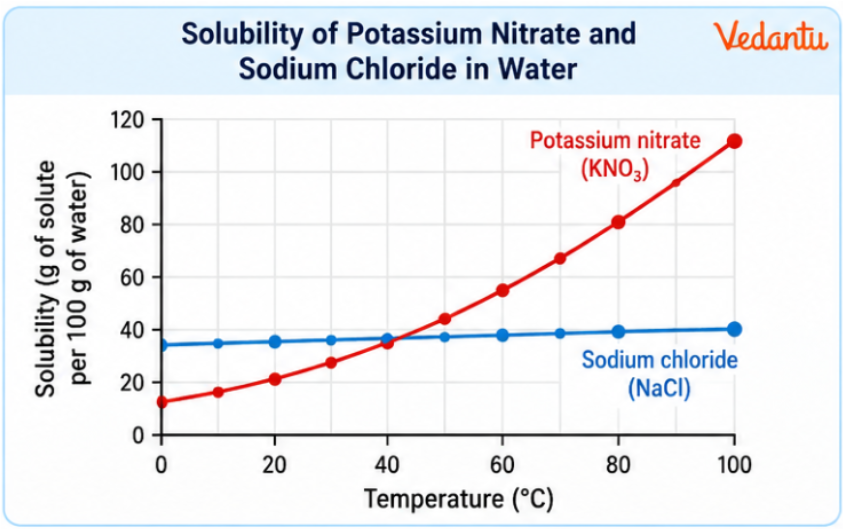
Q15. Study the solubility data for potassium nitrate and sodium chloride. Which substance shows a greater increase in solubility with temperature?
Solubility is expressed in grams per 100 g of water.
Solution:
Change in potassium nitrate solubility from 10°C to 80°C:
= 167 − 21 = 146 g
Change in sodium chloride solubility:
= 37 − 36 = 1 g
Answer: Potassium nitrate shows a much greater increase in solubility over this temperature range.
Graph Interpretation: The potassium nitrate curve rises steeply with temperature, while the sodium chloride curve remains almost horizontal.
Q16. A saturated potassium nitrate solution contains 106 g of solute in 100 g of water at 60°C. It is cooled to 40°C, where its solubility is 62 g per 100 g of water. How much potassium nitrate can crystallise?
Solution:
Solubility at 60°C = 106 g
Solubility at 40°C = 62 g
Mass that can crystallise = 106 − 62
= 44 g
Answer: Up to 44 g of potassium nitrate can crystallise when the solution reaches equilibrium, assuming no water is lost.
Q17. A 500 g packet of a powdered product contains 3% zinc oxide by mass. Calculate the mass of zinc oxide present.
Solution:
Mass of product = 500 g
Zinc oxide concentration = 3% m/m
Mass of zinc oxide = (3 ÷ 100) × 500
= 15 g
Answer: The packet contains 15 g of zinc oxide.
Explanation: A mass percentage expresses the mass of a component present in every 100 g of the total mixture.
Q18. A brass alloy contains 70% copper and 30% zinc by mass. Find the mass of each metal in 250 g of brass.
Solution:
Total mass = 250 g
Copper = (70 ÷ 100) × 250 = 175 g
Zinc = (30 ÷ 100) × 250 = 75 g
Check: 175 + 75 = 250 g
Answer: The alloy contains 175 g of copper and 75 g of zinc.
Experiment-Based Questions on Separation Methods
Q19. Two hot saturated copper sulfate solutions are cooled differently. One is cooled slowly, and the other is cooled rapidly. Predict the differences in the crystals formed.
Answer:
Both solutions may form copper sulfate crystals as their solubility decreases on cooling.
During slow cooling, fewer crystal nuclei may form, allowing more material to collect on growing crystals. This often produces larger and better-shaped crystals.
During rapid cooling, more nuclei may form in a short time, often producing smaller crystals.
Conclusion: Cooling conditions can influence crystal size and appearance.
Safety: Copper sulfate is toxic. Any laboratory demonstration must be carried out under teacher supervision.
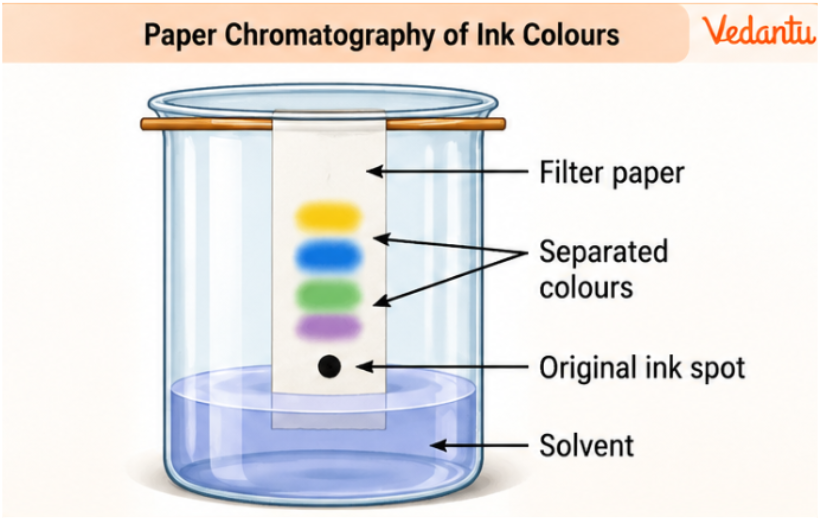
Q20. A black sketch-pen spot produces several coloured bands when water rises through chromatography paper. Explain why the colours separate and state two precautions.
Answer:
The technique is called paper chromatography.
A small spot of ink is placed on chromatography paper above the solvent level.
The solvent rises through the paper and carries the colouring substances with it.
Different components interact differently with the solvent and paper, so they move at different rates.
This produces coloured spots at different heights.
Precautions:
Keep the original ink spot above the solvent level.
Use a pencil to draw the starting line because pencil marks do not normally dissolve in the solvent used.
Conclusion: Paper chromatography can show that an ink appearing to be one colour may contain several different dyes.
Q21. A mixture of camphor and sand is heated gently under an inverted funnel. White deposits form on the inner surface of the funnel. Explain the observation.
Answer:
The mixture is separated by sublimation and deposition.
Camphor changes directly from solid to vapour during heating.
The vapour reaches the cooler inner surface of the glass funnel.
It changes directly into solid camphor through deposition.
Sand remains in the china dish because it does not sublime under these conditions.
Conclusion: Sublimation is suitable when one solid sublimes and the other does not.
Safety: This is a supervised laboratory demonstration, not a home experiment.
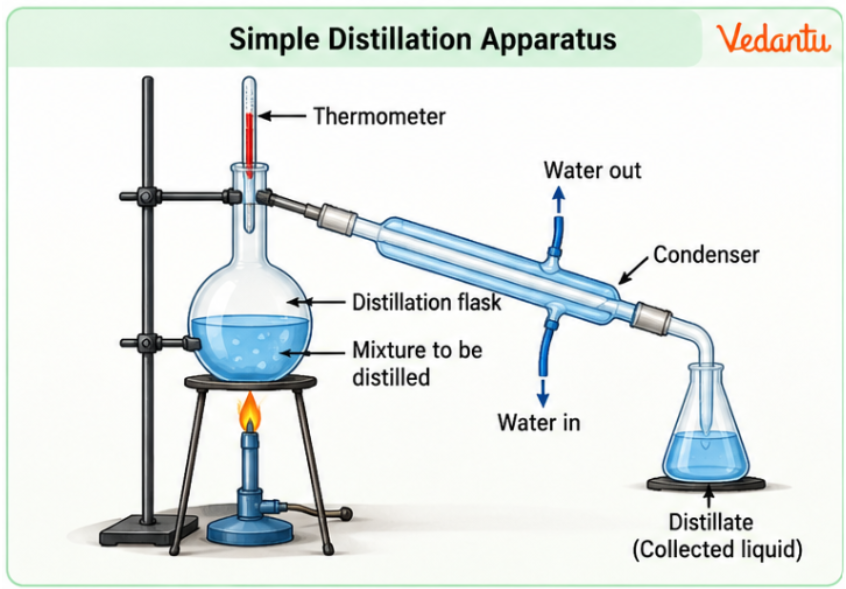
Q22. Explain how acetone and water can be separated by simple distillation. Mention the role of the condenser.
Answer:
Acetone and water mix completely, but their boiling points differ substantially.
Acetone boils at approximately 56°C, while water boils at around 100°C.
Steps:
Place the acetone–water mixture in a distillation flask.
Heat the mixture under controlled laboratory conditions.
The vapour becomes richer in acetone because acetone has the lower boiling point.
Pass the vapour through a condenser.
Cooling turns the vapour into liquid, which is collected in a receiving flask.
Role of the Condenser: It cools the vapour so that it changes back into a liquid called the distillate.
Important Point: Simple distillation works best when the components have sufficiently different boiling points.
Safety: Acetone is flammable. The procedure requires suitable laboratory equipment and trained supervision.
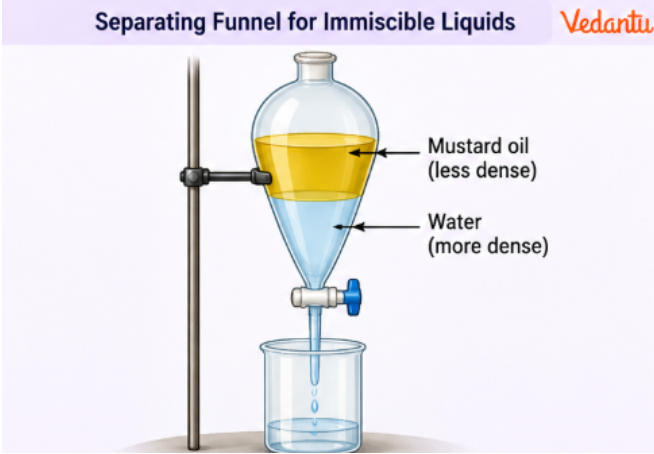
Q23. A separating funnel contains mustard oil and water. Identify the upper and lower layers and explain how the liquids can be collected separately.
Answer:
Mustard oil and water are immiscible liquids.
Mustard oil is less dense than water, so it forms the upper layer.
Water forms the lower layer.
Separation Steps:
Allow the mixture to stand until the layers are clearly visible.
Open the stopcock to drain the lower water layer into a container.
Close it before significant oil enters the collected water.
Collect the upper oil layer separately.
Conclusion: A separating funnel uses differences in density to separate immiscible liquids.
Q24. A container of muddy water still looks cloudy after being passed through filter paper. Explain how coagulation can improve the separation.
Answer:
Muddy water may contain very fine suspended particles that pass through ordinary filter paper or settle very slowly.
Adding a suitable coagulant, such as alum, helps the fine particles join together.
These larger clumps can settle more easily through sedimentation.
The clearer water can then be separated by decantation and further filtration.
Important Point: Coagulation helps remove suspended particles but does not, by itself, make water safe to drink. Further treatment may be needed.
Q25. Explain how centrifugation separates different components of a blood sample. How is a paperfuge useful?
Answer:
Centrifugation separates components of a mixture through rapid spinning.
In a blood sample, components separate according to their sedimentation behaviour during spinning.
After centrifugation, a typical anticoagulated blood sample forms three regions:
A paper centrifuge is a small hand-powered centrifuge that can spin samples without electricity.
It uses a cardboard disc and strings to produce rapid rotation.
The device can support low-cost sample preparation in places with limited laboratory facilities.
Conclusion: Centrifugation is useful in laboratories and medical testing because it separates components that would otherwise remain mixed.
Long Answer and Application-Based Questions on Mixtures
Q26. Compare solutions, suspensions and colloids based on particle size, settling, filtration and scattering of light.
Answer:
Explanation:
Solutions contain very small, evenly distributed particles.
Suspensions contain larger particles that may settle under gravity.
Colloids contain intermediate-sized particles that remain dispersed and scatter light.
Conclusion: Particle size and behaviour help identify the type of mixture and select a suitable separation technique.
Q27. A student is given a dry mixture of common salt, sand and camphor. Explain the correct sequence of methods needed to separate all three components.
Answer:
The components have different physical properties.
Camphor sublimes on heating.
Salt dissolves in water.
Sand does not dissolve in water.
Step 1: Separate Camphor
Use a suitable sublimation apparatus under teacher supervision.
Camphor changes to vapour and deposits as a solid on a cooler surface.
Sand and salt remain behind.
Step 2: Separate Sand
Add water to the remaining salt-and-sand mixture.
Stir until the salt dissolves.
Filter the mixture.
Sand remains as residue on the filter paper.
Step 3: Recover Salt
Evaporate water from the salt solution to recover the dissolved salt.
Final Sequence:
Sublimation → Dissolving in water → Filtration → Evaporation
Conclusion: More than one separation method may be required when the components of a mixture have different properties.
Q28. Explain how different separation methods are used in everyday life, industry and environmental protection.
Answer:
Different techniques are selected according to the properties of the substances being separated.
Environmental Application:
Wastewater treatment can use sedimentation, coagulation and filtration to remove suspended materials.
Waste segregation also helps recover recyclable paper, glass, plastic and metals.
Conclusion: Separation methods are important in homes, laboratories, industries, healthcare and environmental protection.
Q29. A student notices that sunlight forms a visible beam in a dusty classroom, while a beam of light is not clearly visible inside a salt solution. Explain the difference using the Tyndall effect.
Answer:
The Tyndall effect is the scattering of light by sufficiently large particles dispersed in a medium.
Dusty Classroom:
Air contains fine dust particles.
When sunlight enters the room, the particles scatter the light.
This makes the path of the beam visible from the side.
Salt Solution:
Salt dissolves into extremely small particles distributed uniformly in water.
These particles do not scatter enough visible light to show a distinct beam path under ordinary classroom conditions.
Comparison:
Conclusion: Light scattering helps distinguish certain colloids and suspensions from true solutions.
Important Concepts, Formulas and Preparation Tips for Class 9 Science Chapter 5
The Science Chapter 5 important questions Class 9 students practise should cover the classification of mixtures, concentration calculations, solubility and techniques used to separate different substances. Understanding the physical property behind each separation method helps students answer both theory and application-based questions confidently.
Important Concepts in Exploring Mixtures and their Separation
Important Formulas for Class 9 Science Chapter 5
Important Note: A percentage concentration must always be identified by its type, such as % m/m, % m/v or % v/v, because these quantities measure different things.
How to Prepare Class 9 Science Chapter 5 Important Questions
Understand the differences between solutions, suspensions and colloids using familiar examples.
Practise calculating percentage concentrations with the correct units and total solution quantities.
Learn to interpret solubility curves and calculate the mass of crystals formed during cooling.
Revise labelled apparatus diagrams for distillation, chromatography, sublimation and separating funnels.
Practise choosing separation methods based on boiling point, solubility, particle size and density.
Study real-life applications such as water treatment, blood separation, salt production and perfume making.
The Class 9 Science Chapter 5 Important Questions PDF, once available, can help students revise the solved questions, numerical calculations, diagrams and experimental observations offline.
Additional Study Materials for Class 9 Science Chapter 5 – Exploring Mixtures and their Separation
Students can use the following chapter-specific resources alongside these solved questions to revise concepts and practise problems involving concentration and separation methods.
CBSE Class 9 Science Chapter-wise Important Questions
Practising important questions from other chapters helps students revise the different concepts covered in the Class 9 Exploration Science textbook.
Other Important Related Links for CBSE Class 9 Science
Students can explore additional Class 9 Science resources, including revision notes, textbook solutions and sample papers, for regular study and examination preparation.


FAQs on Important Questions and Answers for Class 9 Science Exploration Chapter 5 – Exploring Mixtures and their Separation | 2026–27
1. What are the most important topics in Class 9 Science Chapter 5?
The important topics include homogeneous and heterogeneous mixtures, solutions, concentration, solubility, crystallisation, distillation, chromatography, sublimation, colloids and the Tyndall effect. Students should also understand centrifugation, coagulation and separating funnels through practical examples.
2. Which numerical problems are included in important questions for Class 9 Science Chapter 5?
Students should practise mass-by-mass, mass-by-volume and volume-by-volume percentage calculations. Solubility-based questions involving changes in temperature and the mass of crystals formed are also useful for understanding the chapter.
3. What is the difference between a solution, suspension and colloid?
A solution is a homogeneous mixture with very small dissolved particles. A suspension contains larger particles that may settle on standing. A colloid has dispersed particles that normally remain mixed and can scatter light. These differences help determine suitable separation techniques.
4. Why does muddy water settle on standing, while milk normally does not?
Muddy water contains larger suspended particles that can settle under gravity. Milk is a colloid with much smaller dispersed droplets that remain mixed under normal conditions. Therefore, milk does not settle in the same way as an ordinary mud suspension.
5. How is crystallisation different from evaporation?
Evaporation removes a liquid solvent and can leave a dissolved solid behind. Crystallisation involves the formation of solid crystals, often by cooling a saturated solution. It is particularly useful for obtaining or purifying certain crystalline substances.
6. When should distillation be used instead of evaporation?
Distillation is useful when the solvent must also be collected or when suitably different boiling points allow liquids to be separated. Evaporation may be sufficient when only the dissolved solid needs to be recovered and collecting the solvent is unnecessary.
7. Why must the ink spot remain above the solvent level during paper chromatography?
If the ink spot is submerged, it may dissolve directly into the solvent at the bottom of the container. Keeping the spot above the solvent allows the rising liquid to carry its components along the paper and separate them into different bands.
8. How does temperature affect the solubility of substances?
The solubility of many solid substances in water increases with temperature, although the amount of change varies. For gases dissolved in liquids, solubility generally decreases as temperature rises. Students can compare solubility curves to identify these trends.
9. Why is a separating funnel used for oil and water but not for sugar and water?
Oil and water are immiscible and form separate layers because of their different densities. Sugar dissolves in water to form a homogeneous solution, so it cannot be removed using a separating funnel.
10. How can camphor be separated from sand without dissolving either substance?
Camphor can be separated by sublimation. Under controlled heating, camphor changes into vapour while sand remains behind. The vapour can be cooled to form solid camphor again.
11. What is the role of alum in purifying muddy water?
Alum acts as a coagulant and helps fine suspended particles join into larger clumps. These clumps settle more easily and can then be removed by sedimentation, decantation or filtration. Additional treatment may still be needed to make the water safe for drinking.
12. Why is the paperfuge an important application of separation techniques?
A paperfuge is a low-cost, hand-powered device based on centrifugation. It can help separate components of small blood samples without electricity. This makes it useful for sample preparation in settings where conventional laboratory equipment may be difficult to access.
13. How can students prepare the important questions of Science Class 9 Chapter 5 effectively?
Students should revise the properties of each mixture, practise percentage calculations and understand why different separation methods work. Drawing apparatus diagrams, comparing particle sizes and interpreting solubility graphs can also improve their answers.
14. Where can students find important questions of Science Class 9 Chapter 5 with answers PDF?
Students can practise solved MCQs, concentration numericals, experiment-based questions and separation-method comparisons on this Vedantu page. The Class 9 Chapter 5 important questions Science material covers the main concepts from Exploring Mixtures and their Separation. A downloadable PDF can support offline revision once it is published.