Watch Video





Important Questions for Class 9 Science Chapter 7 – Work, Energy, and Simple Machines
Preparing for Class 9 Science Chapter 7 important questions? This chapter explains how work, energy and simple machines help us perform everyday tasks. Students often find energy calculations, mechanical advantage and the working of pulleys confusing.
 Table of Content

These important questions for Class 9 Science Chapter 7 cover positive and negative work, kinetic and potential energy, the work–energy theorem, conservation of energy, power, inclined planes and levers. Practising solved numericals and application-based questions helps students understand these concepts and avoid common mistakes.
Vedantu provides chapter-wise MCQs, short-answer questions and detailed solutions based on the Exploration textbook. Students can also explore Class 9 Science Important Questions to revise other chapters and strengthen their exam preparation.
Important Questions and Answers for Class 9 Science Exploration Chapter 7 – Work, Energy, and Simple Machines | 2026–27


 ShareShare
The following questions cover the main concepts and practical applications of Work, Energy, and Simple Machines from the Exploration textbook.
Class 9 Science Chapter 7 MCQs
Q1. A student carries a heavy box horizontally across a room at a constant height. What is the work done by the upward supporting force on the box?
(a) Positive
(b) Negative
(c) Zero
(d) Equal to the weight of the box
Answer: (c) Zero
Explanation:
The supporting force acts vertically upwards, while the displacement is horizontal.
Since the force and displacement are perpendicular, the work done by this force is zero.
Remember: A person may use muscular energy while carrying a box, but the upward supporting force does no mechanical work on the box during horizontal movement.
Q2. A moving car doubles its speed without changing its mass. What happens to its kinetic energy?
(a) It doubles.
(b) It becomes four times.
(c) It becomes half.
(d) It remains unchanged.
Answer: (b) It becomes four times.
Explanation:
Kinetic energy is given by:
$K=\frac{1}{2}mv^2$
When speed doubles:
$K'=\frac{1}{2}m(2v)^2$
$K'=4K$
Therefore, doubling the speed increases kinetic energy four times.
Q3. Assertion–Reason Question
Assertion (A): A fixed pulley can make lifting a bucket more convenient without reducing the ideal effort force.
Reason (R): A fixed pulley changes the direction of the applied force.
Choose the correct answer.
(a) Both A and R are true, and R correctly explains A.
(b) Both A and R are true, but R does not explain A.
(c) A is true, but R is false.
(d) A is false, but R is true.
Answer: (a) Both A and R are true, and R correctly explains A.
Explanation:
A fixed pulley allows a person to pull downwards to raise a load upwards.
Its ideal mechanical advantage is 1, so it changes the direction of effort rather than multiplying the force.
Class 9 Science Chapter 7 Very Short Answer Questions
Q4. What is meant by positive, negative and zero work? Give one example of each.
Answer:
Work depends on the direction of force relative to displacement.
Work done by a constant force acting along the displacement is:
$W=Fs$
The SI unit of work is the joule (J).
Q5. State the work–energy theorem. How is it useful?
Answer:
The work–energy theorem relates work done on an object to the change in its energy.
For the net work done on an object:
$W_{\text{net}}=\Delta K$
This means:
$W_{\text{net}}=K_f-K_i$
Where:
$K_f$ = Final kinetic energy
$K_i$ = Initial kinetic energy
Example: When a moving ball is stopped by a goalkeeper, the net negative work done on the ball reduces its kinetic energy to zero.
The theorem helps solve motion problems using energy changes.
Q6. Why can a compressed spring or stretched rubber band do work even when it is not moving?
Answer:
A compressed spring or stretched rubber band stores elastic potential energy because its shape has changed.
When released, the stored energy can be transferred to another object and make it move.
For example, a stretched rubber band can launch a small paper ball when released.
Thus, energy can be stored because of deformation, even when an object is stationary.
Class 9 Science Chapter 7 Short Answer Questions
Q7. A force of 25 N moves a box 6 m in its direction. Calculate the work done. What happens if the displacement doubles?
Solution:
Given:
Force = 25 N
Displacement = 6 m
Using:
$W=Fs$
$W=25\times6=150,\text{J}$
If displacement doubles:
New displacement = 12 m
$W'=25\times12=300,\text{J}$
Answer:
Original work done = 150 J
Work done after doubling displacement = 300 J
Conclusion: When force remains constant, work done increases in direct proportion to displacement along the force.
Q8. A force–displacement graph shows a constant force of 12 N acting over a displacement of 5 m. Calculate the work done using the graph.
Solution:
Work done equals the area under a force–displacement graph.
For a constant force, the graph forms a rectangle.
Area = Height × Width
$W=12\times5$
$W=60,\text{J}$
Answer: The work done is 60 J.
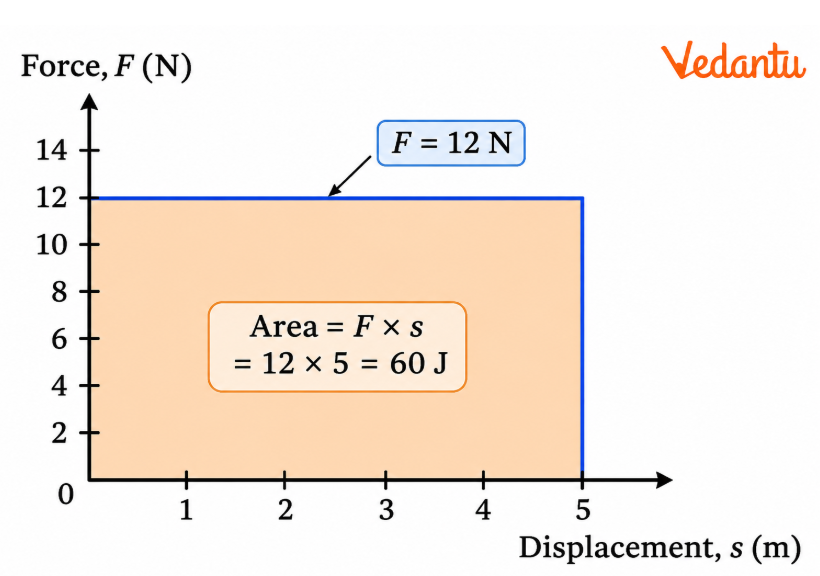
Important Point: The area under a force–displacement graph gives work done, including when the force changes with displacement.
Q9. A ball of mass 0.5 kg moves at 8 m/s. Calculate its kinetic energy. If its speed becomes 12 m/s, find the increase in kinetic energy.
Solution:
Given:
Mass = 0.5 kg
Initial speed = 8 m/s
Final speed = 12 m/s
Step 1: Initial kinetic energy
$K_i=\frac{1}{2}mv_i^2$
$K_i=\frac{1}{2}\times0.5\times8^2$
$K_i=16,\text{J}$
Step 2: Final kinetic energy
$K_f=\frac{1}{2}\times0.5\times12^2$
$K_f=36,\text{J}$
Step 3: Increase in kinetic energy
$\Delta K=36-16=20,\text{J}$
Answer: The kinetic energy increases by 20 J.
Q10. A 3 kg object is lifted vertically to a height of 5 m. Calculate its gravitational potential energy. Take g = 10 m/s².
Solution:
Given:
Mass = 3 kg
Height = 5 m
g = 10 m/s²
Using:
$U=mgh$
$U=3\times10\times5$
$U=150,\text{J}$
Answer: The object gains 150 J of gravitational potential energy relative to its starting position.
Concept: Increasing an object's height increases its gravitational potential energy near Earth's surface.
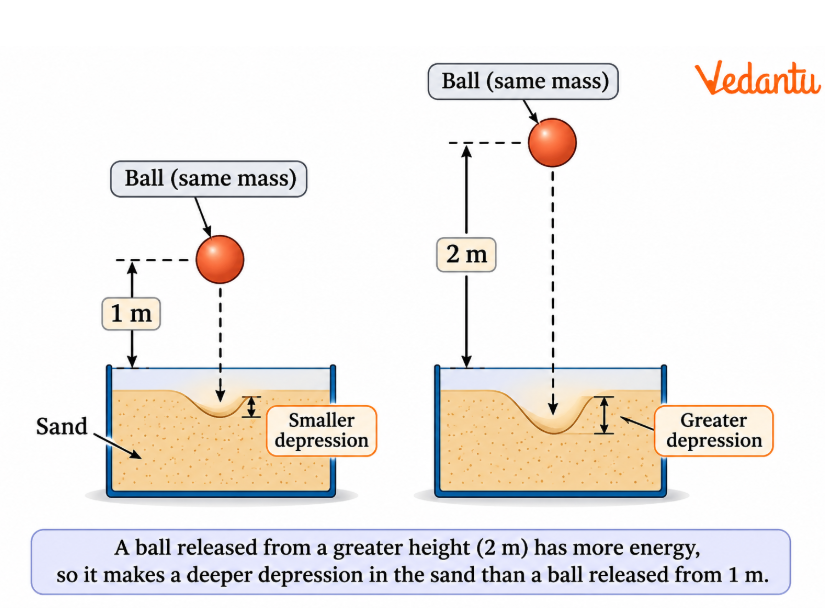
Q11. A student drops identical metal balls into loose sand from heights of 1 m and 2 m. Which ball is expected to create a deeper depression? Explain.
Answer:
The ball dropped from 2 m is expected to create a deeper depression.
Explanation:
The ball released from a greater height initially has more gravitational potential energy.
As it falls, potential energy changes into kinetic energy.
The ball dropped from 2 m reaches the sand with greater kinetic energy, assuming similar conditions.
It can therefore transfer more energy to the sand and produce a deeper depression.
This experiment shows how gravitational potential energy depends on height.
Long Answer and Application-Based Questions
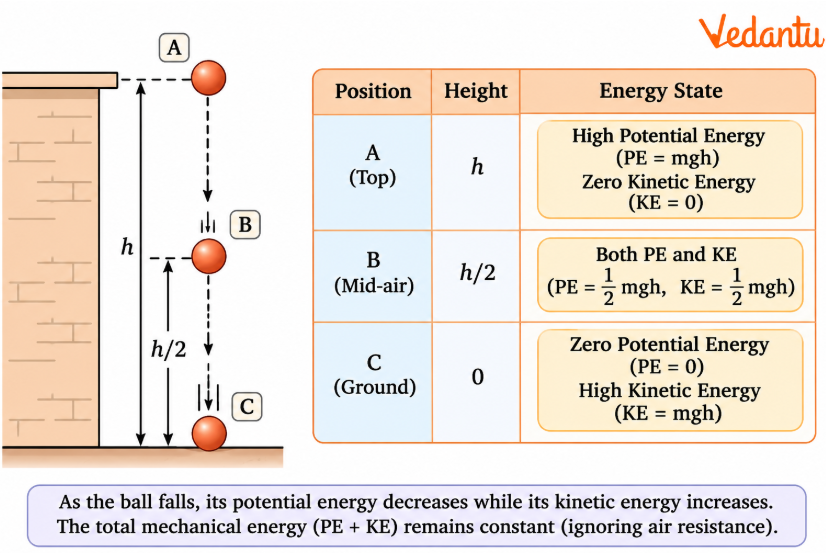
Q12. Explain the conservation of mechanical energy using a freely falling object.
Answer:
The law of conservation of mechanical energy states that the sum of kinetic and potential energy remains constant when only conservative forces, such as gravity, do work.
Consider a ball of mass m dropped from height h.
At the highest point:
The ball starts from rest.
$K=0$
$U=mgh$
Total mechanical energy:
$E=mgh$
During the fall:
The ball loses height, so its potential energy decreases.
At the same time, its speed increases, so kinetic energy increases.
Just before reaching the ground:
Taking the ground as the reference level:
$U=0$
$K=mgh$
Total mechanical energy:
$E=mgh$
Therefore:
$K+U=\text{Constant}$
Conclusion: Potential energy changes into kinetic energy, but total mechanical energy remains constant when air resistance is neglected.
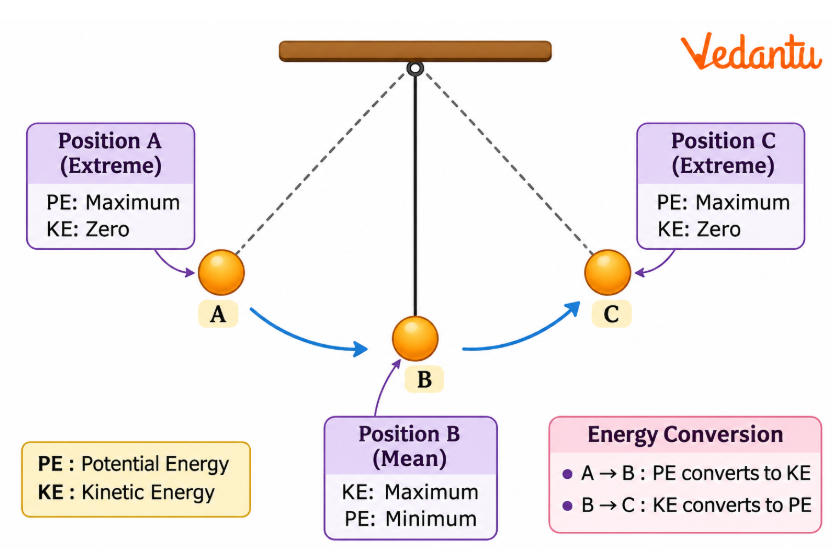
Q13. A pendulum is released from one extreme position. Explain the energy changes at the extreme and middle positions. Why does a real pendulum eventually stop?
Answer:
A pendulum continuously changes energy between gravitational potential energy and kinetic energy.
At an extreme position, the bob momentarily stops before changing direction.
At the lowest point, the bob moves at maximum speed.
In a real pendulum, air resistance and friction at the support transfer mechanical energy into thermal energy and other forms.
The pendulum therefore gradually loses amplitude and eventually stops.
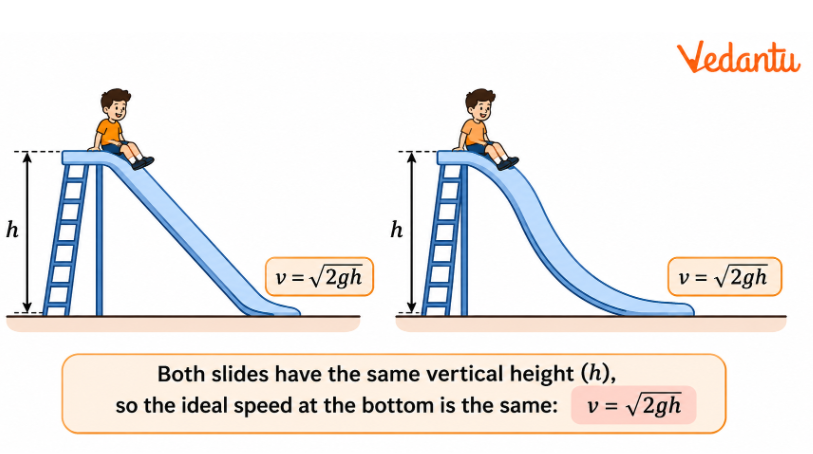
Q14. A child starts from rest at the top of a frictionless slide of vertical height 5 m. Calculate the speed at the bottom. Take g = 10 m/s². Will a heavier child have a different speed?
Solution:
At the top:
Potential energy = mgh
At the bottom:
Kinetic energy = $\frac{1}{2}mv^2$
Using conservation of mechanical energy:
$mgh=\frac{1}{2}mv^2$
Mass cancels from both sides.
$v^2=2gh$
$v=\sqrt{2gh}$
Substituting:
$v=\sqrt{2\times10\times5}$
$v=10,\text{m/s}$
Answer: The child reaches the bottom at 10 m/s.
A heavier child starting from rest at the same height will have the same ideal final speed.
Explanation: The final speed depends on the vertical height, not the mass, when friction and air resistance are neglected.
Q15. A motor performs 2,400 J of work in 12 seconds. Calculate its average power. If the same work is completed in 6 seconds, what will be the new average power?
Solution:
Power is the rate of doing work.
$P=\frac{W}{t}$
First case:
$P_1=\frac{2400}{12}$
$P_1=200,\text{W}$
Second case:
$P_2=\frac{2400}{6}$
$P_2=400,\text{W}$
Answer:
Initial average power = 200 W
New average power = 400 W
Conclusion: Completing the same work in half the time requires twice the average power.
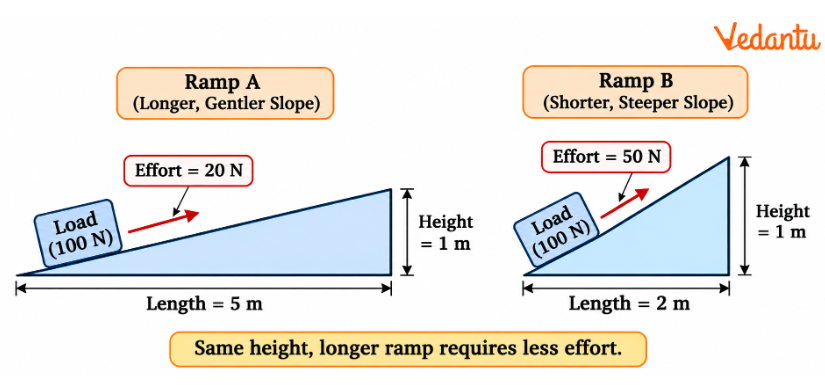
Q16. A student uses two inclined planes to raise the same 200 N load to a height of 1 m. One ramp is 2 m long, while the other is 5 m long. Calculate the ideal effort and mechanical advantage of each ramp.
Solution:
For an ideal inclined plane:
Effort × Length = Load × Height
$F\times L=200\times1$
Ramp A: Length = 2 m
$F_A=\frac{200\times1}{2}$
$F_A=100,\text{N}$
Mechanical advantage:
$MA_A=\frac{200}{100}=2$
Ramp B: Length = 5 m
$F_B=\frac{200\times1}{5}$
$F_B=40,\text{N}$
Mechanical advantage:
$MA_B=\frac{200}{40}=5$
Answer: Ramp B requires less effort and provides greater ideal mechanical advantage.
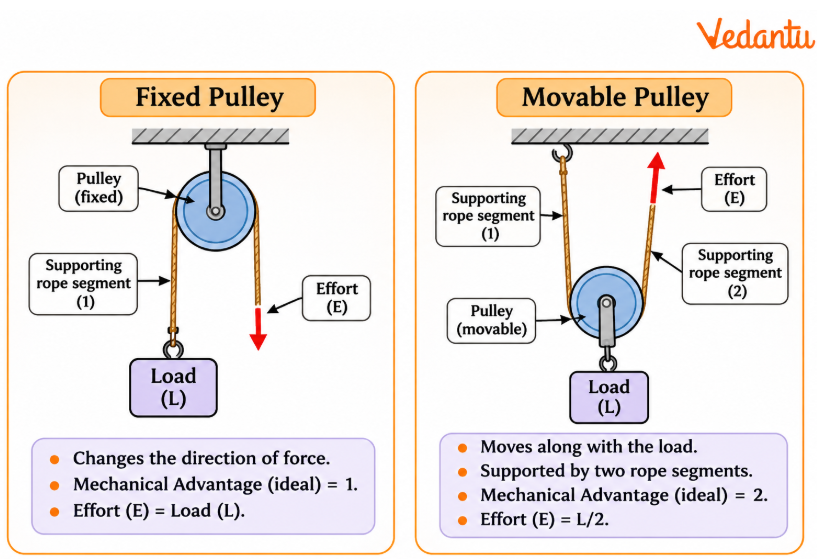
Q17. Explain the difference between a fixed pulley and a movable pulley. Why does a movable pulley reduce the effort required to lift a load?
Answer:
A pulley is a simple machine consisting of a grooved wheel over which a rope or cable passes.
A fixed pulley is attached to a support, while a movable pulley moves with the load.
A single movable pulley can reduce the ideal effort because two rope segments support the load.
If the load is 100 N, each supporting segment ideally carries 50 N of tension.
The effort required is therefore 50 N, neglecting friction and pulley weight.
Q18. A lever is used to lift a 300 N stone. The load is 20 cm from the fulcrum, while the effort is applied 100 cm from the fulcrum. Calculate the effort and mechanical advantage. Explain why a longer effort arm is useful.
Solution:
Given:
Load = 300 N
Load arm = 20 cm
Effort arm = 100 cm
Using the law of levers:
EEffort × Effort arm = Load × Load arm
$F\times100=300\times20$
$F=\frac{300\times20}{100}$
$F=60,\text{N}$
Mechanical advantage:
$MA=\frac{\text{Load}}{\text{Effort}}$
$MA=\frac{300}{60}=5$
Answer:
Effort required = 60 N
Mechanical advantage = 5
Explanation:
The effort arm is five times the load arm. Therefore, a smaller effort can balance a much larger load.
A longer effort arm increases the turning effect of the applied force.
Important Topics and Formulas for Class 9 Science Chapter 7
Revise these key concepts and formulas before solving Class 9 Science Chapter 7 important questions.
How to Prepare Class 9 Science Chapter 7 Important Questions
Understand positive, negative and zero work with everyday examples.
Practise numericals on energy, power, mechanical advantage and levers.
Revise energy transformations using falling objects, slides and pendulums.
Study labelled diagrams of force–displacement graphs, pulleys and inclined planes.
Exam Tip: Write the formula, substitute the given values and include the correct SI unit in every numerical answer.
Download Class 9 Science Chapter 7 Important Questions PDF
Practise important questions for Class 9 Science Chapter 7 with solved numericals, diagrams and application-based answers. Download the PDF for offline revision once it is available.
CBSE Class 9 Science Chapter 7 Study Materials
Students can use the following study materials to revise Work, Energy, and Simple Machines and improve their understanding of the chapter.
CBSE Class 9 Science Chapter-wise Important Questions
Students can also explore important questions from other chapters of Class 9 Science for additional practice and revision.
Other Important Related Links for CBSE Class 9 Science


FAQs on Important Questions and Answers for Class 9 Science Exploration Chapter 7 – Work, Energy, and Simple Machines | 2026–27
1. Why is work done zero when a person pushes a wall that does not move?
Work done is zero because the wall has no displacement. In physics, a force must cause displacement in its direction for mechanical work to occur. Therefore, even if a person applies a large force, the work done on the stationary wall is zero.
2. What is the difference between positive and negative work?
Positive work occurs when the force acts in the direction of displacement, while negative work occurs when the force opposes displacement. For example, pushing a trolley forwards involves positive work, whereas friction slowing the trolley does negative work.
3. What is the work–energy theorem in Class 9 Science Chapter 7?
The work–energy theorem states that the net work done on an object equals the change in its kinetic energy. It is expressed as $W_{\text{net}}=K_f-K_i$ and helps explain changes in an object's speed.
4. What is the difference between kinetic energy and potential energy?
Kinetic energy is energy due to motion, while potential energy is stored energy due to position or deformation. A moving bicycle has kinetic energy, whereas a stretched rubber band stores elastic potential energy.
5. Why does a pendulum have maximum kinetic energy at its lowest point?
At the lowest point, the pendulum moves at its greatest speed. Its gravitational potential energy has decreased and changed into kinetic energy. In the absence of friction and air resistance, total mechanical energy remains constant.
6. What is the difference between work and power?
Work measures energy transferred by a force causing displacement, while power measures how quickly work is done. Work is measured in joules (J), and power is measured in watts (W).
7. Why does a longer inclined plane require less effort?
A longer inclined plane reduces the force needed to raise a load to the same height. However, the load must move through a greater distance. In an ideal machine, the total input work equals the useful output work.
8. What is the difference between a fixed pulley and a movable pulley?
A fixed pulley changes the direction of effort, while a movable pulley can reduce the effort required to lift a load. Their ideal mechanical advantages are 1 and 2, respectively, for the standard single-pulley arrangements.
9. How can students prepare for Chapter 7 Science Class 9 important questions for exams?
Students should practise numericals on work, energy, power and mechanical advantage. They should also revise energy transformations, force–displacement graphs and diagrams of simple machines to strengthen their understanding.