




Earth—Our Shared Home: Important Questions, Diagrams & Full Marks Answers
Activity 1 (Page 162)
Question 1.
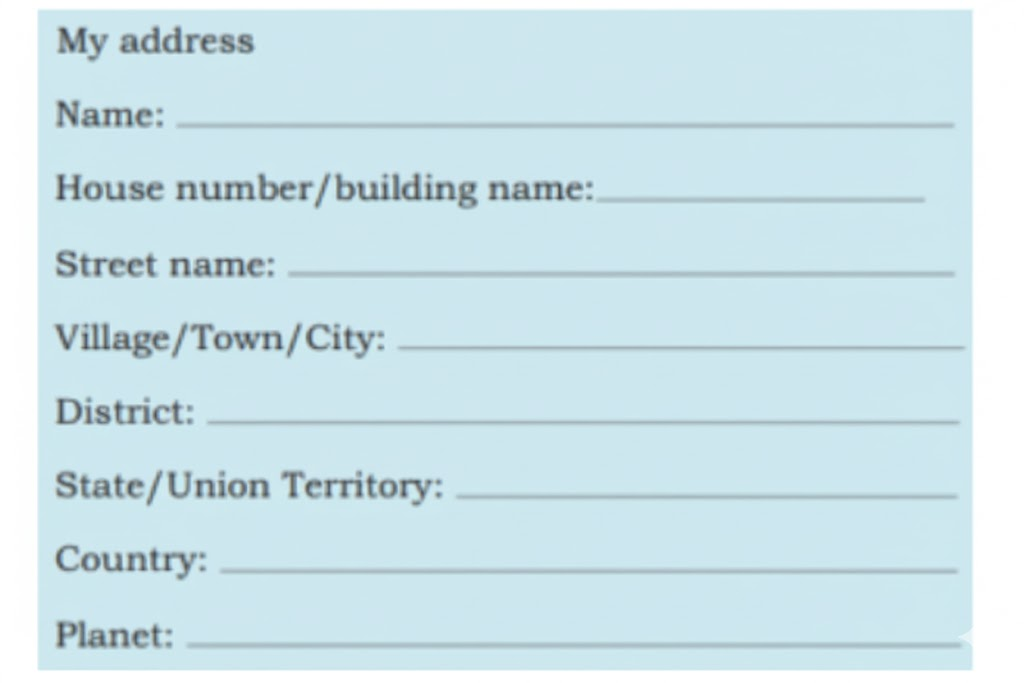
We all live in this planet and each of us has an address. Fill up your address below.
Answer:
1. My address
Name: Aarav Mehta
House number/building name:
22-B, Sunrise Residency
Street name: Lake View Road
Village/Town/City: Ahmedabad
District: Ahmedabad
State/Union Territory: Gujarat
Country: India
Planet: Earth
Question 2.
Use a globe and find out:
(a) Are all the oceans on Earth connected with each other?
(b) Where is India on the globe?
Answer:
(a) Yes, all the oceans on Earth are linked together and make up one huge water body. Although we call them by different names such as the Pacific, Atlantic, Indian, and Arctic Oceans, their waters are all connected.
(b) India is situated in the southern region of the continent of Asia and is positioned just north of the Indian Ocean.
Write (Page 164)
Question 1.
Does the rosy starling visit your area? What is it called locally?
Answer:
Yes, the rosy starling comes to my region in the winter season. People here commonly refer to it as the “gulabi maina.”
Question 2.
What does this story tell us about nature?
Answer: This story teaches us that nature is linked across the entire world. Birds such as the rosy starling can travel from one country to another and settle in new places. It also reminds us that humans, animals, and birds are all part of the same natural system. The rosy starling supports farmers by eating insects that harm crops, showing how nature cooperates to maintain balance.
Activity 2 (Page 165)
Question 1.
Make a poster of 5 birds that visit your place in winter. Try to find out where they come from.
Answer:
Question 2.
Using a string, trace the journey on a globe showing the paths rosy starlings take (Russia/Mongolia $\rightarrow$ India).
Answer:
Students should do it by themselves.
Question 3.
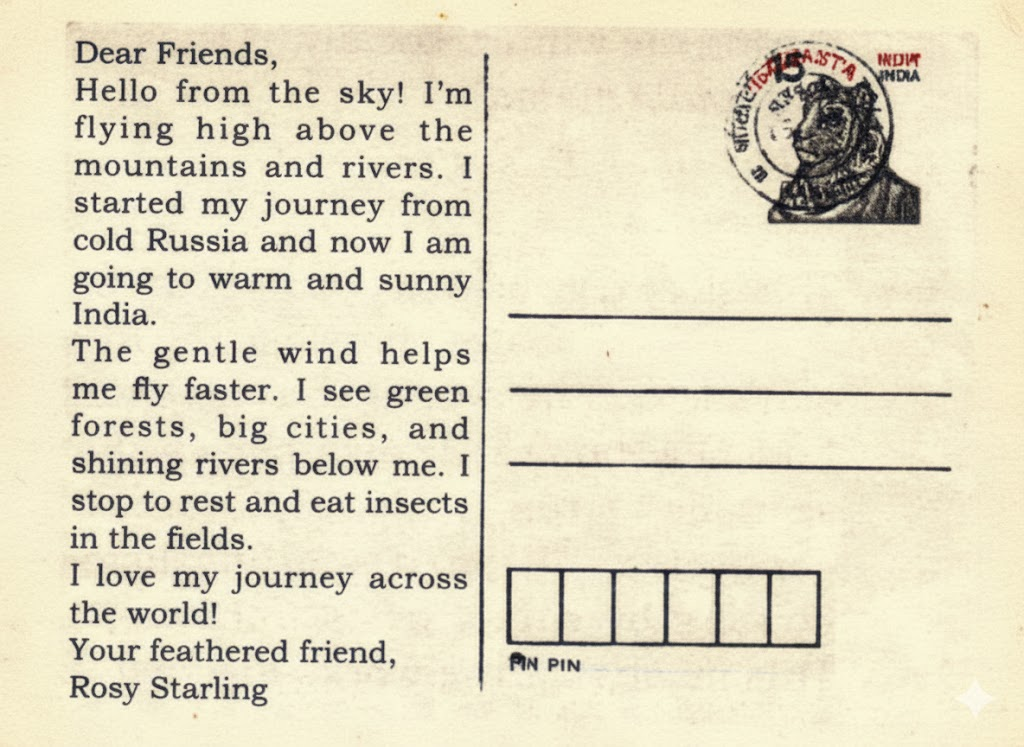
Imagine you are a bird travelling the world. Write a short postcard or note about what you see and what helps you on your journey (wind, ocean currents, warm weather). Share it with your classmates.
Answer:
Write (Page 165)
Question.
What does it mean when we say ‘nature has no boundaries’?
Answer:
It means that nature is not limited by the boundaries created by humans. Air, water, clouds, birds, animals, and even seeds can move freely from one region to another. Birds can travel across continents, and seeds can be carried far away by the wind. Nature links every part of the planet, reminding us that the Earth is a shared home for all living beings.
Discuss (Page 167)
Question. Why do you think yoga became popular in so many countries?
Answer:
Yoga is followed in many countries because it helps people stay fit and relaxed. It is simple to learn and suitable for all age groups. Yoga strengthens the body and brings calmness to the mind, which is why people across the world like it and include it in their daily routine.
Write (Page 167)
Question.
Can you name a yoga pose you have tried or seen? What do you think it helps with?
Answer:
I have practised Vrikshasana, also known as the Tree Pose. It improves my balance and focus, and it also helps strengthen my legs and back.
Write (Page 168)
Question 1.
What would happen if chillies disappeared from our kitchens for a week?
Answer:
If chillies were missing from our kitchens for a week, our food would lose its spicy flavour. People who enjoy hot and tangy dishes might not find their meals as tasty. We would need to use other spices like black pepper or ginger to add some heat to the food.
Question 2.
Ask your parents and write down the name of any recipe in which they have used black pepper and not red chillies.
Answer: My parents add black pepper to tomato soup.
Activity 3 (Page 168)
Question 1.
Using a coloured string, trace the journey of chillies from South America to India on the globe.
Answer:
Students should do it by themselves.
Question 2.
Potatoes, tomatoes, peanuts, cashews, and many other foods have similar stories. They all travelled a long way to reach India and now we enjoy these every day in our food. Find out and write the story of any one of them.
Answer: Answers may differ
Example – Potato
Many years ago, potatoes were found only in South America. Travellers and traders later introduced them to India. Because potatoes grew easily in India’s climate and soil, they quickly became a common ingredient in Indian cooking. Today, we use potatoes in samosas, aloo parathas, curries, and many snacks. It is now difficult to picture Indian food without potatoes.
Discuss (Page 169)
Question 1.
If you could choose one Indian food to share with the world, what would it be?
Answer:
I would choose dal (lentils) to share with people around the world. It is nutritious, delicious, and a common part of daily meals in India. Dal provides energy and helps keep our body strong.
Question 2.
What kind of new food items do you think will travel in the future?
Answer: In the future, instant millet dishes—such as millet upma or millet khichdi in convenient packets—may become popular in other countries. They are nutritious and easy to prepare. As more people worldwide are choosing healthier foods, these Indian millet meals could spread to many places.
Write (Pages 170-171)
Question 1.
Why do you think both Indian and Mexican cultures use marigolds during their festivals?
Answer:
Both Indian and Mexican cultures use marigold flowers because of their bright, attractive colours. They bring joy and vibrancy to celebrations. Marigolds also symbolize warmth, festivity, spirituality, respect, and good fortune.
Question 2.
Why do you think people in different countries include flowers in their celebrations?
Answer:
Flowers are used in celebrations because they are beautiful and natural. They make events feel special and bring joy to people. Flowers also express love and respect during important occasions.
Write (Page 171)
Question.
What does this story tell us about animals moving from one place to another?
Answer:
Animals are capable of moving across countries and adjusting to new surroundings. The Indian cows that were taken to Brazil got used to the climate there and proved to be very helpful. This example shows that, just like humans, animals can settle in new lands and support the communities that live in those regions.
Activity 4 (Page 172)
Question 1.
With help of your teacher or an elder find out the names of at least 5 different breeds of cows.
Answer:
These are five different types of cattle:
Gir
Kankrej
Sahiwal
Ongole
Rathi
Question 2.
Make a list of a few things in your house or school that may have come from another part of the world. Find out where they originally came from.
Answer:
Activity 5 (page 173)
Question 1.
Interview a grandparent or neighbour: Ask them about a food items song, or custom that was not there in their childhood but is common today. Find out where did it come from?

Answer:
(My answer may be different from others.)
When I spoke to my grandmother, she told me that in her childhood there were no special songs or catchy tunes about food. Jingles for things like noodles or pizza only started appearing once TV and radio ads became common. She also mentioned that cutting a cake for birthdays or anniversaries wasn’t a practice in those days. Celebrations were much simpler, and this habit of using cakes became popular much later.
Question 2.
From the stories you have read: List different things that came to India from other countries and those that travelled from India to the world. Then, using two different coloured strings, trace their journeys on a map.
Answer:
Several items that we use in India today originally came from different parts of the world.
Many important practices and products from India have spread to different regions across the globe.
Use a red thread to show the items that arrived in India.
Use a blue thread to mark the items that spread from India to other countries.
Write (page 176)
Question 1.
What does ‘Vasudhaiva Kutumbakam’ teach us?
Answer:
“Vasudhaiva Kutumbakam” conveys the idea that the entire world is like a single family, where humans, animals, plants, and the planet are all linked together. It encourages us to treat everyone and everything with kindness, compassion, and respect.
Question 2.
Write the meaning of ‘Vasudhaiva Kutumbakam’ in your own words.
Answer: It suggests that all people, wherever they may live, belong to one global family. Since we all live on the same planet, we should support, value, and be kind to one another.
Question 3.
How can we live like one big family, even when we are different?
Answer: We can behave like a united family by showing kindness, understanding others, appreciating different traditions, and joining hands to protect the Earth.
Let us reflect (page 176)
Question 1.
Pick one of the ideas. Write a short story about how this idea might have travelled from one place to another long ago. Think about how it helped people change their lives or the way they think.
Answer:
The Journey of Sugar
Many years ago in India, people first learned to prepare jaggery by boiling sugarcane juice. In time, they also figured out how to refine this jaggery into sugar. Visitors and traders who came to India were surprised to see this fine, sweet substance. They carried the knowledge of making sugar back to their own lands. Before long, sugar became popular across the world, adding sweetness to tea, cakes, and desserts, and making people happy everywhere.
Question 2.
Write one way you can care for the Earth.
Answer:
(My answer may be different.)
I can help protect our planet by growing more trees, which freshen the air and create safe spaces for wildlife.
Question 3.
Identify an item that can travel from India to other parts of the world and write about it.
Answer: Indian spices such as pepper, cardamom, and turmeric are sent to many countries across the globe. They not only enhance the flavour of dishes but also offer health benefits. In ancient times, merchants travelled to India to trade for these spices, and even now they remain popular in kitchens worldwide.
Earth—Our Shared Home: NCERT Solutions for Class 5 EVS
Master all key concepts from NCERT Solutions Class 5 Our Wondrous World Chapter 10 Earth—Our Shared Home (2026-27). Gain clear explanations, learn the importance of nature without boundaries, and discover how our planet connects us all through stories, trade, and culture.
With chapter-wise solutions, students will understand how plants, animals, ideas, and foods travel across the world. Strengthen your EVS exam prep, remember examples, and practice answers based strictly on NCERT textbook content for top marks.
Revise regularly to retain facts like “Vasudhaiva Kutumbakam” and migration stories. Reading NCERT exercise-based answers boosts exam confidence and helps you write effective, well-structured responses for Class 5 EVS board exams.
FAQs on NCERT Solutions For Class 5 Our Wonderous World Chapter 10 Earth-Our Shared Home - 2026-27 Free PDF Download (Sign-in Required)
1. What are the key points in Earth—Our Shared Home?
Earth—Our Shared Home highlights the importance of protecting our planet and living sustainably. Key points include:
- Earth as a unique and habitable planet due to air, water, and land.
- Conservation of natural resources like water, soil, and forests.
- Importance of biodiversity and caring for plants and animals.
- Understanding pollution and ways to protect the environment.
2. How to write stepwise NCERT answers to score full marks?
To score full marks in NCERT Class 5 EVS Chapter 10 answers, follow these tips:
- Read the question carefully and match your answer to the marking scheme.
- Write in clear steps or points (use bullet points for clarity).
- Highlight keywords, definitions, and important facts.
- Add a relevant diagram if required, and label it neatly.
- Keep sentences short and precise as per CBSE guidelines.
3. Are diagrams or definitions mandatory in answers?
Including diagrams and definitions in your EVS answers is highly recommended for scoring well:
- **Definitions:** Write textbook definitions for important terms.
- **Diagrams:** Draw and neatly label diagrams or maps if the question requires it.
- Examiners often award extra marks for clear presentation and correct labels.
4. Which questions are likely from this chapter in school exams?
Common exam questions from NCERT Class 5 EVS Chapter 10 include:
- Short answer questions on natural resources, pollution, and ways to protect the Earth.
- Definition-based questions and diagram labelling (Earth, globe, etc.).
- Long answer questions on conservation methods or why the Earth is unique.
- Application questions like listing ways to reduce pollution.
5. Where can I download the chapter’s solutions PDF?
You can download the NCERT Solutions for Class 5 EVS Chapter 10 PDF for free from reliable educational websites.
- Look for the Free PDF Download button on the solution page.
- PDFs offer stepwise, exam-ready answers and diagrams.
- They are ideal for offline study and quick revision.
6. How to write correct diagrams for Class 5 EVS?
To draw correct diagrams for Class 5 EVS Chapter 10:
- Use a sharp pencil and keep the diagram neat and large enough.
- Label each part clearly using straight lines and simple handwriting.
- Follow conventions shown in the textbook.
- Add a caption or title below the diagram.
7. Are all NCERT Chapter 10 questions important?
Yes, all questions in NCERT Class 5 EVS Chapter 10 are important according to the CBSE 2026–27 syllabus.
- Intext and back exercise questions often appear in exams.
- Focusing on all question types ensures complete exam preparation.
8. How to learn diagrams/maps for this chapter?
To learn diagrams/maps for Earth—Our Shared Home:
- Practice drawing maps and key diagrams (like Earth, continents, major resources) regularly.
- Use colored pencils to highlight important features if allowed.
- Refer to textbook illustrations for accurate labelling and structure.
9. What are the most important topics from this chapter?
The most important topics from NCERT Class 5 EVS Chapter 10 Earth—Our Shared Home are:
- Earth’s structure (land, water, air)
- Natural resources (water, soil, forests)
- Importance of conservation and protecting the environment
- Pollution types and prevention methods
- Biodiversity and living things
10. How does Earth—Our Shared Home fit in the CBSE 2026–27 exam pattern?
Earth—Our Shared Home is a core chapter in the CBSE 2026–27 Class 5 EVS syllabus:
- Its concepts are regularly tested in school and board exams.
- Questions may involve definitions, stepwise explanations, diagrams, and applications.
- Studying this chapter helps build strong basics for higher classes in EVS and science subjects.
11. Do examiners award partial marks for correct steps even if the final answer is wrong?
Yes, in CBSE marking for Class 5 EVS, examiners often award partial marks for correctly written steps, even if the final answer is incorrect.
- Always show your working and logical reasoning in every answer.
- Use bullet points or steps where applicable.
12. Are references to textbook page numbers useful during revision?
Referencing textbook page numbers while revising Class 5 EVS Chapter 10 is very helpful:
- It allows for quick cross-checking of facts, diagrams, and definitions.
- Helps you revisit important examples directly from the book.
