



Understanding the Cell Cycle and Its Role in Cell Division
The cell cycle is the sequence of events through which a cell grows, duplicates its genetic material, and divides into two daughter cells. It represents the life cycle of a cell, beginning from its formation after division and ending when it divides again.
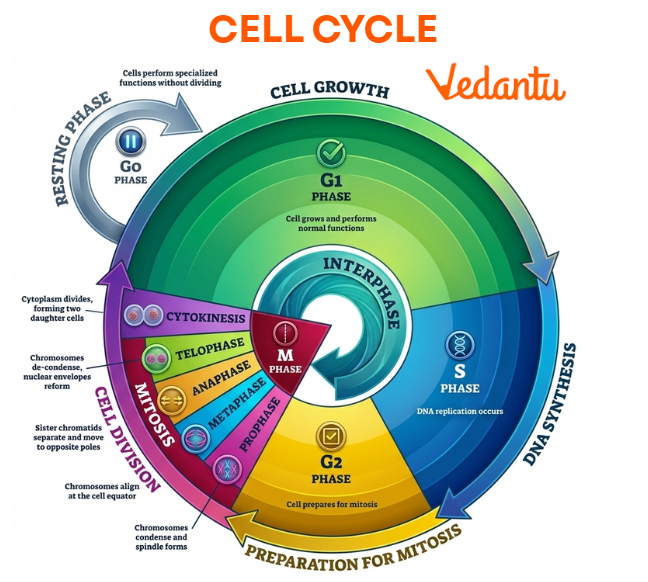
Just like organisms follow a life cycle, cells also undergo a well-organised cycle that ensures continuity of life. The process is cyclic, meaning once a cell completes division, the newly formed cells can re-enter the same cycle and repeat the process.
The cell cycle ensures:
Proper growth of the organism
Accurate DNA replication
Equal distribution of genetic material
Formation of new cells for repair and reproduction
Cell Cycle Phases and Overall Structure
The cell cycle is broadly divided into three main components:
Interphase (G₁, S, G₂ phases)
Mitotic Phase (M phase) (Mitosis + Cytokinesis)
G₀ Phase (Resting phase)
Each phase is highly regulated and occurs in a specific sequence to maintain cellular integrity.
Cell Cycle Diagram and Visual Explanation
A cell cycle diagram helps visualise the progression from one phase to another, showing how a cell grows, replicates DNA, and divides into two identical daughter cells.
Interphase – The Preparation Stage of the Cell Cycle
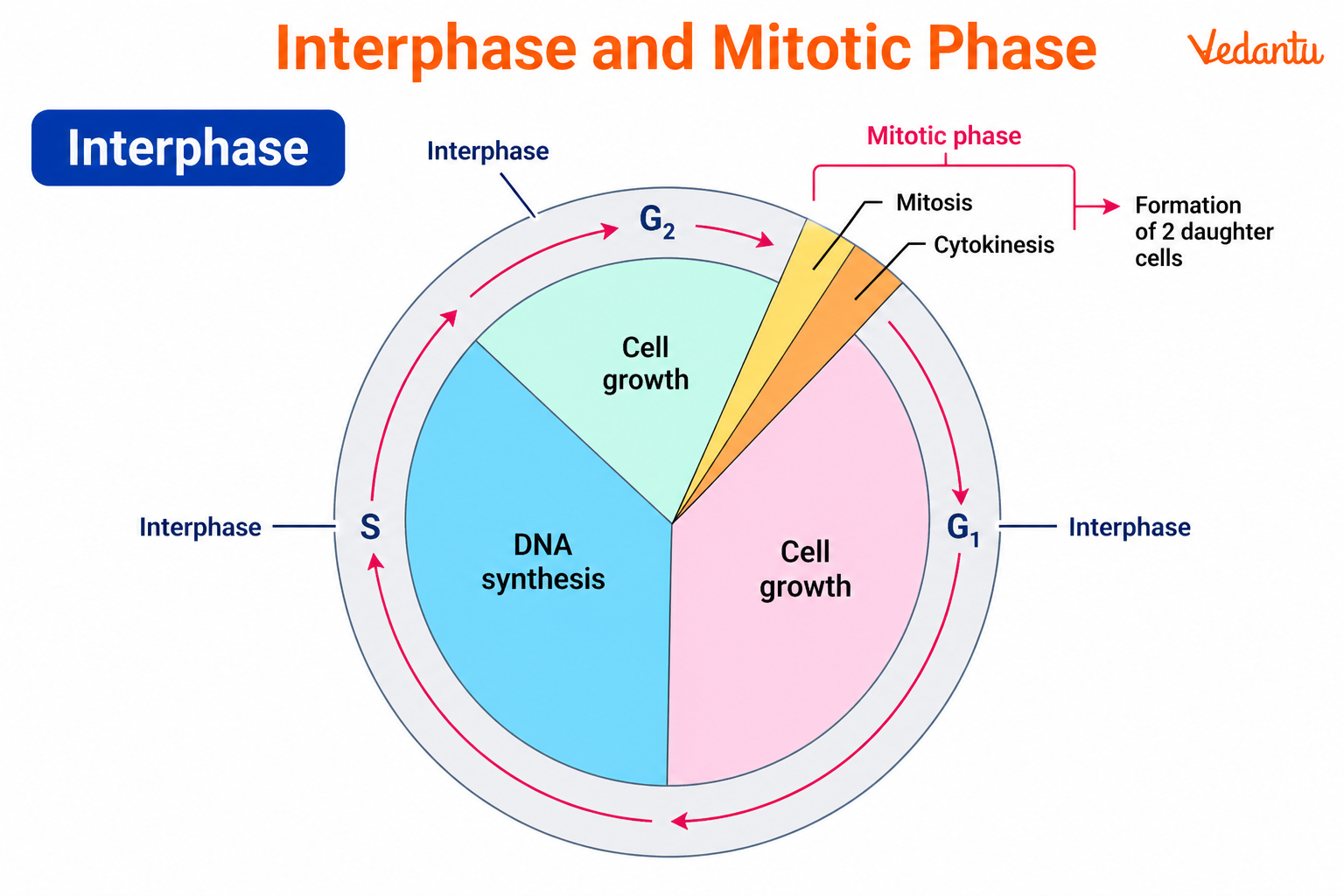
Interphase is the longest phase of the cell cycle, where the cell prepares for division. It consists of three important stages:
G₁ Phase (First Gap Phase)
Cells increase in size
Organelles are duplicated
Proteins and enzymes required for DNA replication are synthesised
This phase determines whether the cell will proceed to division or enter a resting stage.
S Phase (Synthesis Phase)
DNA replication occurs
Each chromosome duplicates into two sister chromatids
Centrosomes are also duplicated
This phase ensures that both daughter cells receive identical genetic material.
G₂ Phase (Second Gap Phase)
Further cell growth occurs
Proteins required for mitosis are produced
Cells check DNA for errors and repair them
The cell becomes fully prepared for division by the end of this phase.
Mitotic Phase (M Phase) – Cell Division Stage
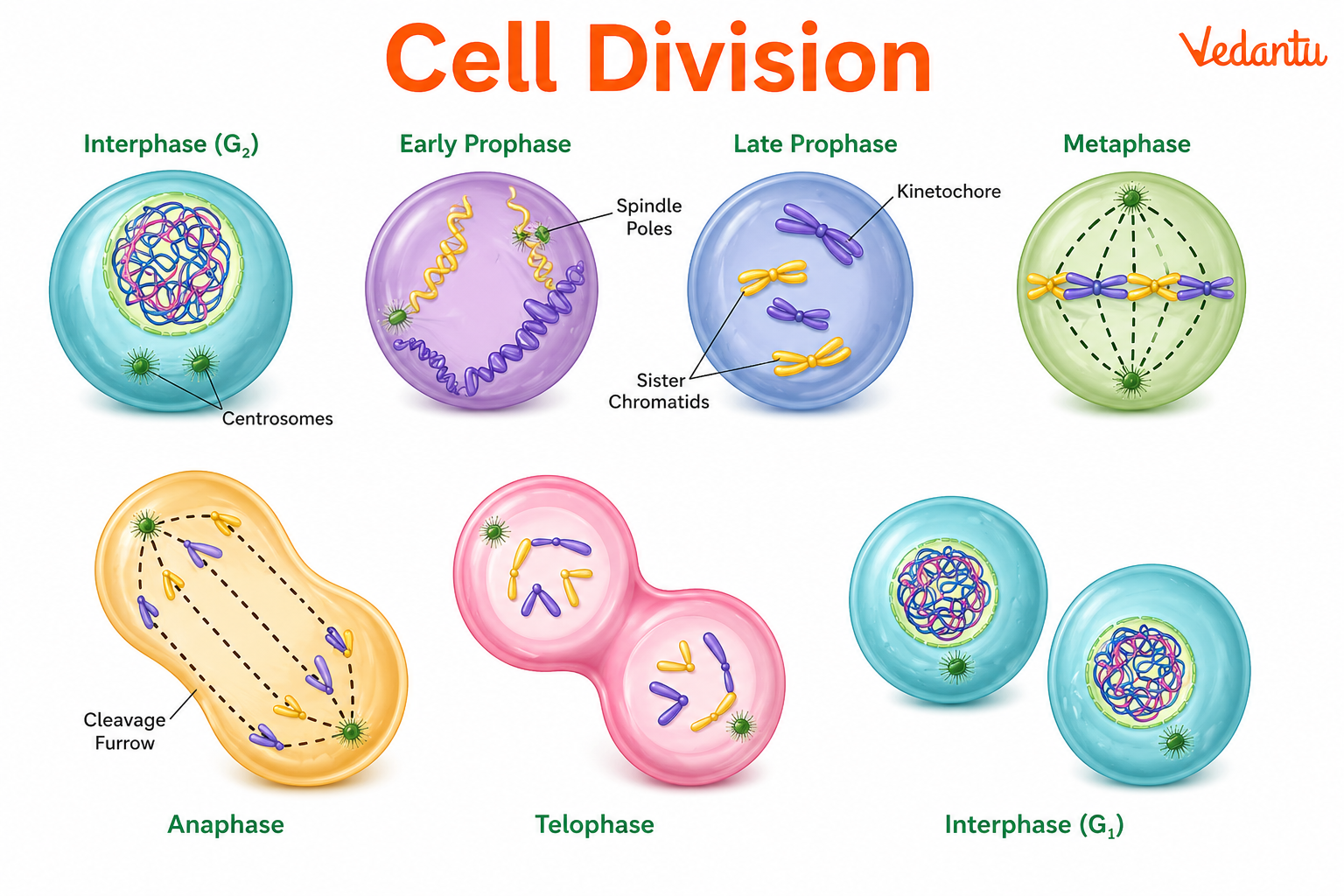
The mitotic phase is when actual cell division occurs. It includes:
Mitosis (Nuclear Division)
Mitosis occurs in four stages:
Prophase – Chromosomes condense and spindle fibres form
Metaphase – Chromosomes align at the equatorial plate
Anaphase – Sister chromatids separate and move to opposite poles
Telophase – Nuclear membranes reform around chromosomes
Cytokinesis (Cytoplasmic Division)
Cytokinesis divides the cytoplasm into two separate cells.
In animal cells, A cleavage furrow forms due to the contraction of a ring of proteins
In plant cells, a cell plate forms from vesicles and eventually becomes a new cell wall.
This results in the formation of two genetically identical daughter cells.
G₀ Phase – The Resting or Quiescent Stage
Some cells exit the cell cycle after G₁ phase and enter the G₀ phase, where they remain metabolically active but do not divide.
Permanent cells (e.g., neurons) stay in G₀ permanently
Some cells can re-enter the cycle when required
This phase plays a key role in maintaining tissue stability.
Cell Cycle Regulation and Control Mechanism
Cell cycle regulation ensures that division occurs only when necessary and under controlled conditions.
Key Regulatory Features:
Checkpoints at G₁, G₂, and M phase
DNA damage detection and repair
Controlled progression through phases
If errors are detected, the cycle can be halted to prevent abnormal cell division.
Duration of the Cell Cycle
The time required for completing the cell cycle varies:
Typical human cells: ~24 hours
Rapidly dividing cells: 9–10 hours
Early embryonic cells: extremely fast cycles
Different cells spend different durations in each phase depending on their function.
Importance of the Cell Cycle in Living Organisms
The cell cycle is essential for:
Growth and development
Tissue repair and regeneration
Replacement of damaged or dead cells
Reproduction in unicellular organisms
Without proper cell cycle control, abnormalities like cancer may occur.
Differences Between Animal and Plant Cell Division
Key NEET Points on Cell Cycle
Interphase is the longest phase
DNA replication occurs in the S phase
Mitosis ensures identical daughter cells
The G₀ phase is a non-dividing stage
Cell cycle is continuous and cyclic
FAQs on Cell Cycle in Biology: Detailed Explanation of Phases, Steps, Diagram and Regulation
1. What are the 4 stages of the cell cycle?
The four stages are G1, S, G2, and M. G1 is for growth, S is for DNA replication, G2 prepares the cell for division, and M phase includes mitosis and cytokinesis to form two daughter cells. Some cells may enter G0 instead of continuing the cycle.
2. What do G1 and G2 do?
G1 helps the cell grow, carry out normal functions, and prepare for DNA replication.
G2 prepares the cell for mitosis by synthesising proteins and checking DNA for errors.
3. What are the 7 stages of cell division?
The stages are interphase, prophase, prometaphase, metaphase, anaphase, telophase, and cytokinesis. These steps cover cell growth, chromosome alignment, separation, and final division.
4. Why is it called a cell cycle?
It is called a cycle because the process repeats continuously. A cell grows, replicates DNA, divides, and the new cells repeat the same steps.
5. Is there more DNA in G1 or G2?
There is more DNA in G2. DNA doubles during the S phase, so G2 has double the DNA compared to G1.
6. What is the role of G2?
G2 prepares the cell for mitosis by producing proteins, checking DNA replication, and ensuring the cell is ready for division.
7. What are the 4 divisions of mitosis?
The four stages are prophase, metaphase, anaphase, and telophase. Cytokinesis follows to divide the cytoplasm.
8. Who controls the cell cycle?
The cell cycle is controlled by cyclins and CDKs, along with checkpoints that ensure proper DNA replication and division.
9. How did a cell get its name?
Robert Hooke named it “cell” after observing box-like structures in cork that resembled small rooms.
10. Is interphase part of mitosis?
No, interphase is not part of mitosis. It is the preparation phase before mitosis, including G1, S, and G2 stages.
