



 Watch Video


Physics and Measurement, Important Concepts and Formulas Explained
Physics and Measurement form the backbone of understanding physical phenomena in science, making it one of the first and most crucial topics in NEET Physics. This concept explores how physical quantities are defined, measured, and analyzed using units, measurements, and dimensions. A strong grasp of these basics is essential for problem-solving, understanding advanced concepts, and avoiding errors in calculations during the NEET exam. Mastering Physics and Measurement helps students build a strong foundation for all topics that follow in physics.
Also Read:
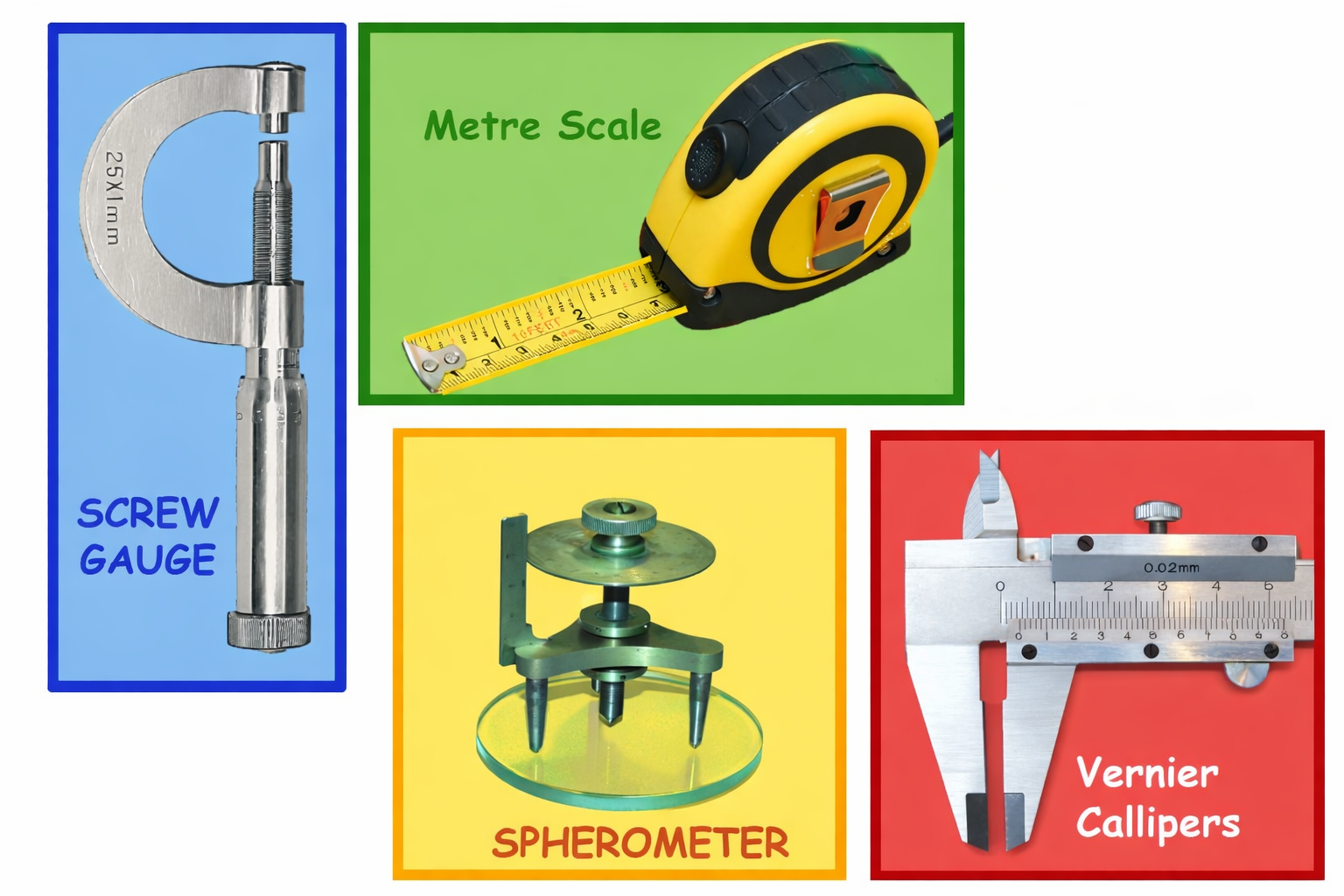
What is Physics and Measurement?
Physics and Measurement refers to the study of how we define, quantify, and analyze the physical quantities around us - such as length, mass, time, temperature, and more. This concept establishes the language of physics by introducing units, standards, and the principles behind measuring and reporting physical quantities. In essence, Physics and Measurement provides the tools to accurately describe, compare, and understand all physical laws and phenomena encountered in NEET Physics and beyond.
Also Check:
Core Ideas and Fundamentals of Physics and Measurement
1. Physical Quantities
A physical quantity is any property of matter or energy that can be measured and expressed numerically. Examples include length, mass, time, temperature, electric current, etc.
2. Units and Standards
Units provide a standard for expressing physical quantities. For example, the length can be measured in meters, centimeters, or kilometers. A standard is a fixed and reproducible value agreed upon internationally, ensuring consistency in measurements.
3. System of Units
Different systems, like CGS (centimeter-gram-second), FPS (foot-pound-second), and, most importantly, SI (International System of Units), are used to define the units of measurement. The SI system is universally adopted and used in NEET.
4. Measurement Process and Precision
The process of measurement involves comparing a physical quantity with its standard unit. The precision and reliability of measurements depend on the instrument's least count, human limitations, and experimental setup.
5. Significant Figures
Significant figures represent digits in a measured value that are reliable and meaningful. They convey the precision of a measurement and help avoid false accuracy in calculations.
Physical Quantities
Physical quantities are measurable properties that help describe the laws of physics. Any quantity that can be measured is called a physical quantity. Examples include length, mass, time, temperature, pressure, electric current, and resistance.
Classification of Physical Quantities
Physical quantities are broadly classified into:
(i) Fundamental (Base) Quantities
These are basic quantities that are independent and cannot be expressed in terms of other quantities.
(ii) Derived Quantities
These are quantities that can be expressed using fundamental quantities through mathematical relationships.
Units
A unit is a standard reference used to measure a physical quantity. It helps express the magnitude of a quantity in a consistent and comparable way.
Properties of a Good Unit
A good unit should have the following characteristics:
It should be of a convenient size.
It must be clearly defined.
It should be easily reproducible and remain the same at different places.
It should not change with time.
It should not vary with physical conditions such as temperature or pressure.
It should be easy to compare with similar physical quantities in experiments.
Types of Units
(i) Fundamental Units
These are the units assigned to fundamental quantities and are independent of other units.
(ii) Derived Units
These are the units of quantities that are obtained from fundamental units using mathematical relationships.
System of Units
Different systems of units are used to measure physical quantities:
FPS System
In this system, the unit of length is foot, mass is pound, and time is second.
CGS System
Here, the units are centimetre for length, gram for mass, and second for time.
MKS System
This system uses meter for length, kilogram for mass, and second for time.
SI System
The International System of Units (SI) is the most widely used system across the world. It is based on seven fundamental units along with supplementary units for certain measurements.
Basic (Fundamental) Units
Supplementary Units
Definitions of Basic and Supplementary Units
Basic (Fundamental) Units
Metre (m)
The metre is defined as the distance travelled by light in vacuum in 1/299,792,458 second.
Kilogram (kg)
The kilogram is the unit of mass, historically defined using a platinum–iridium standard cylinder.
Second (s)
The second is defined as the time taken for 9,192,631,770 vibrations of radiation from a caesium-133 atom.
Ampere (A)
One ampere is the electric current that produces a force of 2 × 10⁻⁷ N per metre between two parallel conductors placed 1 metre apart in vacuum.
Kelvin (K)
Kelvin is the SI unit of temperature, defined based on the thermodynamic scale (earlier linked to the triple point of water).
Candela (cd)
Candela is the unit of luminous intensity, based on the light emitted by a source under specific standard conditions.
Mole (mol)
One mole is the amount of substance containing 6.022 × 10²³ particles (Avogadro number).
Supplementary Units
Radian (rad)
A radian is the angle subtended at the centre of a circle by an arc equal to its radius.
Steradian (sr)
A steradian is the solid angle subtended at the centre of a sphere by a surface area equal to the square of its radius.
Dimensional Formula
The dimensional formula of a physical quantity shows how it depends on fundamental quantities like mass (M), length (L), and time (T).
Steps to Write Dimensional Formula
Write the formula of the physical quantity.
Express all quantities in terms of fundamental quantities (M, L, T).
Replace them with symbols M, L, and T.
Write the powers of each term.
Characteristics of Dimensions
Dimensions do not depend on the system of units.
Only quantities with the same dimensions can be added or subtracted.
Dimensions can be derived from units and vice versa.
Different physical quantities can have the same dimensions.
Multiplication or division of quantities results in new dimensions.
Dimensional Analysis
Dimensional analysis is a method that uses dimensional formulas to:
Check the correctness of physical equations.
Convert units from one system to another.
Derive relationships between physical quantities.
Read More: Unit and Dimensions-Dimension Formula
Units and Dimensions of Important Derived Quantities
Principle of Homogeneity of Dimensions
The principle of homogeneity states that all terms in a physical equation must have the same dimensions.
Example:
s = ut + (1/2)at²
Dimensionally:
s = [L]
ut = [LT⁻¹ × T] = [L]
at² = [LT⁻² × T²] = [L]
So, [L] = [L] + [L], which means the equation is dimensionally correct.
Limitations of Dimensional Analysis
Dimensional analysis has the following limitations:
It cannot determine numerical constants such as 1/2, 2, or π.
It cannot be used when a quantity depends on more variables than the number of fundamental quantities.
It is not useful for deriving equations involving more than three independent variables.
It cannot be applied to equations containing trigonometric, exponential, or logarithmic functions.
Key Points to Remember
A physical quantity is any measurable quantity used to describe physical laws, such as length, mass, and time.
Physical quantities are classified into fundamental and derived quantities.
A unit is a standard used to measure a physical quantity.
Units are classified into fundamental units and derived units.
The SI system is the most widely used system of units.
The SI system is based on seven fundamental units.
A dimensional formula shows how a physical quantity depends on base quantities like mass, length, and time.
All valid physical equations follow the principle of homogeneity.
Solved Examples on Units Dimensions and Measurement
Example 1:
The zero of the vernier scale lies just after 3.40 cm on the main scale. The 6th vernier division coincides with a main scale division. The least count is 0.01 cm. Find the measured length.
Answer: 3.46 cm
Solution:
Measured length = Main scale reading + (Vernier coincidence × Least count)
= 3.40 + (6 × 0.01)
= 3.40 + 0.06
= 3.46 cm
Example 2:
The radius of a sphere has a percentage error of 2%, and its mass has a percentage error of 3%. Find the percentage error in density.
Answer: 9%
Solution:
Density = mass / volume
Volume of sphere ∝ r³
Percentage error in volume = 3 × 2% = 6%
Total percentage error in density = error in mass + error in volume
= 3% + 6% = 9%
Example 3:
What is the dimensional formula of strain?
Answer: [M⁰L⁰T⁰]
Solution:
Strain = change in length / original length
Since both have the same dimensions, they cancel out.
Hence, strain is dimensionless.
Example 4:
A metal rod increases in length by 1% when heated. Find the percentage increase in area of a square sheet of the same material.
Answer: 2%
Solution:
Linear expansion = 1%
Area expansion coefficient = 2 × linear expansion
Percentage increase in area = 2 × 1% = 2%
Example 5:
The measured values are 4.2 cm, 4.4 cm, 4.3 cm, 4.5 cm, and 4.1 cm. Find the mean absolute error.
Answer: 0.12 cm
Solution:
Average value = (4.2 + 4.4 + 4.3 + 4.5 + 4.1) / 5
= 21.5 / 5 = 4.3 cm
Absolute errors:
|4.2 − 4.3| = 0.1
|4.4 − 4.3| = 0.1
|4.3 − 4.3| = 0
|4.5 − 4.3| = 0.2
|4.1 − 4.3| = 0.2
Mean absolute error = (0.1 + 0.1 + 0 + 0.2 + 0.2) / 5
= 0.6 / 5
= 0.12 cm
Important Sub-Concepts Connected to Physics and Measurement
Fundamental and Derived Units
Fundamental (base) units are independent units for basic physical quantities, such as meter for length or kilogram for mass. Derived units arise from combinations of base units, such as newton (kg·m/s²) for force or joule (kg·m²/s²) for energy. Understanding the difference is crucial for analyzing formulae and equations in physics.
Least Count
Least count is the smallest value that can be measured accurately by an instrument. For example, a ruler with a least count of 1 mm cannot measure differences smaller than 1 mm. Knowing the least count helps in assessing precision and reporting results correctly.
Errors in Measurements
Errors are the uncertainties associated with any measurement. They may arise due to instrumental limitations, human error, or environmental factors. Understanding types of errors and methods to reduce them is vital for reporting accurate results and performing practical experiments.
Dimensions and Dimensional Analysis
Dimensions refer to the powers to which fundamental quantities are raised in a physical quantity (for example, velocity has dimensions of length [L] and time [T]: LT⁻¹). Dimensional analysis is a technique used to check the correctness of equations, convert units, and even derive relationships between physical quantities.
Key Formulas, Relationships, and Principles in Physics and Measurement
Physical quantity = Numerical value × Unit (Q = n × u)
Rules for significant figures in addition/subtraction: Result has the same number of decimal places as the least precise measurement.
Rules for significant figures in multiplication/division: Result has the same number of significant digits as the value with least significant digits.
Dimensional formula: Expressed as [Ma Lb Tc], where M = mass, L = length, T = time.
Percentage error calculation: (|Measured value - True value| / True value) × 100%
If Q = A × Bn / Cm, Relative error in Q = relative error in A + n × relative error in B - m × relative error in C.
Common SI Base Units and Examples
These SI base units form the foundation for all measurements in physics. Derived units like newton, joule, and coulomb are built using these base units.
Also Read: SI Unit List
Why is Physics and Measurement Important for NEET?
Physics and Measurement is foundational in NEET because it underpins all further learning in Physics. Questions often test understanding of units, dimensional analysis, conversions, significant figures, and error calculations - directly and indirectly. Mastery of this topic aids in avoiding calculation errors, checking the consistency of equations, and interpreting data from experiments. It also supports logical reasoning and problem-solving, as many advanced topics in physics rely on the concepts introduced here. A solid grasp helps students build confidence and accuracy from the very beginning of their NEET preparation.
How to Study Physics and Measurement Effectively for NEET
Start with understanding the meaning and need for units and measurements in physics.
Memorize all SI base units, their symbols, and learn to identify derived units in common formulas.
Practice conversions between different unit systems and ensure clarity in dimensional analysis.
Work out problems involving error analysis and significant figures, as these are common in NEET questions.
Regularly solve NEET-level MCQs on measurement, least count, dimensional analysis, and error calculation to strengthen understanding.
Revise all basic definitions and rules periodically to maintain accuracy in the rest of the Physics syllabus.
Review experimental setups and measurement techniques used in real-life labs for deeper conceptual clarity.
Common Mistakes Students Make in Physics and Measurement
Forgetting to use SI units, leading to incorrect final answers.
Confusing fundamental and derived units in formula substitutions.
Applying the wrong rules for significant figures in calculations.
Ignoring instrument least count when estimating measurement precision.
Making calculation errors during percentage error or relative error problems.
Incorrectly checking equation correctness using dimensional analysis.
Quick Revision Points
Always use and convert answers to SI units in NEET problems.
Remember all seven SI base units and their symbols.
Count significant figures: non-zero digits always count; leading zeros do not.
Least count is the smallest measurement readable by an instrument.
Type of errors: systematic (consistent, due to instruments) and random (varies unpredictably).
Use dimensional analysis to check equation correctness, derive relations, and convert units.
Master error propagation formulas for NEET numerical questions.
Units, measurements, and dimensional concepts appear throughout all Physics chapters.
Most Important NEET 2026 Topics Physics
Physics and Measurement for NEET Exam: Units, Dimensions, SI System, Physical Quantities, Practice Questions

 Share
ShareFAQs on Physics and Measurement for NEET Exam: Units, Dimensions, SI System, Physical Quantities, Practice Questions
1. What are the fundamental and derived units in Physics according to the NEET syllabus?
Fundamental units are the basic units used to define physical quantities, while derived units are formed by combining fundamental units according to physical laws. For NEET, remember:
- Fundamental units (base units): Meter (m), Kilogram (kg), Second (s), Ampere (A), Kelvin (K), Mole (mol), Candela (cd)
- Derived units: Formed by multiplication or division of fundamental units, e.g., Newton (N) for force, Joule (J) for energy, Pascal (Pa) for pressure
2. What is least count and why is it important in Physics measurements for NEET?
Least count is the smallest measurement that can be accurately read by an instrument. It is important because it determines the precision of measurement tools used in NEET Physics. Key points:
- The lower the least count, the more precise the instrument
- Common examples: Vernier caliper (least count: 0.01 cm), screw gauge (least count: 0.01 mm)
- Understanding least count helps minimize measurement errors in NEET practical questions
3. What are S.I. units and why are they used in the NEET Physics syllabus?
S.I. units (International System of Units) provide a standardized system for all scientific measurements, essential for NEET Physics uniformity. Important details:
- S.I. base units include meter, kilogram, second, ampere, kelvin, mole, and candela
- They ensure consistency in solving NEET Physics numerical problems
- Every measured quantity in NEET exams should be expressed in S.I. units for clarity and accuracy
4. What are significant figures and how do they affect measurement in NEET Physics?
Significant figures indicate the precision of a measured value by including reliable digits and the first uncertain digit. Key points for NEET:
- All nonzero digits are always significant
- Zeros between nonzero digits are significant
- Leading zeros are not significant, trailing zeros are significant if there's a decimal
5. What are the common types of errors in Physics measurements and how are they addressed in NEET?
Errors in Physics measurements are differences between the measured and true values, crucial for NEET Physics understanding. Main types:
- Systematic errors: Consistent & repeatable, due to flaws in equipment or method
- Random errors: Vary unpredictably from one measurement to another
- Gross errors: Due to mistakes or misreading instruments
6. What is dimensional analysis and how is it applied in NEET Physics questions?
Dimensional analysis involves expressing physical quantities in terms of basic dimensions to check equation consistency and derive relationships. In NEET Physics, use it for:
- Verifying if equations are dimensionally correct
- Deriving new formulas or units
- Converting units between systems
7. Why is unit conversion important in Physics and what methods are used in NEET preparation?
Unit conversion ensures all quantities in Physics are comparable and allows numerical values to be expressed in the required units, as needed for the NEET syllabus. Methods include:
- Multiplying the given value by conversion factors
- Ensuring units cancel appropriately during calculations
- Focusing on S.I. units in NEET for uniformity and accuracy
8. State the seven base quantities and their S.I. units as per the NEET exam.
The seven base quantities with their S.I. units are fundamental to Physics and the NEET syllabus:
- Length: meter (m)
- Mass: kilogram (kg)
- Time: second (s)
- Electric current: ampere (A)
- Temperature: kelvin (K)
- Amount of substance: mole (mol)
- Luminous intensity: candela (cd)
9. How does dimensional analysis help in deriving relationships between physical quantities for NEET Physics?
Dimensional analysis allows you to determine relationships between physical quantities based on their dimensions. It is useful in NEET for:
- Checking the correctness of equations
- Finding the formula relating different physical quantities
- Converting from one unit system to another
10. Define accuracy and precision. How are they different in the context of NEET Physics measurements?
Accuracy is how close a measurement is to the true value, while precision shows how closely repeated measurements agree. In NEET Physics:
- High accuracy means correct value, even if measurements are not close to each other
- High precision means repeated measurements are very similar, even if far from true value
- The best scientific results in NEET are both accurate and precise, minimizing errors
11. Why are significant figures important in reporting answers in NEET Physics exams?
Significant figures help NEET students report answers based on measurement precision, avoiding overstatement of accuracy. Key rules:
- The result should not have more significant figures than the least precise measurement
- Proper use of significant figures reflects good scientific practice expected in NEET
12. What is the S.I. unit of force and which physical quantities form its dimensional formula for NEET?
The S.I. unit of force is newton (N). Its dimensional formula is based on mass, length, and time:
- 1 N = 1 kg·m·s-2
- Dimensional formula: [M1 L1 T-2]
- NEET physics frequently tests such unit and dimensional relations
