



What Are Logic Gates And Number Systems With Types Conversions And Truth Tables
Logic Gates and Number System form the foundation of digital electronics and computer science. Every computer, smartphone, and digital device works using binary numbers and logical operations. Understanding this topic helps students learn how data is represented, processed, and stored inside a computer. Logic gates perform operations on binary inputs, while number systems define how numbers are expressed in digital form. Together, they explain how hardware circuits make decisions and how computers interpret information efficiently. This knowledge is essential for learning digital circuits, Boolean algebra, programming, and computer architecture.
Definition and Meaning
Logic Gates and Number System in computer science refer to the basic building blocks of digital systems that operate using binary values 0 and 1.
- Number System is a method of representing numbers using a set of digits. Common systems include Binary, Decimal, Octal, and Hexadecimal.
- Binary Number System uses only two digits 0 and 1 and is the core of digital electronics.
- Logic Gates are electronic circuits that perform logical operations on one or more binary inputs to produce a single output.
- Boolean Algebra is the mathematical foundation used to describe logic gate operations.
How It Works - Working Principle
Logic Gates and Number System working is based on binary representation and logical decision making. Digital circuits interpret electrical signals as binary values.
- Data is converted into binary form using the binary number system.
- Binary inputs 0 or 1 are fed into logic gates.
- Each gate performs a specific logical operation such as AND, OR, or NOT.
- The output is produced based on the truth table of that gate.
- Complex circuits combine multiple gates to perform arithmetic and decision making operations.
For example, in a binary addition circuit, logic gates combine bits according to Boolean rules to produce a sum and carry output.
Types and Classification
Logic Gates and Number System types can be classified into number systems and logic gates.
1. Types of Number Systems
Number Systems
| Number System | Base | Digits Used |
|---|---|---|
| Binary | 2 | 0, 1 |
| Decimal | 10 | 0 to 9 |
| Octal | 8 | 0 to 7 |
| Hexadecimal | 16 | 0 to 9, A to F |
Binary is the most important number system in digital electronics because logic gates operate using only 0 and 1.
2. Types of Logic Gates
- Basic Gates - AND, OR, NOT
- Universal Gates - NAND, NOR
- Special Gates - XOR, XNOR
Truth Table Concept
A truth table shows all possible input combinations and their corresponding outputs.
Basic Logic Gates with Symbols and Truth Tables
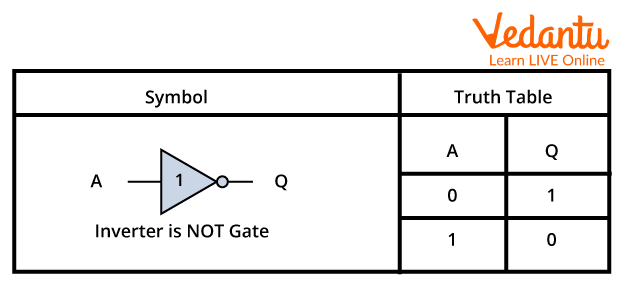
NOT Gate
The NOT gate inverts the input.
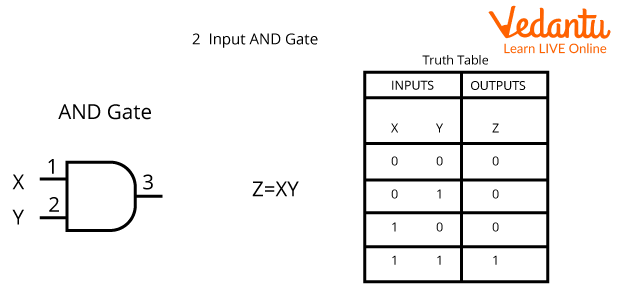
AND Gate
The AND gate outputs 1 only when both inputs are 1.
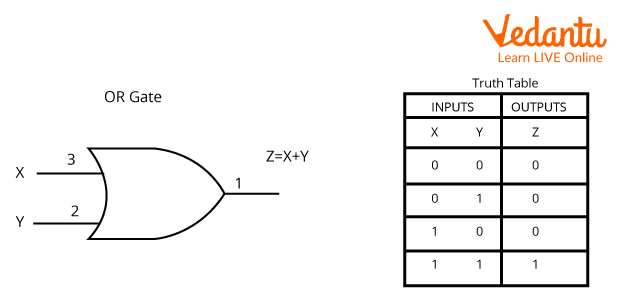
OR Gate
The OR gate outputs 1 if at least one input is 1.
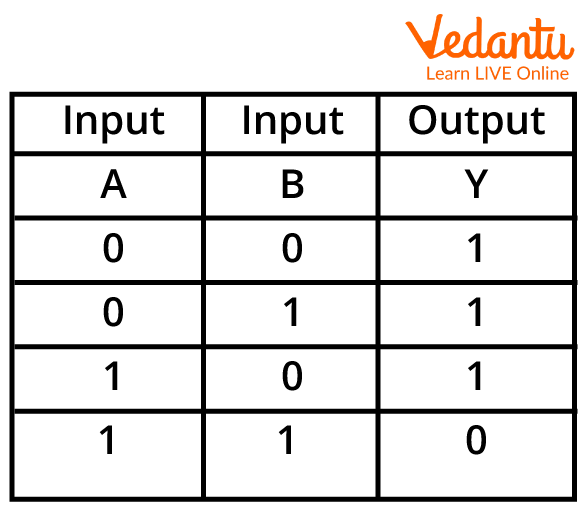
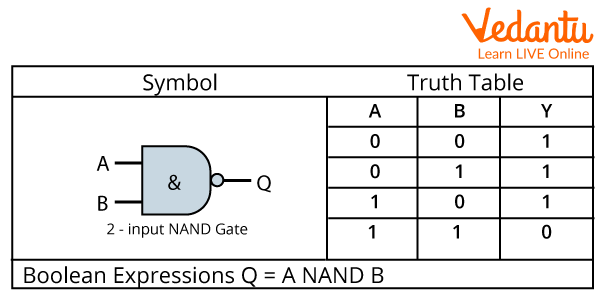
NAND Gate
The NAND gate is the inverse of the AND gate and is a universal gate.
Features and Characteristics
- Based on binary logic.
- Operate using Boolean algebra rules.
- Logic gates are the building blocks of digital circuits.
- Universal gates like NAND can create any other gate.
- Essential for arithmetic and memory circuits.
Advantages
- Simple and reliable digital operations.
- High processing speed.
- Easy implementation in integrated circuits.
- Scalable for complex computations.
Disadvantages / Limitations
- Limited to binary operations.
- Complex circuits require many gates.
- Power consumption increases with circuit size.
Applications and Use Cases
- Computer processors and ALU design.
- Memory devices and registers.
- Digital clocks and calculators.
- Control systems and automation circuits.
- Communication systems.
Quick Facts About Logic Gates and Number System
| Aspect | Details | Example |
|---|---|---|
| Core Number System | Binary | 1010 |
| Basic Gates | AND, OR, NOT | A AND B |
| Universal Gate | NAND | (A AND B)' |
| Mathematical Base | Boolean Algebra | A + B |
These quick facts summarize the essential components and foundations of logic gates and number systems in digital computing.
Key Terms / Glossary
| Term | Meaning |
|---|---|
| Binary | Base 2 number system using 0 and 1 |
| Truth Table | Table showing all possible input and output combinations |
| Boolean Algebra | Mathematics of logical operations |
| Universal Gate | Gate capable of implementing any Boolean function |
Interesting Facts About Logic Gates and Number System
- All modern computers operate entirely on binary logic.
- NAND gate alone can be used to build an entire computer.
- Hexadecimal is widely used in memory addressing.
- Boolean algebra was developed by George Boole.
- Microprocessors contain billions of logic gates.
- Digital circuits use voltage levels to represent 0 and 1.
Conclusion
Logic Gates and Number System are fundamental concepts in computer science that explain how digital systems represent and process information. Binary numbers form the language of computers, while logic gates perform essential operations based on Boolean algebra. Understanding these concepts helps students grasp digital electronics, circuit design, and computing fundamentals. Mastery of this topic builds a strong foundation for advanced studies in computer architecture, programming, and embedded systems.


FAQs on Logic Gates And Number System in Digital Electronics
1. What are Logic Gates and Number System in Computer Science?
Logic Gates are digital circuits that perform logical operations on binary inputs, while a Number System is a method of representing numbers using specific digits and bases in computing.
- Logic gates work with binary values (0 and 1)
- Common number systems include Binary, Decimal, Octal, and Hexadecimal
- Both are fundamental in digital electronics, computer architecture, and programming
2. What are the basic types of Logic Gates?
Basic logic gates are the building blocks of digital circuits and perform simple Boolean operations.
- AND Gate outputs 1 only if all inputs are 1
- OR Gate outputs 1 if at least one input is 1
- NOT Gate inverts the input
- NAND, NOR, XOR, XNOR are derived logic gates
3. How do Logic Gates work in digital circuits?
Logic gates work by applying Boolean algebra rules to binary inputs and producing a single binary output.
- Inputs are represented as 0 (LOW) and 1 (HIGH)
- Operations follow Boolean expressions
- Used in CPU design, memory units, and digital systems
4. What are the different types of Number Systems used in computers?
Computers use multiple number systems to represent and process data efficiently at hardware and software levels.
- Binary (Base 2) uses digits 0 and 1
- Decimal (Base 10) uses digits 0–9
- Octal (Base 8) uses digits 0–7
- Hexadecimal (Base 16) uses 0–9 and A–F
5. Why is the Binary Number System important in Computer Science?
The Binary Number System is the foundation of computing because digital hardware operates using two voltage levels.
- Represents data as bits (0 and 1)
- Used in machine language and low-level programming
- Forms the basis of logic gate operations
6. How are Number System conversions performed?
Number system conversion involves changing a number from one base to another using division or multiplication methods.
- Decimal to Binary uses repeated division by 2
- Binary to Decimal uses positional weight method
- Binary and Hexadecimal conversion is grouped in 4-bit sets
7. What is the relationship between Logic Gates and Boolean Algebra?
Boolean Algebra provides the mathematical foundation for designing and analyzing logic gates in digital electronics.
- Uses logical operators like AND, OR, NOT
- Helps simplify digital circuit expressions
- Important for exam preparation and circuit design
8. What are the applications of Logic Gates in real-world systems?
Logic gates are used to build all digital electronic systems including computing and communication devices.
- Used in processors and ALUs
- Form memory elements like flip-flops and registers
- Applied in embedded systems and control units
9. What are the advantages and disadvantages of different Number Systems?
Each number system has specific advantages depending on hardware design and programming requirements.
- Binary is simple for hardware but lengthy for humans
- Decimal is human-friendly but not hardware-efficient
- Hexadecimal is compact and widely used in programming and memory addressing
10. Why are Logic Gates and Number Systems important for exams and interviews?
Logic Gates and Number Systems are core topics in Computer Science exams, competitive tests, and technical interviews.
- Frequently asked in school, college, and engineering entrance exams
- Important for understanding computer organization and digital electronics
- Forms the base for advanced topics like microprocessors and computer architecture
